

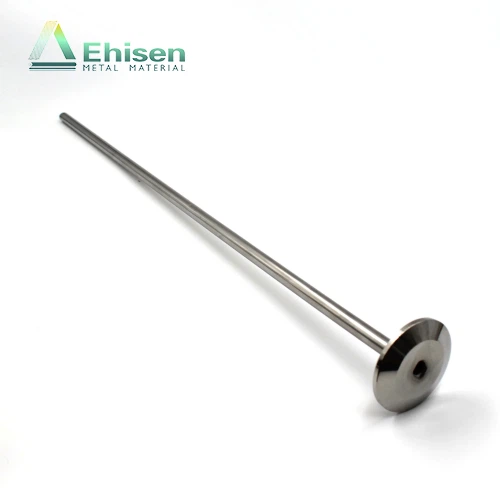


Products Description
Thermowells are used to protect temperature sensors such as thermocouples, thermistors, and bimetal thermometers from damage caused by excessive pressure, material velocity, and corrosion. They also extend sensor life, allow sensor replacement without draining the system, and reduce the potential for contamination. To ensure integrity, thermowells designed for high voltage applications are often machined from bar stock. Smaller thermowells used in low-pressure environments may be constructed from tubes welded on one end.

Products Specifications
Essential Parameters:
|
product specifications (mm) |
3*20 3*50 3*60 3*100 3*200, etc., wall thickness 0.5 |
|
Thermocouple Dimensional Tolerance |
Length tolerance ±0.5mm |
|
Air tightness technical requirements |
The detection pressure is 0.1~0.3Mpa, and the pressure is maintained for 10 minutes. There is no abnormal sound or leakage. |
|
Other technical requirements |
Laser welding, Ra3.2~6.3, can be customized according to drawings |

Chemical Composition:
|
Element |
% |
Ni |
Cr |
Al |
Mn |
Cu |
Si |
Fe |
C |
Nb |
P |
|
Standard |
Min |
58.0 |
21.0 |
1.0 |
-- |
-- |
-- |
margin |
-- |
-- |
-- |
|
max |
63.0 |
25.0 |
1.70 |
1.0 |
1.0 |
0.50 |
margin |
0.10 |
1.0 |
0.03 |

Material properties:
Inconel601 alloy is a nickel-chromium alloy with excellent oxidation resistance at 1200°C. Alloy 601 can produce a dense oxide layer to prevent oxidation in harsh cyclic thermal environments. The alloy has excellent high-temperature strength and can still maintain its unique toughness under long-term high-temperature conditions. Alloy 601 also has good corrosion resistance under oxidizing conditions. However, it is not recommended to use 601 alloy in highly reducing and sulfurizing environments.
Selection of installation methods for thermowells and thermal resistance sleeves
There are three installation methods for thermowells and thermal resistance sleeves: flange, thread and welding. The welded type is generally determined according to the needs of the site. For both flange and corrugated methods, it is recommended to use flange installation for the following reasons:

①
For occasions with higher pressure levels, threaded installation is not suitable and can only be installed with flanges.
01
②
For corrosive occasions, threaded installation is prone to corrosion and cannot be disassembled. In this case, flange installation must be selected.
02
③
When used on equipment, choose flange installation
03
④
For occasions where the temperature is higher than 230°C, the thread is prone to high-temperature gap deformation, so flange installation should be used.
04
⑤
Based on the above points, between thread and flange installation, it is recommended that thermowells and thermal resistance sleeves be installed with flanges.
05

Production Process

Make a metal base pipe cylinder. The end of the base pipe cylinder is processed into an arc-shaped surface. The material of the base pipe cylinder is 316L stainless steel or corrosion-resistant gray cast iron alloy;
Before spraying, the metal-based pipe cylinder must be degreased and textured;
Use high-speed oxygen flame spraying or plasma spraying on the surface of the pretreated base pipe cylinder to produce a protective coating. The protective coating includes a metal bonding bottom layer, an intermediate transition layer and a surface working layer.
The metal bonding bottom layer is the same metal as the base pipe cylinder. For cermet materials with similar properties, the surface working layer is an oxide ceramic material, and the intermediate transition layer is a mixture of cermet materials and oxide ceramic materials.
The spraying of the intermediate transition layer is to separate metal powder and ceramic powder from two powder feeders. The method of determining the powder feeding amount of cermet and oxide ceramic powders or mixing the two powders in advance by mechanical method in proportion and then feeding the powder into the spray gun. The proportion of cermet powder decreases layer by layer, and the oxide ceramic powder increases layer by layer, forming a gradient. Transition coating.
Products features
Products features
(1) The thermocouple base tube cylinder is made of a relatively corrosion-resistant metal material with good thermal conductivity, which makes the thermocouple more sensitive to temperature changes and ensures the accuracy of temperature measurement and control.
Products features

Causes and treatment methods of ruptured thermowells

The main causes of thermowell rupture are as follows:
1.
The thermowell is impacted by high-speed fluid, the load is too large, and the stress exceeds the limit, causing the casing to rupture;
2.
The processing defects of the thermocouple sleeve itself lead to stress concentration and easily cause the sleeve to break;
3.
Excessive vibration of the pipeline causes fatigue damage to the thermowell;
4.
When the fluid flows through the thermowell, it induces vibration in the thermowell, that is, the natural frequency of the thermowell resonates with the fluid vortex shedding frequency. This resonance phenomenon will cause the thermowell to damage more quickly and even break.
The main treatments:
Strictly control the insertion depth of the thermowell. As the insertion depth increases, the force on the protective sleeve increases squarely. Therefore, when we measure temperature, we only need to insert the thermowell into the isothermal zone of the fluid without inserting it into the center point of the pipe. This will help shorten the length of the cantilever of the thermometer bag and reduce the amplitude of its endpoint. .
Optimize the diameter of the thermowell while ensuring the necessary strength of the thermowell. Because when the diameter of the thermowell increases, the force on the watch bag increases linearly. Therefore, when selecting the diameter of the watch bag, it is necessary to reasonably ensure the strength of the thermowell and stagger the resonance danger zone as much as possible.
Change the cross-sectional shape and process its surface into a structural form so that the fluid does not produce vortex shedding.
Strictly control the quality of maintenance, conduct a good inspection of the material of the thermocouple sleeve, and also conduct a flaw detection inspection to strictly prevent the occurrence of abnormal accidents such as cracks and breaks in the welding joints.
When the system is put into operation, avoid the sudden full opening of the valves on the pipeline. When the valve is first put into operation, the thermowell will bear a large one-way force. Therefore, when the system is first put into operation, the valve should be opened slowly to allow the system pressure to gradually rise and the thermowell to be as small as possible. The pressure difference between the front and back prevents the casing from breaking due to excessive one-way force.

FAQ
do you have any question?

What is Inconel601 Thermowell?
Inconel601 Thermowell, also known as a thermocouple sheath or thermowell, is a device used to protect thermocouples from damage caused by harsh environments, chemicals, and particulates. TheInconel601 Thermowell extends the lifespan and accuracy of the thermocouple by acting as a barrier between the measuring instrument and the process media.
What materials are Inconel601 Thermowells made of?
Inconel601 Thermowells are typically made of high-quality nickel-chromium alloy. This materials is chosen for their high-temperature tolerance, corrosion resistance, and mechanical strength.
How do Inconel601 Thermowells prolong product lifespan?
Inconel601 Thermowells are designed to withstand extreme temperatures and harsh environments without compromising accuracy or reliability. By providing a durable layer of protection,Inconel601 Thermowells prevent damage to the thermocouple, which can lead to costly and time-consuming repairs. This extended lifespan saves time, money, and resources while improving overall product quality and performance.
How do I select the rightInconel601 Thermowell for my application?
Choose aInconel601 Thermowell that is made from materials that can withstand your specific process environment. Pay attention to factors like temperature, pressure, corrosive conditions, and abrasives. It is also important to consider the type of thermocouple being used and the measurement requirements of your application. Consulting with a trusted supplier or manufacturer can help ensure the proper selection and installation of aInconel601 Thermowell.
Packaging And Shipping

1. Packaging materials: Use moisture-proof paper, plastic film, foam plastic and other packaging materials to prevent molybdenum flanges from getting damp or suffering minor collisions. In addition, wooden outer packaging boxes or wooden pallets can also be used as packaging auxiliary materials.
2. Outer packaging: The product can be placed in a wooden outer packaging box or wooden pallet of appropriate size to prevent it from being squeezed or bumped during transportation.
3. Transportation method: Choose the appropriate transportation method, such as sea transportation, land transportation or air transportation, and ensure suitable handling equipment to avoid product damage during transportation.
about us

ehisen
The company is created in 2004 as a high-tech organization focused on advanced metal material production,including melting,profiling,machining,and precious metal anode research and development.Our company, which employs 50 people and occupies a 15 mu area, is focused on innovative manufacturing.
The business is equipped with rolling, heat-treating, stamping, and alloy production machinery.Processing centers, electroplating,titanium anode production lines and precious metal coating laboratory,as well as related testing equipment.It has evolved over years into a whole business that combines R&D, manufacturing, and sales.
Contact Us
we are here for you
admin@ehisen-anode.com
+86 18700703333 Elsa Lin
Hot Tags: inconel601 thermowell, China inconel601 thermowell manufacturers, suppliers, factory, High Temperature Resistant Metal Plug Screw