

Your Trusted Supplier of Titanium Anode For Electroplating
Anodes used in the electroplating industry are generally divided into soluble anodes and insoluble anodes. The soluble anode plays the role of supplementing metal ions and conducting electricity during the electroplating process, while the insoluble anode only plays the role of conduction. The earliest applied insoluble anodes were graphite anodes and lead anodes. In the 1970s, titanium anodes began to be used in the electrolysis and electroplating industries as a new technology.

Chlorine evolution anode
Ruthenium oxide Ru
Alkaline electrolysis industry
Marine industry

Oxygen evolution anode
Iridium Oxide Ir
Metal plating copper, tin, zinc
Metal foil production
Precious metal electrolysis recycling
Electrolytic synthesis of organic compounds

Platinum anode
Platinum Pt
Hard chrome plating
Acid-base ionized water
Titanium Anode For Electroplating
1.Ir-Ta Anode Wire
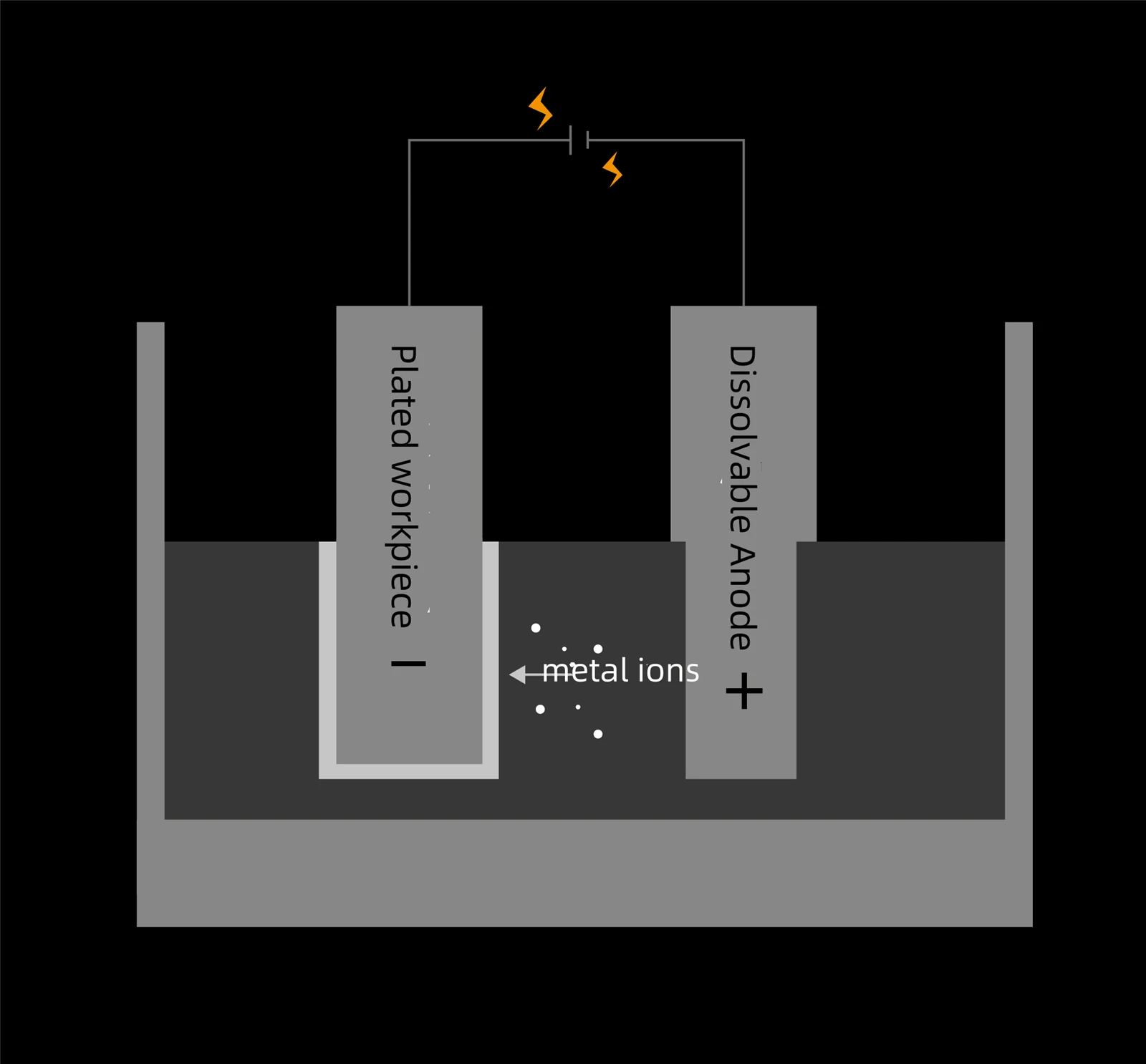
In the field of electroplating applications, the required coating metal is dissolved in the electrolyte, the plated metal substrate serves as the negative electrode, and the anode serves as the positive electrode, forming a complete current transmission cycle. A chemical reaction that occurs simultaneously with electroplating in the electroplating bath is the evolution of oxygen on the anode surface.
Compared to non-inert anodes such as graphite, the advantage of Ir-Ta Anode Wire is that they maintain a stable positive-to-negative distance (distance between electrodes) over their service life. Graphite anodes will gradually dissolve during use, causing the distance between electrodes to increase, while inert Ir-Ta Anode Wire can ensure stable voltage and product quality. Due to the catalytic properties of the platinum group elements, the exchange current density on the electrode surface is large and the oxygen precipitation overpotential is low. A special process is used to form a fine-structured oxide film on the titanium surface, which achieves maximum results per unit electrode area. active surface area, so it is particularly suitable for high-speed and high-current density electroplating production.
In addition to Ir-Ta Anode Wire and graphite, lead anodes can also be used in this field. However, when lead anodes dissolve, their reactants can negatively impact the environment. These problems can be avoided by using Ir-Ta Anode Wire. The oxygen-evolving titanium anode has a lower operating voltage, which can also save energy.
Products Specifications
|
Ir-Ta Anode Wire |
||
|
Coating Type |
Platinum, Iridium Tantalum, etc. |
|
|
Base material |
Pure titanium (Gr1) |
|
|
Titanium material standard |
ASTM B348 |
|
|
Operating temperature |
32°C max |
|
|
Iridium and tantalum plating |
Ir+Ta system, Ir consumption per square meter is 10g, coating thickness is more than 3.5 microns |
|
|
Size |
3*360mm, 5*360mm, 8*360mm, etc |
|
|
Platinum plating thickness |
3 microns, 3.5 microns or OEM |
|
|
Current density(A/㎡) |
80A/m² max |
|
|
Processing method |
Iridium tantalum |
Brushing + sintering |
|
Platinum plating |
Electroplating |
|
Platinum-Plated Titanium Anode Brush Head For Electroplating

Platinum-Plated Titanium Anode Brush Head For Electroplating
The platinum layer is firmly combined with the titanium base substrate,with stable performance,high current and low voltage,It is used in precious metal plating tanks and the coating is uniform.
Electroplating process technology will be used to create electrodes with platinum plating on titanium. Additionally, the titanium substrate that has been treated is entirely or partially plated with platinum.
The product's silver-white surface has the benefits of a fine and uniform coating, strong bonding, a high output current, and a long service life.
When platinum is either metallurgically clad or plated onto a titanium substrate, it serves as an anode material. When titanium is made anodic, stable oxide layers emerge. Anodes that have been platinized are consumed at a rate of 6 to 10 mg/A-y.
Product Parameter:
|
Base material |
Titanium (Gr1, Gr2, TA1, TA2) |
|
Shape |
Arc-shaped (customized) |
|
Current density |
<8000 A/m2 |
|
Production process |
electroplating |
|
Coating material |
Platinum (purity 99.99%) |
|
Precious metal content |
≥ 21.48 g/㎡ |
|
Platinum layer thickness |
0.2-15 μm |
|
Temperature |
<80℃ |
|
PH value |
1-12 |
Titanium Anode For Chrome Plated

Titanium Anode For Chrome Plated
Titanium anode for chrome plated is an anode made of titanium material,which is used in the plating process.
In the plating process,a titanium anode is connected to the anode end of the power supply.The current passes through the anode,causing the metal ions on the anode to dissolve and precipitate chromium metal on the surface of the chromium plated article.When the titanium anode is exposed to the electrolyte,it reacts chemically with the ions in the solution to produce oxide layers on the surface.These oxide layers resist chemical attack and maintain the stability of the electrode even at high current densities.
When using titanium anodes for plating, attention needs to be paid to the energizing time,current density and electrolyte formulation.The control of these parameters can affect the quality and uniformity of the plating.Usually,plating needs to be performed at a lower current density to ensure the uniformity and quality of the coating.
Product Parameters
|
Current Density |
Chrome plating project needs to set the current density according to the specific requirements,generally need to be adjusted between 1-50A/d㎡ |
|
Electrolysis tank temperature |
Between 20°C and 40°C |
|
Solution composition |
Usually composed of chromic acid,sulfuric acid,ammonium chloride,etc.,the ratio of which needs to be adjusted according to the specific situation |
Iridium-Tantalum Coated Titanium Anode

Iridium-Tantalum Coated Titanium Anode
Titanium anodes covered with iridium oxide are unique electrochemical parts. They are made of an iridium oxide layer covering a titanium base material. The anode gains special qualities from this coating, which increases its efficacy across a range of uses.
The anode's resilience to corrosion, stability under challenging conditions, and longevity are all improved by the iridium oxide coating. Additionally, it encourages effective oxygen evolution reactions, which are necessary for electrolysis, water treatment, and electroplating, among other procedures.
Iridium oxide-coated titanium anodes are widely used in industries that need precise control over electrochemical processes because of their remarkable features. These anodes help in a variety of applications, from metal polishing to chlorine generation, by improving performance, longevity, and cost-effectiveness.
Essential Parameters:
|
Coating material |
Iridium Oxides (IrO2), Tantalum Oxides (Ta2O5) |
|
Base metal |
Gr1, Gr2 titanium |
|
Temperature range |
<85 ℃ |
|
Current density |
500-800A |
|
Oxygen evolution potential |
<1.45V |
|
Fluoride content |
<50mg / L |
|
Precious metal content |
8-13g / m2 |
|
Coating thickness |
8-15μm |
|
PH value |
1-12 |
|
Enhanced life |
300 H-400H |
|
Titanium anode shapes |
plates, tubes, rods, wires, machined parts |
Electrolytic Deposition Anode

Electrodeposition anodes are an important component of the electrowinning process, a widely used technique for extracting metals from liquid solutions. The process is particularly useful for recycling precious metals such as gold, silver and copper.
During electrolytic extraction, an electric current flows from an anode through a liquid solution containing metal ions. This results in electrolytic deposition or electroextraction of the metal. The metal is then collected and further processed for refining and purification.
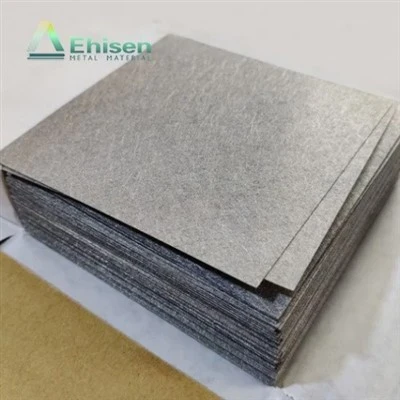
The electrolytic metallurgy industry uses different types of anodes to extract metals, including MMO-coated titanium anodes, iridium-coated anodes, and oxide-coated titanium anodes. Each type of anode has unique properties that make it suitable for different applications.
Click on the product list below for more product details




Classification of insoluble anodes

The insoluble anodes currently used can be divided into two categories: chlorine evolving anodes and oxygen evolving anodes.
Chlorine-evolving anodes are mainly used in chloride electrolyte systems. During the electroplating process, chlorine gas is released from the anode, so it is called chlorine-evolving anodes. Oxygen-evolving anodes are mainly used in electrolyte systems such as sulfate, nitrate, and ammonia cyanate. Electroplating During the process, oxygen is released from the anode, so it is called an oxygen-evolving anode. Graphite anodes are chlorine-evolving anodes, lead alloy anodes are oxygen-evolving anodes, and titanium anodes have chlorine-evolving functions, oxygen-evolving functions, or both depending on their surface catalytic coatings.
Compared with graphite anodes and lead anodes, titanium anodes do not suffer from mechanical dimensional attenuation, so they are also called dimensionally stable anodes. Titanium anodes have the following advantages: Geometric dimensional stability: diversity of geometric shapes Excellent stability of electrochemical and chemical properties Excellent electrocatalytic activity Low anode potential, insensitive to changes in circuit density; Power and energy saving: maintenance-free; No pollution; long life (very important); high quality cathode product (no or very few impurities, uniform microstructure).
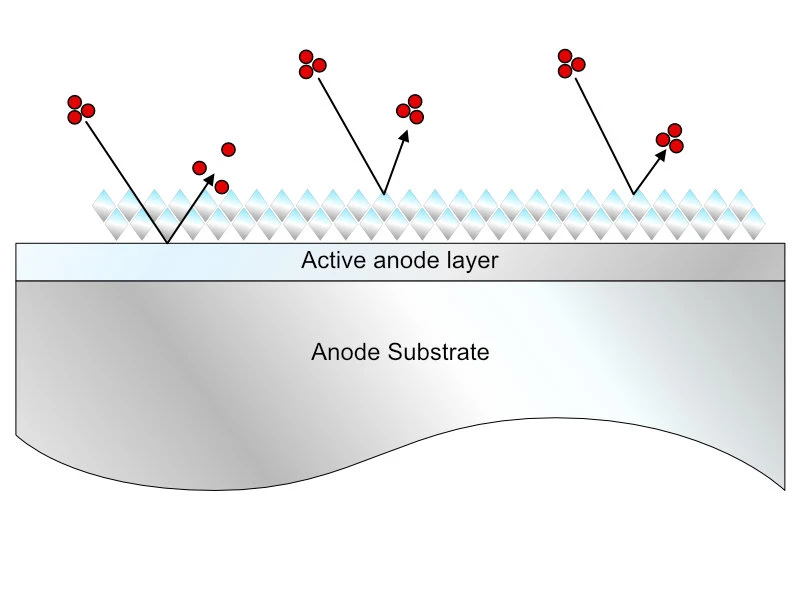
Titanium anode is a double-layer composite structure consisting of a metal substrate and a coating on the substrate. The titanium substrate serves as a conductor, and the coating functions as an electrochemical catalyst for the oxygen evolution/chlorine evolution reaction. The oxygen evolution/chlorine evolution potential of this coating is low, and the oxygen evolution/chlorine evolution potential hardly changes with the current density. Titanium-based conductor is a permanent material with long coating life. Using this new technology, an almost completely pure cathode product can be obtained, which is pollution-free and energy-saving. Technically speaking, the oxygen evolution electrode is a development of the chlorine evolution electrode. Between 1970 and 1980, oxide-coated titanium anodes successfully replaced the old graphite electrodes in the chlor-alkali industry in all chlor-alkali industries. This event has been called a "technological revolution" in the electrochemical industry. The chlor-alkali industry has since bid farewell to the era of graphite anodes and entered the era of titanium anodes.
The basic coating of chlorine-evolving titanium anodes consists of mixed crystals of RuO: and TiO: and specific additives. Ruo1 is an electrochemical catalyst for 2Cf- CI: +2e. TiO2 is a stabilizer or binder, which combines RuO: electrochemical catalyst and titanium matrix.
Additives exist in the form of oxides to improve conductivity and inhibit side reactions, such as oxygen evolution reactions.
There are two types of oxygen-evolving titanium anodes: precious metal oxide titanium anodes and platinum-coated titanium anodes. The basic coating of the noble metal oxide titanium anode is composed of IrO: (catalyst for oxygen evolution reaction, H20-1/2 02+2H+2e) and TaO2 (binder between titanium matrix and IrO, electrochemical catalyst).
Benefits of Titanium Anodes Coated with Iridium Oxide
Superb Resistance to Corrosion: The layer of iridium oxide acts as a barrier to prevent corrosion of the anode. This feature not only increases the anode's lifespan but also lowers the need for maintenance and replacements, which results in significant cost savings.
Effective Oxygen Evolution: These anodes stand out for their capacity to produce oxygen with a low overpotential, which reduces undesirable side effects and increases process effectiveness. This qualifies them for electrochemical synthesis and water treatment.
High Electrocatalytic Activity and Durability: These anodes are renowned for their resilience and long-term high electrocatalytic activity. They are perfect for demanding applications like metal recovery and electroplating because of their robustness and reliable performance.
Reusability Factor: After being deactivated, these anodes may be renewed and reused, making them an environmentally friendly and cost-effective option.
High Current Density Management: Designed to withstand high current densities, titanium anodes coated with iridium oxide facilitate effective, large-scale manufacturing, which is beneficial for industries that heavily rely on electrochemical processes.

Customized Iridium Oxide Titanium Anode
At Ehisen, we understand the distinct requirements and character of every project. Our dedication is to providing custom solutions that precisely match the needs of your application. We prioritize accuracy and adaptability in our design process to make sure you get the iridium oxide titanium anode that best suits the requirements of your project. Our extensive array of configurations indicates our commitment to meeting the diverse demands of many industries.
Customizing the Shape of Your Titanium Anodes with Iridium Oxide Coating
Our customisation options cover a wide range of shapes, so you may get the ideal fit for your application using strips, sheets (available in standard, expanded, corrugated, or perforated forms), foils, squares, wires, rods, discs, bars, and tubes.

Dimensional Variety for Precise Applications:
Rods: Available from 10mm to 50mm in diameter, accommodating robust designs.
Wires: Ranging from 0.5mm to 10mm in diameter, for intricate connections.
Tubes: From 10mm to 200mm in diameter, supporting substantial structures.
Plates: Thicknesses from 0.5mm to 5mm, for sturdy surface coverage.
Meshes: 0.5mm to 2.0mm thick, offering versatile applications.
How Do I Choose the Best Titanium Anode with Iridium Oxide Coating?
Evaluate Your Requirements: To start, make sure you are aware of the particular demands and specifications of your project. Clearly state why you require the anode and what results you hope to achieve.
Evaluate Your Requirements
To start, make sure you are aware of the particular demands and specifications of your project. Clearly state why you require the anode and what results you hope to achieve.
Electrolyte Compatibility:
Check the electrolyte solution's makeup before using it with the anode. To prevent undesired reactions or corrosion, make sure the anode and electrolyte are compatible.
Consideration of Current Density:
Consider the current density per square meter. This figure shows how much current, relative to surface area, one anode can support. Select an anode that is capable of supporting the current density needed for your application.
Temperature Range:
Determine the range of temperatures at which the anode can function as intended. Choose an anode that won't deteriorate under the process's temperature settings..
pH Tolerance
Take into account the ranges of pH that the anode may withstand without degrading. Make sure the pH tolerance of the anode matches the pH range of your electrolyte solution.
Clearly state your intended application
Clearly state your intended application for the anode as well as the anticipated results you hope to attain. Anode properties may vary depending on the application.
Estimate Lifespan
Find out how long the anode is predicted to live. In the long term, a longer lifespan can save replacement costs and downtime.
Budget and Pricing:
Consider the pricing and see if it is within your means. Finding a balance between performance and cost-effectiveness is crucial, even though quality is still critical.
Investigate reliable producers or suppliers
Investigate reliable producers or suppliers of titanium anodes coated with iridium oxide. Verify if they have a history of creating dependable, high-quality products.
Consultation:
Seek advice from specialists or other professionals in the industry who, thanks to their experience, can offer valuable insights.
Review and Comparison:
Using the above mentioned criteria, evaluate several anode choices. Consider their features, benefits, and specifications.
Trial Test
Whenever feasible, test a sample anode in your application to objectively evaluate its efficacy and appropriateness for your operating environment.

A guide to optimizing the performance of iridium oxide-coated electrodes
To maximize the service life of iridium oxide coated electrodes and ensure their operating efficiency, specific handling and maintenance procedures need to be followed. These electrodes are valued for their excellent electrochemical properties, including high durability and excellent corrosion resistance, making them suitable for a variety of industrial applications. To maintain these qualities and ensure optimal performance of the electrode throughout its service life, it is important to follow best practices in use, handling and storage.

Prevent Scratching: Refrain from using harsh items to scratch the precious metal coating on the electrode in order to preserve its functionality.
Steer Clear of Specific Electrolytes: Because they can result in short circuits, electrolytes containing fluorine, cyanogen, and bromine ions should be avoided.
Micro-current Protection: Make sure that there is micro-current protection when the production is stopped.
Refrain from Elevated Temperatures: Make sure the electrolyte temperature is not excessively high.
Refrain from Using High Current Density: Using high current density can exacerbate the reaction and reduce the anode's lifespan.
Increase Current Gradually: When the procedure is first begun, increase the loading current gradually.
Stable Current and Voltage: Assure consistent output of current and voltage.
Clean and keep Correctly: After using an electrode, always give it a thorough wash with water, let it air dry, and keep it somewhere dry.
Watch Out for High Currents: Keep in mind that high currents might negatively impact the anode's service life.
FAQ
FAQ
Q: 1. Why is platinum-coated titanium preferred for precious metal plating?
A: High catalytic efficiency and chemical purity.
Q: 2. What thickness of platinum is recommended for gold plating?
A: 1.0–3.0 µm depending on current density.
Q: 3. What current density is used for gold plating?
A: Typically 5–20 mA/cm².
Q: 4. Can MMO anodes be used for gold plating?
A: Not recommended; purity and stability are insufficient.
Q: 5. Why do gold plating tanks require smooth anode surfaces?
A: To avoid particle shedding and contamination.
Q: 6. What causes black spots on Pt-coated anodes?
A: Organic contamination or electrolyte impurities.
Q: 7. Why does platinum coating sometimes show rainbow colors?
A: Oxide film formation—normal and harmless.
Q: 8. Can Pt-coated anodes be used in cyanide solutions?
A: Yes. Pt is stable in most precious metal electrolytes.
Q: 9. What lifetime is typical for platinum anodes?
A: 1–3 years depending on µm thickness.
Q: 10. Does plating temperature affect Pt anode life?
A: Yes. Higher temperatures accelerate Pt dissolution.
Q: 11. How to avoid uneven plating caused by anodes?
A: Maintain equal spacing and consistent anode-to-cathode distance.
Q: 12. Why is Pt-coated mesh less common in gold plating?
A: Mesh may trap contaminants; plates are preferred.
Q: 13. Can Pt-coated anodes be used for rhodium plating?
A: Yes. Rh plating requires high catalytic activity.
Q: 14. Why is adhesion critical for Pt coatings?
A: Poor adhesion causes flaking and shortens life.
Q: 15. What causes Pt-coated anode surface roughening?
A: Long-term electrolyte attack or mechanical abrasion.
Q: 16. Can Pt-coated anodes be refurbished?
A: Yes. Old coating can be removed and re-applied.
Q: 17. Why do platinum anodes sometimes corrode in gold baths?
A: High chloride content or incorrect bath pH.
Q: 18. Can Pt-coated anodes be used for silver plating?
A: Yes. Pt is stable in cyanide and nitrate solutions.
Q: 19. What cleaning method is recommended?
A: Mild acid cleaning followed by DI water rinse.
Q: 20. Why do some customers prefer electroplated platinum?
A: For lower cost, but thermal-decomposed Pt has better adhesion.
Production Process Of The Ehisen Titanium Anode

1
SUBSTRATE PREPARATION:
The first step in our process is the careful selection of titanium substrates, which can be plates, sheets, meshes, or rods, according on the needs of the customer. This crucial stage establishes the anode's properties, guaranteeing endurance and optimum performance in a range of electrochemical applications.

2
SANDBLASTING PROCESS:
By employing sophisticated sandblasting methods, we improve the substrate's surface area and texture, removing any remaining oxidation and guaranteeing a consistent, coating-ready surface. The careful preparation yields a matte finish that improves the electrochemical performance and adherence of the coating.

3
LASER CUTTING
We shape titanium with unmatched precision using state-of-the-art laser technology, producing edges that are burr-free and maintain structural integrity and dimensional accuracy. Our anodes fulfill strict specifications and function dependably in challenging operating settings thanks to their precision.

4
WELDING:
The final structure of the titanium is formed by our expert professionals using argon arc welding and spot welding, among other welding techniques. We provide optimal structural integrity, preventing deformations or fractures, and ensuring durability in service by customizing each technique to the specifications of the substrate.

5
ACID PICKLING:
In the acid pickling step, substrates are submerged in an accurately measured solution of oxalic acid that has been heated to exact temperatures to ensure complete cleaning. A flawless substrate is left behind after this painstaking process eliminates all oxide coatings and contaminants, which is necessary for better coating adherence and performance.

6
PRECIOUS METAL SOLUTION PREPARATION:
We customize precious metal solutions to the application environment of the anode, adjusting the blend to improve performance and increase longevity. Precise alignment with application requirements is ensured by this customized method, which also guarantees optimum performance in various electrochemical environments.

7
TITANIUM ELECTRODE COATING PROCESS:
With several passes, we apply valuable metals like ruthenium-iridium with precision, guaranteeing a consistent coating thickness of 8–10 μm. By improving electrocatalytic characteristics precisely, this coating guarantees uniform performance throughout the whole anode surface.

8
SINTERING AND ANNEALING:
Annealing is a methodical process that reduces hardness, relieves internal tensions, and refines grain structure after sintering in our specially constructed furnace. By improving binding strength and material endurance, this method guarantees that our anodes will fulfill the most stringent performance standards in the most demanding applications.

9
QUALITY TESTING (LIFE ENHANCEMENT TEST):
Strict industry standards are followed during the extensive testing that every anode goes through to verify performance and durability. We guarantee long-term operating stability and reliability through thorough examination, ensuring that our anodes perform above expectations in a variety of electrochemical settings.

10
PACKAGING:
Our anodes undergo rigorous quality control testing before being carefully packaged to preserve integrity during transit. Because of the careful packaging, our clients can be confident in our products and have peace of mind knowing that they will arrive in perfect shape, ready for deployment.
about us
20+
Senior technical engineer
500+
Global customers
2000+
Factory land occupation
10+
Utility model patent
Honor and qualification
Official certification, professional after sales service.


cooperative partner
We are looking for a cooperative partner to expand our business.


Processing Equipment

Melting Equipment

Forging Equipment

Pickling Production Line

Plate Rolling Equipment

Stamping Equipment

Surface Treatment Equipment

Machining Center

Chemistry Lab
Detection Process

Dimensional Test

Grain Size Test

Plate Tensile Test

Flaw Detection

Three-coordinate Optical Measuring Machine

CMM

Anode Strengthening Life Test

Anode Composition Test
Why Choose Us

why choose us
ADVANCED EQUIPMENT
Ehisen has multiple processing equipment to quickly provide products to customers
Perfect Sales Service:
Ehisen provides you with one-stop non-ferrous metal production, processing, after-sales, and other supporting services
Quality Advantage:
Strictly control quality, guaranteed quality, and high processing precision
Price Advantage
High-cost performance, all products are produced independently
Complete Manufacturing Proficiency
Top-notch titanium items covering all grades are offered in a range of forms, such as plates, flanges, rods, bolts, and tube fittings.
Personalized Solutions For Titanium Anodes
Our unique, near-net-shape titanium fabrication services can help you achieve greater value from your titanium anodes.
Confidentiality Advantage:
After signing a confidentiality agreement, non-relevant personnel cannot enter the workshop at will, making proofing more secure.
Economical Production Solutions
Discover specialized, affordable manufacturing options for an extensive array of titanium items. Our LOW MOQ ensures excellent quality at an affordable price.
As one of the leading titanium anode for electroplating manufacturers and suppliers in China, we warmly welcome you to buy or wholesale bulk high purity titanium anode for electroplating at competitive price from our factory. Contact us for quotation and free sample.
Titanium Anode for Precious Metal Plating, Titanium Anode for Electroplating