

Marine Sacrificial Anodes: Essential Protection for Your Vessel
Marine sacrificial anodes are protective components made from reactive metals like zinc, aluminum, or magnesium, designed to prevent corrosion on boats and underwater metal structures. By leveraging the principle of galvanic corrosion, these anodes intentionally corrode first, "sacrificing" themselves to divert damage away from critical parts such as hulls, propellers, and rudders. Essential for both saltwater and freshwater environments, they significantly extend the lifespan of marine equipment by shielding it from electrochemical degradation. Regular inspection and replacement ensure continuous protection, reducing maintenance costs and preventing structural damage. At Ehisen, we supply high-performance sacrificial anodes engineered for durability and optimal corrosion resistance, helping vessel owners safeguard their investments in all water conditions.

1.Aluminum Alloy Sacrificial Anode

Commonly used aluminum alloy anodes include the Al-Zn-In series and Al-Zn-Hg series, which are suitable for the cathodic protection of structures such as ships in seawater, port and marine engineering facilities, seawater cooling systems, and the deposited water areas of storage tanks. The production of aluminum alloy anodes complies with the GB4948-2002 standard, "Al-Zn-In Series Alloy Sacrificial Anodes."
The performance of aluminum anodes is influenced by the chemical composition of the alloy. We offer different alloy compositions to meet customer requirements and can also manufacture anodes with special chemical compositions based on customer specifications.
Products specifications
|
Model |
Dimensions (A × (B1+B2) × C) / mm |
Weight / kg |
|
Al-1 |
2300 × (220+240) × 230 |
310.0 |
|
Al-2 |
1600 × (200+210) × 220 |
190.0 |
|
Al-3 |
1500 × (170+200) × 180 |
130.0 |
|
Al-4 |
900 × (150+170) × 160 |
58.0 |
|
Al-5 |
1500 × (148+178) × 170 |
120.0 |
|
Al-6 |
850 × (180+220) × 180 |
85.0 |
|
Al-7 |
800 × (200+280) × 150 |
80.0 |
|
Al-8 |
700 × (160+220) × 180 |
72.5 |
|
Al-9 |
1250 × (115+135) × 130 |
56.0 |
|
Al-10 |
1000 × (115+135) × 130 |
46.0 |
|
Al-11 |
750 × (115+135) × 130 |
35.0 |
|
Al-12 |
500 × (115+135) × 130 |
23.0 |

Commonly used aluminum alloy anodes include the Al-Zn-In series and Al-Zn-Hg series, which are suitable for cathodic protection of structures such as:
Ships in seawater
Port and marine facilities
Seawater cooling systems
Deposited water areas of storage tanks
The production of aluminum alloy anodes complies with the GB4948-2002 standard (Al-Zn-In Series Alloy Sacrificial Anodes).
The performance of aluminum anodes depends on their chemical composition. We offer various alloy formulations to meet customer requirements and can also manufacture anodes with custom chemical compositions upon request.
|
Model |
Dimensions (A × (B1+B2) × C) / mm |
Weight / kg |
|
AC-1 |
750 × (115+135) × 130 |
35.0 |
|
AC-2 |
500 × (115+135) × 130 |
23.0 |
|
AC-3 |
500 × (105+135) × 100 |
16.0 |
|
AC-4 |
300 × (105+135) × 100 |
10.0 |

|
Model |
Dimensions (A × (B1+B2) × C) / mm |
Weight / kg |
|
AT-1 |
500 × (115+135) × 130 |
23.0 |
|
AT-2 |
1500 × (65+75) × 70 |
21.5 |
|
AT-3 |
500 × (110+130) × 120 |
20.0 |
|
AT-4 |
1000 × (58.5+78.5) × 68 |
13.2 |
|
AT-5 |
800 × (56+74) × 65 |
10.0 |
|
AT-6 |
1150 × (48+54) × 51 |
9.0 |
|
AT-7 |
250 × (80+100) × 85 |
5.0 |
|
AT-8 |
200 × (70+90) × 70 |
3.0 |

|
Model |
Dimensions (A × (B1+B2) × C) / mm |
Shape Description |
Weight / kg |
|
AE-1 |
1200 × (200+280) × 150 |
Trapezoidal |
120.0 |
|
AE-2 |
800 × (200+280) × 150 |
Trapezoidal |
80.0 |
|
AE-3 |
1000 × (115+135) × 130 |
Trapezoidal |
46.0 |
|
AE-4 |
500 × (115+135) × 130 |
Trapezoidal |
23.0 |
|
AE-5 |
1000 × (80+100) × 80 |
Trapezoidal |
20.0 |
|
AE-6 |
500 × (105+135) × 100 |
Trapezoidal |
16.0 |
|
AE-7 |
500 × (80+100) × 80 |
Trapezoidal |
10.0 |
|
AE-8 |
400 × (110+120) × 50 |
Trapezoidal |
7.0 |
|
AE-9 |
300 × (140+160) × 40 |
Trapezoidal |
5.0 |
|
AE-10 |
200 × (90+110) × 40 |
Trapezoidal |
3.0 |
|
AE-11 |
300 × 50 |
Disc-shaped |
11.5 |
|
AE-12 |
360 × 40 |
Disc-shaped |
9.0 |
|
AE-13 |
300 × 40 |
Disc-shaped |
7.5 |
|
AE-14 |
200 × 50 |
Disc-shaped |
4.0 |
|
AE-15 |
180 × 50 |
Disc-shaped |
3.5 |
|
AE-16 |
120 × 100 |
Disc-shaped |
2.5 |

|
Model |
Dimensions (A×B×C) / mm |
Weight / kg |
|
AH-1 |
800×140×60 |
17.0 |
|
AH-2 |
800×140×50 |
15.0 |
|
AH-3 |
800×140×40 |
12.0 |
|
AH-4 |
600×120×50 |
10.0 |
|
AH-5 |
400×120×50 |
6.5 |
|
AH-6 |
500×100×40 |
5.5 |
|
AH-7 |
400×100×40 |
4.5 |
|
AH-8 |
300×100×40 |
3.5 |
|
AH-9 |
250×100×40 |
2.5 |
|
AH-10 |
180×70×35 |
1.2 |
|
AH-11 |
300×150×50 |
5.8 |
|
AH-12 |
300×150×40 |
4.6 |
|
AH-13 |
300×150×40 |
4.8 |

|
Alloy Type |
Chemical Composition (%) |
||||||||||
|
Zn |
In |
Cd |
Sn |
Mg |
Si |
Ti |
Impurities (max) |
Al (Balance) |
|||
|
Si |
Fe |
Cu |
|||||||||
|
--------------------------- |
----- |
------ |
------ |
------ |
------ |
------ |
------ |
------ |
------ |
------ |
------ |
|
Al-Zn-In-Cd |
2.5-4.5 |
0.018-0.050 |
0.005-0.020 |
- |
- |
- |
- |
0.10 |
0.15 |
0.01 |
Remainder |
|
Al-Zn-In-Sn |
2.2-5.2 |
0.020-0.045 |
- |
0.018-0.035 |
- |
- |
- |
0.10 |
0.15 |
0.01 |
Remainder |
|
Al-Zn-In-Si |
5.5-7.0 |
0.025-0.035 |
- |
- |
- |
0.10-0.15 |
- |
0.10 |
0.15 |
0.01 |
Remainder |
|
Al-Zn-In-Sn-Mg |
2.5-4.0 |
0.020-0.050 |
- |
0.025-0.075 |
0.50-1.00 |
- |
- |
0.10 |
0.15 |
0.01 |
Remainder |
|
Al-Zn-In-Mg-Ti |
4.0-7.0 |
0.020-0.050 |
- |
- |
0.50-1.50 |
- |
0.01-0.08 |
0.10 |
0.15 |
0.01 |
Remainder |
|
Type |
Open Circuit Potential (-V) |
Closed Circuit Potential (-V) |
Actual Capacitance (A·h/kg) |
Current Efficiency (%) |
Dissolution Behavior |
|
AA-I |
1.05-1.18 |
1.05-1.12 |
≥2400 |
≥85 |
Uniform Dissolution |
|
AA-II |
1.05-1.18 |
1.05-1.12 |
≥2600 |
≥92 |
Uniform Dissolution |

The aluminum anodes we offer can prevent corrosion of steel structures in seawater, and are widely used for corrosion protection of ship hulls, ballast tanks, seawater pipelines, port and dock facilities, offshore engineering, drilling platforms, condensers, and pipelines in soil media. The performance of aluminum anodes is affected by the chemical composition of the alloy, we provide different alloy compositions to meet customers' requirements, and we can also manufacture anodes with special specifications according to customers' requirements.
2.Magnesium alloy sacrificial anode
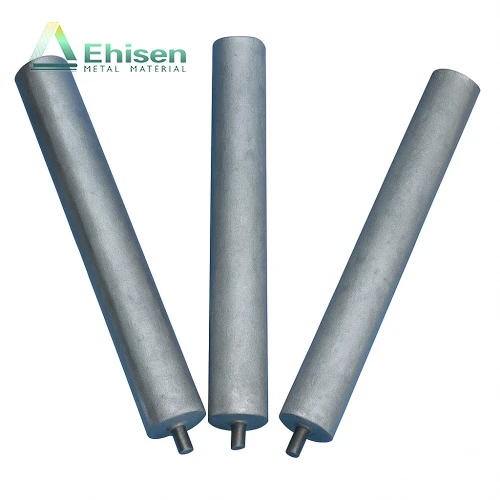
The magnesium anode produced by our company adopts high quality raw materials to produce, the anode potential is negative, the electricity generated per unit mass is large, it is the ideal sacrificial anode material. It is suitable for cathodic protection of metal structures in soil, freshwater and seawater media, such as petroleum gas pipelines, storage tanks, hot water exchangers, condensers and so on.
Magnesium alloy sacrificial anode is produced according to the national standard GB/T17731-2015 “Magnesium Alloy Sacrificial Anode”, and the anode used for pipeline is also in line with SY/T0019-97 “Design Code for Cathodic Protection of Sacrificial Anode for Buried Steel Pipeline”.
Products specifications

Chemical Composition Specifications
|
Grade |
|
|
|||||||||
|
Al |
Zn |
Mn |
Mg |
Fe |
Cu |
Ni |
Si |
Ca |
|||
|
---------- |
----- |
----- |
----- |
----- |
----- |
----- |
----- |
----- |
----- |
||
|
MGAZ63B |
5.3-6.7 |
2.5-3.5 |
0.15-0.60 |
Balance |
0.003 |
0.01 |
0.001 |
0.08 |
- |
||
|
MGAZ31B |
2.5-3.5 |
0.60-1.4 |
0.20-1.0 |
Balance |
0.003 |
0.01 |
0.001 |
0.08 |
0.04 |
||
|
MGMLC |
≤0.01 |
- |
0.50-1.3 |
Balance |
0.01 |
0.01 |
0.001 |
0.05 |
- |
||
|
MG |
≤0.02 |
≤0.03 |
≤0.01 |
≥99.9% |
0.005 |
0.004 |
0.001 |
0.01 |
- |
||
Electrochemical Performance Specifications
|
Grade |
Open Circuit Potential (V, Cu/CuSO₄) |
Closed Circuit Potential (V, Cu/CuSO₄) |
Actual Capacitance (A·h/kg) |
Current Efficiency (%) |
|
MGAZ63B |
1.57-1.67 |
1.52-1.57 |
≥1210 |
≥55 |
|
MGAZ31B |
1.57-1.67 |
1.47-1.57 |
≥1210 |
≥55 |
|
MGM1C |
1.77-1.82 |
1.64-1.69 |
≥1100 |
≥50 |


Single-piece Magnesium Sacrificial Anodes
|
Model |
Dimensions (Length × (Top+Bottom) × Height) (mm) |
Weight (kg) |
|
MG-22 |
700 × (130+150) × 125 |
22.00 |
|
MG-14 |
700 × (120+100) × 102 |
14.00 |
|
MG-11 |
700 × (110+90) × 88 |
11.00 |
|
MG-8 |
700 × (95+75) × 75 |
8.00 |
|
MG-4 |
350 × (95+75) × 75 |
4.00 |
|
MG-2 |
350 × (55+60) × 55 |
2.00 |
Sacrificial Anodes for Degassing Tanks and Heat Exchangers
|
Model |
Dimensions (mm) |
Weight (kg) |
Current Output (mA) |
Application |
|
ME-1 |
500 × (105+135) × 100 (Trapezoidal) |
10.0 |
3471 |
Gas Phase Systems |
|
ME-2 |
350 × (60+90) × 75 (Trapezoidal) |
4.0 |
2404 |
Gas Phase Systems |
|
ME-3 |
φ200 × 50 (Cylindrical) |
3.0 |
600 |
Heat Exchangers |
|
ME-4 |
200 × 140 × 50 (Rectangular) |
2.0 |
1144 |
Heat Exchangers |
|
ME-5 |
φ100 × 80 (Cylindrical) |
1.0 |
541 |
Heat Exchangers |

The product has the following characteristics:
(1) Small specific gravity and negative potential;
(2) High driving voltage to iron and low current efficiency; and
(3) Especially suitable for high resistivity medium. (For resistivity greater than
100Ω-m, strip magnesium alloy sacrificial anode is recommended)
Precautions for use:
(1) Impact with steel structure should be avoided.
(2) When used in soil, it should be buried in a low-lying and wet place.
(3) When used in soil, the anode must be buried in a filler bag.
(4) When installing, the distance between the pipe and the anode and the distance between the anode and the anode should be greater than or equal to three meters, and the minimum should not be less than 0.3m.
(5) After the anode is put into the soil pit in the dry soil area, the filler bag should be fully saturated with water before backfilling the soil, so that the anode will not be able to conduct electricity adequately.
3.Zinc Alloy Sacrificial Anode

The zinc anodes we provide can be used for the cathodic protection of steel structures such as ships, port facilities, marine engineering, buried metal pipelines, storage tanks, seawater cooling water systems, etc. Zinc alloy sacrificial anodes are produced according to the national standard GB/T4950-2002 Zinc-Aluminum-Cadmium Alloy Sacrificial Anodes, which are used as the anodes of pipelines and also conform to SYITO019-97 Sacrificial Anodes for Buried Steel Pipelines. It also conforms to SYITO019-97 “Design Code for Sacrificial Anode Protection of Buried Steel Pipelines”.
Zinc Alloy Ribbon Anode Specifications
Zinc strip anode product performance
Zinc strip is mainly used in narrow space localization (such as pipe section in casing) and high anodicity soil, fresh water, for protecting oil tanks or other steel structures in high anodicity electrolyte.
★ good flexibility, easy to install, easy to make a variety of anode length and shape, such as spiral, disk;
★ uniform current distribution, current efficiency is high, greater than 95%:
large can be adapted to higher electric anodic rate of the environment,
★ do not need external power supply, the strip has a continuous conductive core, less electrical connections
★ can be traversed through the narrow local occasions and difficult environments, the application of the more flexible,
★ unit weight of the earth to the electric positive is small, the Shen current large:
★ unit weight of the earth to the electric positive is small, and the electric current can be used to protect the oil tank or steel structure. Shen current:
★ Can be used as a grounding pole, release AC, lightning, protection of equipment and people
|
Type |
Dimensions (mm) |
Unit Weight |
||
|
A (Thickness) |
B (Width) |
C (Length) |
(g/cm) |
|
|
Extra Large (A) |
25.4 |
31.75 |
30.5 |
35.72 |
|
Large (B) |
15.88 |
22.23 |
61 |
17.82 |
|
Standard (C) |
12.7 |
14.29 |
152.5/305/1098 |
8.93 |
|
Small (D) |
8.73 |
11.91 |
305 |
3.72 |


Chemical Composition of Zinc Alloy Ribbon Sacrificial Anodes
|
Type |
Al (%) |
Cd (%) |
Fe (max %) |
Pb (max %) |
Cu (max %) |
Zn (%) |
|
Type I |
0.1-0.5 |
0.02-0.07 |
0.005 |
0.006 |
0.005 |
Balance |
|
Type II |
≤0.005 |
≤0.003 |
0.0014 |
0.003 |
0.002 |
Balance |
|
High Purity Zn |
≤0.003 |
≤0.002 |
0.001 |
0.003 |
0.001 |
Balance |
Products Specifications

Chemical Composition of Zinc Alloy Sacrificial Anodes
|
Chemical Element |
Al |
Cd |
Impurities (max %) |
||||
|
Content (%) |
0.3-0.6 |
0.05-0.12 |
Fe |
Cu |
Pb |
Si |
Zn |
|
0.005 |
0.005 |
0.006 |
0.125 |
Balance |
|||
Electrochemical Performance of Zinc Alloy Sacrificial Anodes
|
Performance Indicator |
Open Circuit Potential -V(SCE) |
Working Potential -V(SCE) |
Actual Capacity (A·h/kg) |
Current Efficiency (%) |
Dissolution Behavior |
|
In Seawater |
-1.09 to -1.05 |
-1.05 to -1.00 |
≥780 |
≥95 |
Corrosion products detach easily; uniform surface dissolution |


Hull-Mounted Sacrificial Anodes Specifications
|
Model |
Dimensions (A×B×C) mm |
Configuration |
Weight (kg) |
|
ZH-1 |
800×140×60 |
Standard |
47.0 |
|
ZH-2 |
800×140×50 |
Standard |
39.0 |
|
ZH-3 |
800×140×40 |
Standard |
31.0 |
|
ZH-4 |
600×120×50 |
Standard |
25.0 |
|
ZH-5 |
400×120×50 |
Standard |
16.0 |
|
ZH-5 |
300×150×50 |
Double steel feet |
14.5 |
|
ZH-6 |
500×100×40 |
Standard |
13.6 |
|
ZH-6 |
300×150×40 |
Double steel feet |
11.5 |
|
ZH-7 |
400×100×40 |
Standard |
11.0 |
|
ZH-7 |
300×150×50 |
Bolt-on |
12.0 |
|
ZH-8 |
300×100×40 |
Standard |
7.5 |
|
ZH-8 |
300×150×40 |
Bolt-on |
9.0 |
|
ZH-9 |
250×100×40 |
Standard |
6.5 |
|
ZH-10 |
180×70×40 |
Standard |
3.5 |
Standard Sacrificial Anodes for Ballast Water Tanks
|
Model |
Dimensions (A × (B1+B2) × C) mm |
Weight (kg) |
|
ZT-1 |
500 × (115+135) × 130 |
56.0 |
|
ZT-2 |
1500 × (65+75) × 70 |
50.0 |
|
ZT-3 |
500 × (110+130) × 120 |
50.0 |
|
ZT-4 |
1000 × (58.5+78.5) × 68 |
33.0 |
|
ZT-5 |
800 × (56+74) × 65 |
25.0 |
|
ZT-6 |
1150 × (48+54) × 51 |
20.0 |
|
ZT-7 |
250 × (80+100) × 85 |
13.0 |
|
ZT-8 |
200 × (70+90) × 70 |
7.5 |


Sacrificial Anodes for Port and Marine Engineering Structures
|
Model |
Dimensions (A × (B1+B2) × C) mm |
Weight (kg) |
|
ZI-1 |
1000 × (115+135) × 130 |
115.0 |
|
ZI-2 |
750 × (115+135) × 130 |
85.0 |
|
ZI-3 |
500 × (115+135) × 130 |
56.0 |
|
ZI-4 |
500 × (105+135) × 100 |
40.0 |
Long Strip Sacrificial Anodes for Seawater Cooling Systems
|
Model |
Dimensions (A × (B1+B2) × C) mm |
Shape |
Weight (kg) |
|
ZE-1 |
500 × (115+135) × 130 |
Trapezoidal |
56.0 |
|
ZE-2 |
1000 × (80+100) × 80 |
Trapezoidal |
50.0 |
|
ZE-3 |
500 × (105+135) × 100 |
Trapezoidal |
40.0 |
|
ZE-4 |
500 × (80+100) × 80 |
Trapezoidal |
25.0 |
|
ZE-5 |
400 × (110+120) × 50 |
Trapezoidal |
16.0 |
|
ZE-6 |
300 × (140+160) × 40 |
Trapezoidal |
12.5 |
|
ZE-7 |
200 × (90+110) × 40 |
Trapezoidal |
5.5 |
|
ZE-8 |
300 × 60 |
Disc |
30.0 |
|
ZE-9 |
360 × 40 |
Disc |
28.5 |
|
ZE-10 |
300 × 40 |
Disc |
20.0 |
|
ZE-11 |
200 × 50 |
Disc |
10.5 |
|
ZE-12 |
180 × 50 |
Disc |
8.5 |
|
ZE-13 |
120 × 100 |
Disc |
7.5 |


Sacrificial Anodes for Tank Interior Corrosion Protection
|
Model |
Dimensions (A × (B1+B2) × C) mm |
Weight (kg) |
|
ZC-1 |
750 × (115+135) × 130 |
85.0 |
|
ZC-2 |
500 × (115+135) × 130 |
56.0 |
|
ZC-3 |
500 × (105+135) × 100 |
40.0 |
|
ZC-4 |
300 × (105+135) × 100 |
25.0 |
Sacrificial Anodes for Buried Pipelines
|
Model |
Dimensions (A × (B1+B2) × C) mm |
Weight (kg) |
|
ZP-1 |
1000 × (78+88) × 85 |
50.0 |
|
ZP-2 |
1000 × (65+75) × 65 |
33.0 |
|
ZP-3 |
800 × (60+80) × 65 |
25.0 |
|
ZP-4 |
800 × (55+64) × 60 |
22.0 |
|
ZP-5 |
650 × (58+64) × 60 |
18.0 |
|
ZP-6 |
550 × (58+64) × 60 |
15.0 |
|
ZP-7 |
600 × (52+56) × 54 |
12.5 |
|
ZP-8 |
600 × (40+48) × 45 |
9.0 |

Click on the product list below for more product details


Sacrificial anode cathodic protection

Sacrificial anode cathodic protection method, also known as sacrificial anode protection method, as one of the two forms of cathodic protection, is the earliest application of electrochemical protection technology . The protection method a method of preventing metal corrosion, that is, the reducing metal as a protective pole, and the protected metal connected to form a primary battery, the reducing metal will be used as a negative electrode oxidation reaction and consumption, the protected metal as a positive electrode can be avoided corrosion.
Sacrificial anode cathodic protection method is often used to protect such as steel piles in the water, ocean liner shells, etc., in the water as an example of steel gates, the protection is usually below the water line in the ship shell or near the propeller rudder welded zinc block, as a means of preventing the corrosion of the hull and other parts of the ship.
Definition:
Primary
Definition 1: The anode is gradually consumed with the outgoing current, so it is called sacrificial anode, this anode is consumed quickly, the location and method of installation must be easy to replace. Low-potential metal materials include magnesium, magnesium alloy, pure zinc, zinc alloy, aluminum alloy and so on.
Definition 2: This method is called sacrificial anode method of cathodic protection of such active metals or alloys is called sacrificial anode. Sacrificial anode method of cathodic protection is the earliest application of an electrochemical protection technology.
Definition 3: To get the protection of the anode, the anode is gradually consumed, so it is called sacrificial anode.The forced current method is to apply a cathodic current to the protected metal structure and an anodic current to the auxiliary anode, constituting a corrosion current, so that the metal structure is protected .

Intermediate
Definition 4: Since the corrosion of this metal provides protection to the original corrosion cell and accelerates its own corrosion, it is called a sacrificial anode. The sacrificial anode material should be able to meet the following requirements: (l) It should have sufficient negative potential and be stable.
Definition 5: Sacrificial anode method (:sacrificialanode) made of metal materials with negative potential, when it is connected with the protected pipeline, its own preferential dissociation occurs, thus inhibiting the corrosion of the pipeline, so it is called sacrificial anode. Sacrificial anode should have enough negative stabilizing potential to maintain a large enough driving voltage: at the same time there is a large amount of theoretical electricity, but also a high and stable current efficiency.
Definition 6: A metal or alloy with a negative enough neutral potential is called a sacrificial anode. Considering the crude oil gas itself explosive danger to avoid stray currents crude oil storage tanks inside the use of applied current corrosion prevention method is not reliable.
Definition 7: In the cathode (protected structure) to be protected at the same time, the anode is constantly consumed, so it is called the sacrificial anode. 3 ideal anode material is magnesium, aluminum and zinc, they are in the natural environment of the corrosion potential reaches -10V (relative to Cu, CuSO4, the same below).
Advanced
Definition 8: Electrodes with a negative potential are called sacrificial anodes because the anode material is consumed as the current continues to flow. As a sacrificial anode material, metal or alloy must meet the following conditions [1]: (1) the potential is negative enough to supply sufficient electrons to make the protected metal equipment cathodic polarization.
Features


Advantages
1. No external power supply required;
2. Very little maintenance;
3. Small current output results in little or no stray current interference;
4. easy to install;
5. easy to add anodes in most cases;
6. provides uniform current distribution;

Disadvantages
1. lower drive voltage/current;
2. requires more anodes for poorly coated structures;
3. may be ineffective in high resistance soil environments;
4. higher cost per ampere of current than applied current cathodic protection due to lower current efficiency (self-corrosion consumption);
5. replacement of spent anodes is difficult or expensive.
System Requirements

Sacrificial anodes are usually only economically used on structures with low protection current requirements and in low soil resistivity environments. In addition, they are only of value when power supply conditions are not available or when uneconomical situations arise.
Sacrificial anode materials suitable for use in soil are mainly magnesium, and in seawater zinc and aluminum. In order to keep the current output as stable as possible and to reduce the anode grounding resistance, the sacrificial anode in soil should be surrounded by a chemical filler consisting mainly of a mixture of 75% calcium sulfate, 20% bentonite and 5% sodium sulfate. Sacrificial anodes should not be buried in coke, and when used in groups, the anode spacing should be at least 3 m. The thickness of the soil cover on top of the anodes should be at least 0.6 m. In order to be able to measure the disconnection potential, sacrificial anodes should be connected to the pipeline by means of a measuring box, and the AC induced sustained voltage on the body of the anode should not exceed 20 V when the sacrificial anodes are used in the vicinity of an AC traction system.
Anode requirements
1, the potential is negative enough, but not too negative, so as not to produce hydrogen precipitation reaction in the cathode area;
2, the polarization rate of the anode should be small, and the potentiodynamic pole current output should be stable;
3, the capacitance of the anode material should be large;
4, there must be a high current efficiency;
5, the dissolution of the homogeneous. Easily dislodged;
6, the material is inexpensive and adequately sourced.
7, the resulting corrosion products should be non-toxic and harmless, no pollution of the environment, no danger of public health;

Construction and Installation

1. Bagged sacrificial anodes shall be backfilled with properly compacted material. When anodes are supplied separately from the special packing material, the anode shall be placed in the center of the packing material and the packing material shall be compacted before backfilling. Care should be taken in all operations to ensure that conductors and joints are not damaged. To avoid tensile stresses, the conductor should be left with sufficient slack.
2. Where bracelet-type anodes are used, the pipe cover beneath the anode shall be free of defects. Installation of bracelet anodes should be done carefully to prevent damage to the cover. If concrete is sprayed on the pipe, all concrete should be removed from the surface of the anode. If reinforced concrete is used, metal contact between the anode and the reinforcing mesh or between the reinforcing mesh and the pipe is strictly prohibited.
3. Where bagged anodes are used, they may be buried by digging a trench or plowing a furrow, with or without chemical filler as required, usually parallel to the pipe section of the pipe being protected.
Product Applications


Valves on buried pipelines with very poor or no corrosion protection at all;
Areas where short casing or coverings have been severely damaged;
Areas where electrical shielding occurs, which should have attenuated the effective current from a distant applied current system;
If anodic interference occurs under suitable circumstances, sacrificial anodes may be used at the drain point of the pipeline to return the interfering current flowing into the pipeline to the source of the interfering current.
For areas with many buried structures and complexity, it is very difficult to apply applied current cathodic protection without interfering with structures in close proximity. For structures in this environment, the sacrificial anode method is the more economical choice.
Sacrificial anodes are widely used for the protection of the inner walls of exchangers and other vessels. The effectiveness of the protection depends on the quality of the lining, the flow of the medium and the temperature.
For deep sea structures, large sacrificial anodes can be used to protect underwater components.
The stern of a ship and the part of the ship's hull below the waterline are loaded with a certain amount of zinc blocks to prevent corrosion of the ship's hull, etc.
Underwater properties

Sacrificial anodes are used for underwater metal structures, and usually measurements are carried out once every 3 months or so, mainly to measure the potential of each measurement point, anode output current and other values.
It should also be noted that cables are connected to the anode with the metal of the underwater structure, and the cables should be inspected regularly to avoid timely repair of damage caused by waves and ships.
When the protective potential of the structure to water is not negative enough, it is necessary to replace the anode, but also consider proposing other anodes for inspection.
There is also the sacrificial anode fixed in the underwater structure, which can not measure the output current, but only according to the protective potential measurement.
The degree of pollution of seawater sometimes also affects the working performance of anode.
Honor and qualification
Official certification, professional after sales service.


Processing Equipment

Melting Equipment

Forging Equipment

Pickling Production Line

Plate Rolling Equipment

Stamping Equipment

Surface Treatment Equipment

Machining Center

Chemistry Lab
Detection Process

Dimensional Test

Grain Size Test

Plate Tensile Test

Flaw Detection

Three-coordinate Optical Measuring Machine

CMM

Anode Strengthening Life Test

Anode Composition Test

Contact us
we are here for you
+86 15619363855 Edward Wu
+86 18700703333 Elsa lin
+86 15291791403
Eve Zhang
As one of the leading marine sacrificial anodes manufacturers and suppliers in China, we warmly welcome you to buy or wholesale bulk high purity marine sacrificial anodes at competitive price from our factory. Contact us for quotation and free sample.