


Production Introduction
A platinum coated titanium rod anode is a dimensionally stable electrode (DSA) made by applying a platinum layer onto a titanium substrate.
This structure combines:
• Titanium → excellent corrosion resistance
• Platinum → high conductivity and catalytic activity
Platinum coated titanium rod anodes are widely used in electroplating, cathodic protection, and electrolysis systems where high current efficiency, corrosion resistance, and long service life are required.
Compared with traditional consumable anodes, Pt/Ti rod anodes deliver stable performance, lower maintenance cost, and consistent output under demanding industrial conditions.
Product Advantages
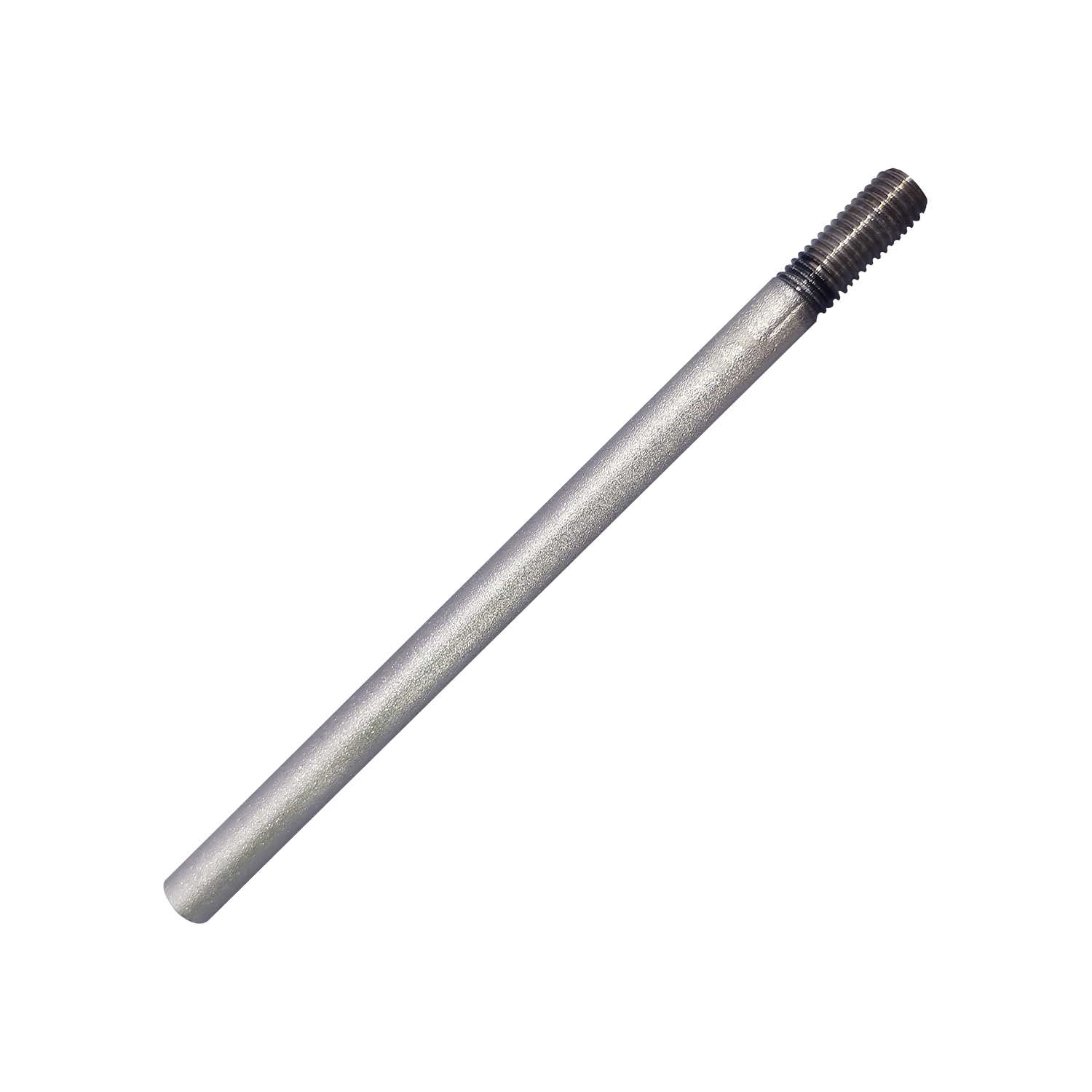
Long Service Life
Platinum coating significantly reduces consumption rate
High Current Density Capability
Suitable for demanding electrochemical environments
Stable Voltage Performance
Ensures consistent system efficiency
Low Maintenance Cost
Fewer replacements compared to traditional anodes
Uniform Current Distribution
Improves plating quality and system reliability
|
Base Material |
Titanium (Gr1, Gr2) |
|
Size |
3*360 mm,5*360 mm,8*360 mm etc. |
|
Operating Voltage |
0.5-1.5 V |
|
Current Density |
<2000 A/m2 |
|
Production Process |
Electroplating |
|
Coating |
Platinum |
|
Coating Thickness |
Customizable based on customer requirements |
|
Solution pH |
1-7 |
|
Service Life |
Enhanced service life testing based on customer requirements and usage environment |
Base Material Information
Platinum-plated anode rods use industrial pure titanium, typically with a purity of over 99%. Industrial pure titanium has four purity grades: Grade 1 (99.5% Ti), Grade 2 (99.2% Ti), Grade 3 (98.7% Ti), and Grade 4 (98.0% Ti). Ehisen's platinum-plated anode rods use Grade 1 and Grade 2 industrial pure titanium as the base material, providing better conductivity, physical properties, and corrosion resistance.
Compliance Standard: ASTM B481
Composition:
|
Grade |
Chemical composition (Mass) ,% |
|||||||||||||
|
Main components |
Impurities, not greater than |
|||||||||||||
|
Ti |
Al |
Sn |
Mo |
Pd |
Ni |
Si |
Fe |
C |
N |
H |
O |
Other elements |
||
|
Single |
Sum |
|||||||||||||
|
Gr1 |
Margin |
- |
- |
- |
- |
- |
- |
0.20 |
0.08 |
0.03 |
0.015 |
0.18 |
0.10 |
0.40 |
|
Gr2 |
Margin |
- |
- |
- |
- |
- |
- |
0.30 |
0.08 |
0.03 |
0.015 |
0.25 |
0.10 |
0.40 |
Physical Properties:
|
Density |
4.51 g/cm³ |
|
Melting Point |
1,670 °C |
|
Specific Heat Capacity |
0.52 J/g·K |
|
Thermal Conductivity |
15.6 W/m·K |
|
Elastic Modulus |
105 GPa |
|
Yield Strength (0.2%) |
240 MPa |
|
Tensile Strength |
240 MPa |
|
Elongation |
24% |
Finished product inspection
Ehisen has strict requirements for the inspection of finished products, which requires the inspection of appearance, the inspection of coating bonding force and the inspection of coating thickness and composition.
Appearance inspection:
Visual inspection is used. The appearance must meet the requirements
1. The coating area is consistent with the drawing requirements.
2. The coating surface should be uniform, no stains, no indentations, no impurities.
3. Slight scratches and abrasions are allowed on the surface of the anode coating (depth shall not expose the substrate). If customers have special requirements for scratches and abrasions, customer requirements shall prevail.
4. The product is free from bump and deformation.

Coating binding force detection:
1. Wear white gloves to wipe the anode coating, and the gloves will not lose dust and color.
2. Attach the attached sample to the anode coating with 3M transparent tape (18mm wide), press it tightly with your hand and quickly remove it. The tape will leave no obvious black marks on the white paper. Sampling 1 piece per batch.
3. Bend the sample 90°, the coating at the bend has no cracks and peeling.
Coating thickness and composition testing:
1. Use a thickness gauge or measure the thickness by grinding cross-section metallography and using SEM.
2. Use precious metal spectrometer to detect the chemical composition of the coating.
Production Process

Applications

Our platinum coated titanium rod anodes are widely used in:
● Electroplating Industry
Chrome plating, nickel plating, PCB plating
● Cathodic Protection Systems
Storage tanks, pipelines, marine structures
● Electrolysis & Water Treatment
Electrochlorination, EDI systems
● Metal Recovery Systems
Precious metal recovery processes
👉 Designed for stable operation in corrosive and high-current environments.
How to Choose the Right Pt/Ti Rod
Selecting the correct platinum coating thickness is critical:
● 2.5 μm
Cost-effective for stable conditions
● 5 μm
Balanced performance and lifetime (most common choice)
● 10 μm+
Recommended for high current density or harsh environments
⚠️ Incorrect selection may lead to:
● early coating failure
● voltage increase
● higher long-term cost
👉 We recommend selecting based on actual operating conditions.

FAQ
Our company provides all kinds of metal materials, including but not limited to steel, aluminum, copper, titanium, nickel, zinc and so on. Specific products and specifications can be found in our product catalogue.
FAQ

01.What is the lifetime of a platinum coated titanium rod anode?
02.Can coating thickness be customized?
03.Is this suitable for high current density applications?
04.How is the price calculated?
05.Do you provide samples?
Why Choose Ehisen


At Ehisen, we focus on coating performance engineering, not just product supply.
● Precision platinum coating process
● Uniform coating on complex geometries
● Real surface area calculation for accurate pricing
● Customized solutions based on current density and electrolyte
👉 We help you achieve the best balance between lifetime and cost.

Logistics freight
01
Before Delivery
We will check the quality and quantity of the goods to ensure they are correct and error-free, and then package them for shipment.
02
Before Receiving
Please inspect the packaging before signing for the goods upon receipt, and contact us promptly if there are any issues.
03
Delivery Time
We will arrange delivery within 5 working days after receiving the order.

Contact Us
we are here for you
To get a fast and accurate quotation, please confirm:
● Rod diameter and length
● Required coating thickness
● Quantity
● Application (electroplating / CP / electrolysis)
● Operating conditions (current density, electrolyte)
👉 Providing this information allows us to recommend the most cost-effective solution.
+86 15619363855 Edward Wu
+86 18700703333 Elsa lin
+86 15291791403 Eve
+86 18896992206 Leo Liu
+86 18191911868 Yuki Lang


Hot Tags: Platinum Coated Titanium Rod Anode (Pt/Ti Electrode), China Platinum Coated Titanium Rod Anode (Pt/Ti Electrode) manufacturers, suppliers, factory, titanium table products, Lead Dioxide Titanium Electrode, CNC Machining Metal False Stacking Parts, Titanium Anode for Electroplating, Titanium Anodes for Water Treatment, Multilayer Metal Titanium Composite Panel