



Products Description
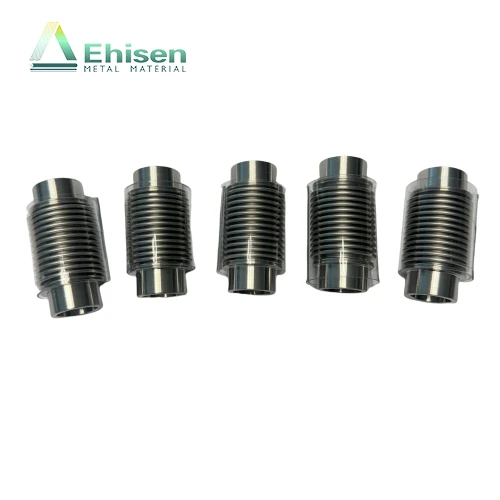
Bellows refer to tubular elastic sensitive elements connected by foldable corrugated sheets along the direction of folding and expansion. Bellows are widely used in instruments and meters. They are used as measuring elements of pressure measuring instruments to convert pressure into ripples or force ripples. The tube has a thinner wall, and again, the measurement range is from gap Pa to vacuum MPa. Its open end is fixed, the sealed end is in a free state, and an auxiliary coil spring or spring leaf is used to increase elasticity. During operation, the effect of internal pressure extends along the length of the pipe, causing the movable end to produce ripples that are related to the pressure. The movable end drives the pointer to directly indicate the pressure. Ladder tubes are often combined with ripple sensors to form pressure sensors with a logic output. , and sometimes isolation components are also provided. Since the extension of a bellows requires increased incremental changes, it responds less quickly than a bourdon tube. Bellows are approximately measuring low pressure.

Products specifications
Chemical components:
|
element |
% |
Ni |
Cr |
Mo |
Mn |
Cu |
Co |
Fe |
C |
Nb |
Al |
|
standard |
min |
Rest |
20.0 |
8.0 |
-- |
-- |
-- |
-- |
-- |
3.15 |
-- |
|
max |
rest |
23.0 |
10.0 |
0.5 |
0.07 |
1.0 |
5.0 |
0.10 |
4.15 |
0.4 |

Raw material standard:ASTM B564, ASTM B443, ASTM B444;

Essential Parameters:
|
Specification |
Inner diameter mm (Db) |
Wave height (h) |
Wave distance mm (q) |
Wavenumber (N) |
Double Wall Thickness (t2) |
Single wall thickness (t1) |
|
DN25 |
22 |
≥1.0 |
3.2 |
≥3 waves |
0.4~0.8 |
0.2~0.4 |
|
DN32 |
32 |
≥1.0 |
3.6 |
≥3 waves |
0.4~0.8 |
0.2~0.4 |
|
DN40 |
40 |
≥1.0 |
4.5 |
≥3 waves |
0.4~0.8 |
0.2~0.4 |
|
DN50 |
55 |
≥1.0 |
5.4 |
≥3 waves |
0.4~0.8 |
0.2~0.4 |
|
DN80 |
83 |
≥2.0 |
16 |
≥3 waves |
0.4~0.8 |
0.2~0.4 |
|
DN100 |
100 |
3.0 |
16 |
≥4 waves |
0.4~1.0 |
0.2~0.6 |
|
DN150 |
150 |
3.5 |
9.5 |
≥4 waves |
0.4~1.0 |
0.2~0.6 |
|
DN170 |
168 |
4.0 |
14 |
≥4 waves |
0.4~1.0 |
0.2~0.6 |
|
DN185 |
180 |
4.0 |
11 |
≥4 waves |
0.4~1.0 |
0.2~0.6 |
|
DN200 |
200 |
5.0 |
11 |
≥5 waves |
0.4~1.5 |
0.2~0.8 |
The principle of bellows


Due to its special structure, bellows can adapt to use in a variety of complex environments, such as high temperature and pressure, as well as corrosive liquids or gases such as chemicals. its surface
A corrosion-resistant coating is often applied to enhance its ability to resist corrosion and extend its service life.
Products advantages

Products Performance
Bellows for connection are made of austenitic stainless steel or materials according to user requirements. They have excellent flexibility, corrosion resistance, high temperature resistance (-235℃ ~ +450℃), and high pressure resistance (up to 32MPa). The pipeline can be connected in any direction to compensate for temperature, absorb vibration, reduce noise, change the direction of medium transportation, eliminate mechanical displacement between pipelines or between pipelines and equipment, etc. The double-flange metal corrugated hose is suitable for pipes with displacement and vibration. Suitable for flexible joints of various pumps, valves, etc.
The working temperature range of metal bellows is (-253 ~600) ℃. (The materials used for bellows working at high temperatures must have sufficient thermal stability. As the operating temperature increases, the elastic modulus of the material decreases, resulting in a decrease in the stiffness, pressure resistance and fatigue life of the bellows. At low temperatures The bellows material used must have good low-temperature properties. At low temperatures, the brittleness of the material is sensitive to surface defects, so the surface quality of the material should be strictly controlled).
It refers to the corrugation pattern and shape after being cut along the axial direction. The corrugated shape of the bellows affects the stiffness, displacement and pressure-bearing capacity of the bellows. According to the geometric shape, the waveform can be divided into U-type, C-type, S-type, V-type and Ω-type.
As a kind of flexible pressure-resistant pipe fitting, metal bellows is installed in the liquid transportation system to compensate for the mutual displacement of the connecting ends of pipes or machines and equipment, absorb vibration energy, and can play the role of vibration reduction and noise reduction. It has good flexibility and light weight. , corrosion resistance, fatigue resistance, high and low temperature resistance and many other characteristics.
There are three main types of metal bellows: metal bellows, corrugated expansion joints and metal corrugated hoses.
The size specifications of metal bellows have been serialized according to the inner diameter standard. Generally, the inner diameter or outer diameter of the metal bellows is used as the basic size, and other structural parameters are used as relative sizes. When the inner diameter or outer diameter is determined, the wall thickness, wave pitch, wave thickness, etc. are determined in appropriate proportions based on the inner diameter or outer diameter. When designing bellows parameters, the performance requirements of the bellows must be met, and the manufacturing process and structural stability of the bellows must also be considered.
There is a certain proportional relationship between the wall thickness and the inner diameter of the bellows. For the bellows with an inner diameter of φ10~1000mm, the ratio of the wall thickness to the inner diameter is generally controlled at 0.0006~0.05; if it is too thick, its flexibility will be poor; if it is too thin, it will not be able to bear pressure. Capabilities are limited. Therefore, various corrugated pipes need to choose a reasonable wall thickness according to the specific usage conditions and performance requirements, and according to the corresponding relationship between the inner diameter and wall thickness. When designing high-pressure bellows, in order to reduce the stiffness and stress of the bellows, it is necessary to design a multi-layer bellows. However, the ratio of the total wall thickness to the inner diameter of the multi-layer bellows should generally not be greater than 0.05.

Bellows forming process
Hydroforming is the most common and widely used forming method for bellows. It is mainly used to manufacture ring-shaped bellows. It can form bellows with a wall thickness of 0.08~4mm. Hydroforming uses the liquid pressure in the tube blank to expand the pipe. After re-compression, it is formed into a corrugated pipe. This forming process is often used for small-diameter metal corrugated pipes.
The roll forming process relies on the rolling of the forming wheel installed in the tube blank. Some of the corrugated tubes formed can only roll out one corrugation at a time, and some can roll out several corrugations at a time. This process is mainly used. For manufacturing large corrugated pipes.
Deposition molding is to deposit the corrugated pipe material on the mold core, and then dissolve the mold core. This process is generally used to manufacture metal corrugated pipes with lower hardness, and the manufacturing cost is relatively high.

Bellows production line and forming mold
Production line pipe specifications φ4-58mm
The bellows forming machine has a closed structure and can provide vacuum forming.
The forming module moves back and forth in an integrally closed forming tunnel.
The forming tunnel is a mezzanine design, and the module is forced to cool evenly through cooling water.
The forming mold strip is made of hard alloy steel, which is wear-resistant and corrosion-resistant.
The molding modules are not connected to each other, so the time required to change formats is shortened.
Extrusion dies and coating dies for single-wall and double-wall flexible pipes are available.

fAQ
do you have any question?

What are bellows?
Bellows, also known as ripple tubes or expansion joints, is a flexible element that is typically made of metal or rubber. It is designed to expand and contract in response to changes in pressure, temperature, or volume.
What are the main uses of bellows?
Bellows are used in a wide variety of applications, including HVAC systems, exhaust systems, industrial machinery, and aerospace systems. They are often used to connect two pipes or vessels, allowing for movement and flexibility while maintaining a seal.
What are some advantages of using bellows?
Bellows offer a number of advantages over traditional mechanical connections. They provide a flexible, leak-free seal that can accommodate movement and vibration, and they are easy to install and maintain. Additionally, bellows can be designed to withstand extreme temperatures, pressures, and chemical environments.
Are there any downsides to using bellows?
They can be expensive to manufacture, and they may require regular inspection and maintenance to ensure proper performance. In addition, bellows may be susceptible to damage from external forces, such as impact or abrasion.
Packaging And Shipping

1. Packaging Materials: Use Moisture-Proof Paper, Plastic Film, Foam Plastic And Other Packaging Materials To Prevent Molybdenum Flanges From Getting Damp Or Suffering Minor Collisions. In Addition, Wooden Outer Packaging Boxes Or Wooden Pallets Can Also Be Used As Packaging Auxiliary Materials.
2. Outer Packaging: The Product Can Be Placed In A Wooden Outer Packaging Box Or Wooden Pallet Of Appropriate Size To Prevent It From Being Squeezed Or Bumped During Transportation.
3. Transportation Method: Choose The Appropriate Transportation Method, Such As Sea Transportation, Land Transportation Or Air Transportation, And Ensure Suitable Handling Equipment To Avoid Product Damage During Transportation.
about us

ehisen
The company is created in 2004 as a high-tech organization focused on advanced metal material production,including melting,profiling,machining,and precious metal anode research and development.Our company, which employs 50 people and occupies a 15 mu area, is focused on innovative manufacturing.
The business is equipped with rolling, heat-treating, stamping, and alloy production machinery.Processing centers, electroplating,titanium anode production lines and precious metal coating laboratory,as well as related testing equipment.It has evolved over years into a whole business that combines R&D, manufacturing, and sales.
contact us
we are here for you
admin@ehisen-anode.com
0086-0917-3292780
+86 18700703333 Elsa Lin
Hot Tags: bellows for connection, China bellows for connection manufacturers, suppliers, factory, SOFC SOEC Gas Pipeline Components, SOFC SOEC Air Pipeline Components