


Are your existing anodes affecting plating quality and production efficiency?

Traditional anode materials may face several challenges during long-term operation:
- Metal Contamination: Anode dissolution or corrosion may introduce unwanted metal impurities into the plating bath.
- Anode Sludge: Corrosion products and accumulated deposits can increase bath maintenance requirements.
- Frequent Replacement: Material degradation may lead to additional maintenance and replacement costs.
- Process Instability: Changes in anode condition and geometry may affect current distribution and plating consistency.
For electroplating systems requiring insoluble anodes, coated titanium anodes offer an alternative designed to reduce these issues.
What Is a Titanium Mesh Auxiliary Anode?
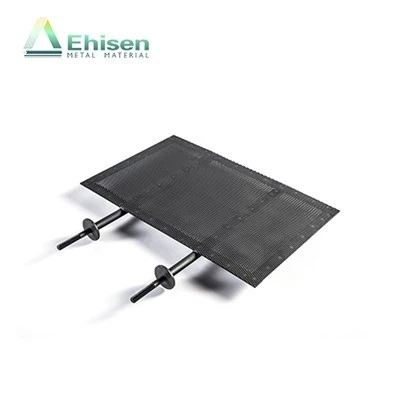
A titanium mesh auxiliary anode is an insoluble electrode made from a titanium mesh substrate coated with a functional catalytic layer, such as Mixed Metal Oxide (MMO) or platinum.
It is designed to provide additional anodic activity in selected areas of an electroplating tank, helping support local current distribution.
Its Main Components

01
Titanium Substrate
Provides mechanical strength and a lightweight supporting structure.
02
Catalytic Coating
Provides the electrochemical activity required by the application.
03
Mesh Structure
Allows electrolyte circulation through the open surface.
04
Electrical Connection
Connects the anode to the power supply.
Key Advantages & Performance Value
Designed for Stable and Efficient Electroplating Operations
Reduced Contamination Risk
Insoluble titanium anodes can reduce metal contamination associated with the dissolution of conventional anode materials.
Open Mesh Structure
The mesh design supports electrolyte circulation and can be customized to fit different tank and workpiece geometries.
Stable Anode Dimensions
The titanium substrate provides a stable supporting structure during operation.
Electrochemical Performance
Suitable catalytic coatings can provide high electrochemical activity and low anode polarization under appropriate operating conditions.
Corrosion Resistance
The combination of titanium substrate and application-specific coating is designed for demanding electrochemical environments.
Flexible Customization
Mesh dimensions, coating systems, and electrical connections can be tailored to individual equipment requirements.
Actual performance and service life depend on electrolyte chemistry, operating conditions, coating specifications, and anode design.
Custom-Made to Match Your Electroplating System
Ehisen manufactures titanium mesh auxiliary anodes according to customer drawings, samples, and operating requirements.
| Parameter | Customization Options |
|---|---|
| Titanium Substrate | Commercially Pure Titanium |
| Titanium Grade | Gr1 / Gr2 |
| Mesh Structure | Expanded Mesh / Custom Design |
| Coating Type | MMO / Platinum |
| Coating Surface | Single-Sided / Double-Sided |
| Mesh Opening | Customized |
| Substrate Thickness | Customized |
| Overall Dimensions | Customized |
| Electrical Connection | Customized |
What We Need to Evaluate Your Requirements
- Electroplating process and electrolyte composition
- Operating temperature and pH
- Operating current or current density
- Anode dimensions or technical drawing
- Required service life
Our technical team can evaluate the substrate, mesh design, and coating system based on your application.
Applications of Insoluble Anodes
Titanium Anode Solutions for a Wide Range of Electroplating Industries
Coated titanium anodes can be evaluated for various industrial electroplating processes, including:

Precious Metal Plating

PCB Electroplating

Hexavalent Chromium Plating

Trivalent Chromium Plating

Steel Strip Electroplating

Other Metal Plating Applications
Long-Term Cost: Beyond the Initial Price
The Lowest Purchase Price Does Not Always Mean the Lowest Operating Cost.
When evaluating an anode solution, consider more than the initial purchase price.
| Cost Factor | Traditional Anodes | Coated Titanium Anodes |
|---|---|---|
| Initial Purchase | May be lower | Depends on coating and design |
| Replacement | Depends on material degradation | Depends on coating life and operating conditions |
| Maintenance | May require frequent cleaning or replacement | May reduce certain maintenance requirements |
| Bath Management | Corrosion products may increase treatment needs | Can reduce contamination associated with anode dissolution |
| Production Stability | May be affected by anode degradation | Stable dimensions can support consistent operation |
A practical comparison should include:
- Initial anode purchase cost
- Replacement frequency
- Maintenance labor
- Production downtime
- Plating bath treatment
- Potential quality-related losses
A properly selected titanium anode may offer long-term operating value by reducing certain maintenance and replacement burdens.
The right solution should be evaluated over its entire service life, not by purchase price alone.
Why Choose Ehisen?

Your Manufacturing Partner for Customized Titanium Anodes
Shaanxi Ehisen Technology specializes in titanium anode manufacturing for industrial electrochemical applications.
Based in Baoji, China, we provide customized anode solutions for different equipment designs and operating conditions.
From product evaluation to customized manufacturing, Ehisen works with customers to develop anode solutions for their applications.
Specialized Manufacturing
Customized Solutions
Technical Support
FAQ
How do I determine whether a coated titanium mesh anode is suitable for my electroplating process?
Suitability depends on the electrolyte composition, anodic reaction, operating temperature, pH, current density, and anode potential. Our technical team evaluates these parameters to determine whether a coated titanium mesh anode is appropriate and to recommend a suitable coating system.
Can titanium mesh auxiliary anodes replace conventional soluble anodes?
In selected processes, coated titanium anodes can replace conventional soluble anodes. However, they do not release metal ions into the plating bath. For processes such as copper and nickel plating, a separate metal replenishment system may therefore be required to maintain bath composition.
How does mesh geometry affect current distribution and plating uniformity?
Mesh opening, wire or strand dimensions, anode-to-cathode distance, and installation position can all influence current distribution. An appropriately designed mesh structure helps optimize electrolyte circulation and electrode placement. The final geometry should be determined according to the workpiece shape and plating tank configuration.
What operating parameters determine the service life of a coated titanium mesh anode?
Service life is influenced by electrolyte composition, current density, operating temperature, anodic potential, coating formulation, and operating cycles. Excessive current density or unsuitable chemical conditions may accelerate coating degradation. Service-life estimates should therefore be based on actual operating conditions rather than coating type alone.
Request a Custom Anode Solution
Looking for a Titanium Mesh Auxiliary Anode Manufacturer?
Tell us about your electroplating application. Our team will review your requirements and help evaluate a suitable anode solution.
To Get Started, Please Share:
- Your application or plating process
- Electrolyte composition and operating conditions
- Required anode dimensions
- Estimated quantity
- Technical drawings or reference photos
Hot Tags: titanium mesh auxiliary anodes for electroplating, China titanium mesh auxiliary anodes for electroplating manufacturers, suppliers, factory, automated precious metal anode, conductive precious metal anode, printed precious metal anode, reusable precious metal anode, Titanium Anode for Electroplating, Titanium Anode for Precious Metal Plating