


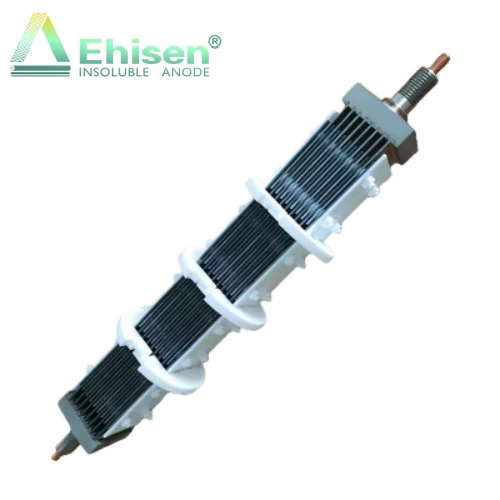
Products Description
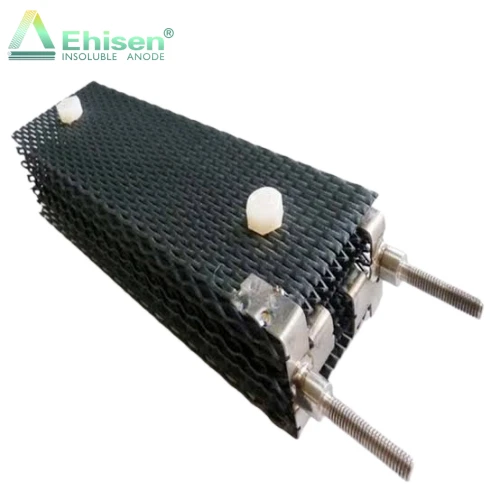
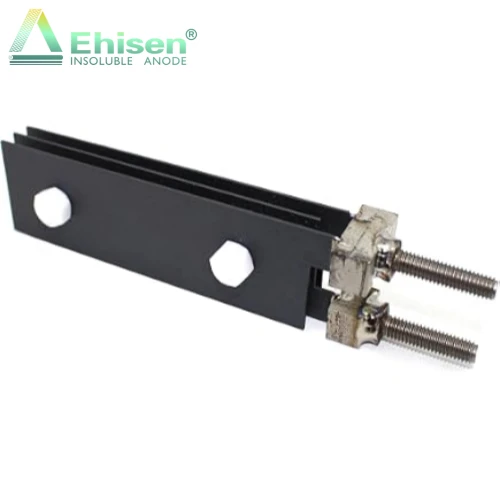
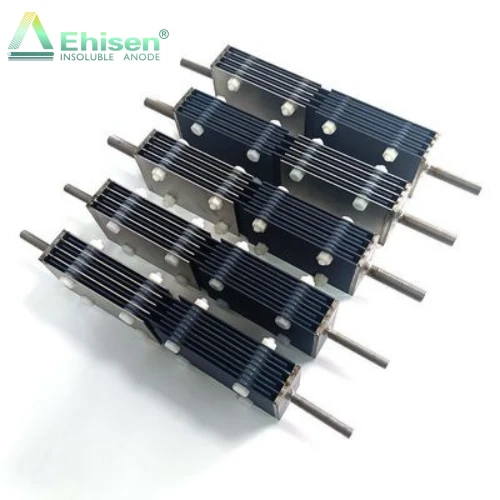
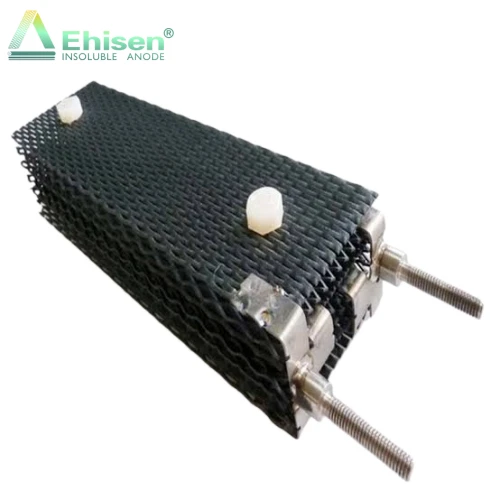
Ehisen manufactures Ru-Ir coated titanium anodes for sodium hypochlorite generators, designed for the electrolysis of brine or chloride-containing water to produce sodium hypochlorite on site.
Using commercially pure titanium as the substrate and a ruthenium-iridium mixed metal oxide coating as the electrocatalytic layer, the electrode provides high chlorine evolution efficiency, good electrical conductivity and stable performance under continuous electrolysis conditions.
Our titanium anodes can be customized according to the electrolyzer design, chlorine production capacity, operating current, current density, salt concentration, polarity mode and required service life.
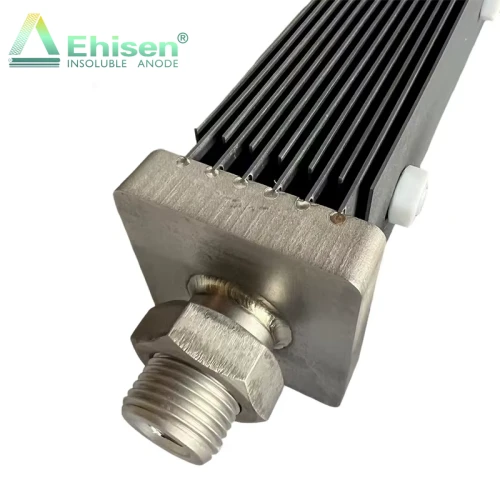
Available forms include titanium plates, mesh electrodes, tubes, rods and complete electrode assemblies.
Typical applications include:
● Sodium hypochlorite generators
● Brine electrolysis systems
● Seawater electrochlorination
● Drinking water disinfection
● Wastewater disinfection
● Cooling water treatment
● Aquaculture water treatment
● Swimming pool chlorination
● Industrial process water treatment
● On-site chlorine generation systems
Send us your operating parameters or electrode drawing for a customized electrode recommendation and quotation.
Technical Specifications
The following specifications represent common customization options. Final parameters should be confirmed according to the actual electrolyzer operating conditions.
| Item | Typical Option |
|---|---|
| Product | Ru-Ir Titanium Anode |
| Substrate | Commercially Pure Titanium |
| Common Titanium Grade | Grade 1 / Grade 2 |
| Coating | Ru-Ir Mixed Metal Oxide |
| Main Reaction | Chlorine Evolution |
| Electrode Form | Plate / Mesh / Tube / Rod / Custom |
| Coating Side | Single Side / Double Side / Customized |
| Dimensions | According to Drawing or Application |
| Current Density | Customized According to Operating Conditions |
| Salt Concentration | According to Electrolysis System |
| Operating Temperature | Customized According to Process |
| Electrode Connection | Bolt / Thread / Welded Tab / Custom |
| Polarity | Normal Polarity / Reverse Polarity Design |
| Service Life | Designed According to Actual Operating Conditions |
| OEM / ODM | Available |
Important: The operating current, current density and electrolyte conditions should be confirmed before determining the coating specification and expected service life.
Why Ru-Ir Coated Titanium Anodes Are Used for Hypochlorite Generation
Ruthenium-iridium mixed metal oxide coatings are widely used for chlorine evolution in chloride-containing electrolytes.
Compared with an uncoated titanium electrode, the Ru-Ir catalytic coating provides a much more active surface for the electrochemical oxidation of chloride ions.

A properly designed Ru-Ir MMO titanium anode can provide:
High Chlorine Evolution Activity
The Ru-Ir coating promotes the oxidation of chloride ions and helps improve chlorine generation efficiency during brine electrolysis.
Lower Electrode Overpotential
A highly active coating can reduce the reaction resistance at the anode surface, helping control electrolyzer voltage and energy consumption.
Good Corrosion Resistance
Titanium forms a naturally stable oxide layer and provides excellent corrosion resistance in many chloride-containing environments.
The catalytic coating protects the electrochemically active surface while allowing the electrode to operate efficiently under anodic polarization.
Long-Term Dimensional Stability
Unlike consumable graphite or certain metallic anodes, MMO titanium electrodes are dimensionally stable during normal electrolysis operation.
This allows the electrode spacing and cell geometry to remain relatively stable throughout the service period.
Flexible Electrode Design
Titanium can be fabricated into different structures depending on the electrolyzer design, including:
● Plate
● Expanded mesh
● Perforated plate
● Tube
● Rod
● Wire
● Custom electrode assembly
The active coating area can therefore be optimized according to the required current and chlorine production capacity.
What Determines Titanium Anode Service Life?
There is no meaningful way to determine electrode life from coating type alone.
The service life of a Ru-Ir titanium anode is influenced by the complete electrochemical operating environment.

Important factors include:
Current Density
Higher current density generally increases the electrochemical load on the coating.
If the active coating area is too small for the operating current, coating degradation may accelerate.
Chloride Concentration
The chloride concentration affects reaction efficiency and the balance between chlorine evolution and competing electrochemical reactions.
Temperature
Elevated electrolyte temperature may influence reaction kinetics and coating degradation.
Water Composition
Impurities, hardness ions and certain aggressive species can influence electrode performance.
Electrode Spacing
Improper spacing may increase cell voltage or create uneven current distribution.
Polarity Reversal
Reverse-polarity systems require a coating and electrode structure designed for the actual reversal conditions.
Coating Loading
A higher precious metal loading may support a longer designed operating life under the same conditions, but simply increasing coating loading without considering operating parameters is not always the most economical solution.
Ehisen therefore recommends determining the coating specification after evaluating the complete operating conditions rather than selecting an electrode based only on dimensions.
Applications

On-Site Sodium Hypochlorite Generation
On-site hypochlorite generators electrolyze prepared brine to produce low-concentration sodium hypochlorite solution directly where it is required.
This approach is widely used for:
● Drinking water disinfection
●Wastewater treatment
● ndustrial water systems
● Agricultural irrigation
● Cooling water treatment
Ru-Ir coated titanium electrodes act as the main catalytic component responsible for chlorine evolution.
Seawater Electrochlorination
Because seawater naturally contains chloride ions, it can in many cases be used directly as the electrolyte for electrochlorination.
Titanium anodes for seawater electrochlorination can be applied in:
● Marine aquaculture
● Coastal power plants
● Seawater cooling systems
● Offshore facilities
● Marine engineering
● Anti-biofouling systems
Operating conditions in seawater can differ significantly from those in prepared brine, so electrode selection should be based on actual water composition and process parameters.
Aquaculture Water Disinfection
Electrochemical chlorine generation is increasingly used in marine aquaculture and recirculating water systems.
The generated active chlorine species can help control microorganisms and biological contamination in water circulation systems.
For aquaculture projects, the electrode design should take into account:
● Seawater salinity
● Flow rate
● Required chlorine concentration
● Current density
● Continuous operating time
● Water temperature
Cooling Water and Industrial Water Treatment
Electrochlorination can also be integrated into cooling towers and industrial circulating water systems to control microbial growth and biofouling.
Compared with transporting and storing large quantities of hypochlorite solution, on-site electrolysis can provide a practical alternative for certain industrial installations.
Quality Control

Stable electrode performance depends not only on precious metal content but also on the complete manufacturing process.
Ehisen controls key manufacturing steps including:
Titanium Material Inspection
The substrate is checked according to the required titanium grade and dimensions.
Surface Preparation
Proper titanium surface pretreatment is important for coating adhesion and long-term electrochemical stability.
Coating Application
The Ru-Ir precursor system is applied according to the designed coating specification.
Thermal Treatment
Controlled thermal processing converts the coating precursor into the active mixed metal oxide layer and helps establish a stable bond with the titanium substrate.
Coating Inspection
Depending on project requirements, inspection can include coating appearance, dimensional inspection, coating composition analysis and electrochemical testing.
Dimensional Inspection
Critical dimensions and connection positions are checked according to customer drawings.
For customized electrode assemblies, trial assembly can also be conducted where required.
Customized Titanium Anode Manufacturing
Ehisen specializes in customized precious-metal-coated titanium electrodes rather than limiting customers to standard sizes.

Customization options include:
● Titanium substrate dimensions
● Mesh opening
● Plate thickness
● Tube diameter
● Rod diameter
● Coated surface area
● Single-side or double-side coating
● Ru-Ir coating system
● Precious metal loading
● Connection tabs
● Threaded connections
● Mounting holes
● Welding structure
● Electrode assemblies
● Reverse-polarity designs
Prototype quantities and customized small batches can be manufactured for equipment development and testing before mass production.
FAQ
FAQ
01.What coating is commonly used for sodium hypochlorite generator anodes?
02.Can titanium anodes be used for direct seawater electrolysis?
03.Can you manufacture electrodes according to our drawing?
04.Can you manufacture both anodes and cathodes?
05.Can the electrode be designed for reverse polarity?
06.What information is required for a quotation?
Why Choose Ehisen?
product key technologies

Ehisen focuses on the development and manufacturing of precious-metal-coated titanium electrodes for electrochemical applications.
Our products include:
● Ru-Ir coated titanium anodes
● Ir-Ta coated titanium anodes
● Platinized titanium electrodes
● MMO titanium mesh
● Titanium plates
● Titanium tubes
● Titanium rods
● Custom electrode assemblies
For sodium hypochlorite generator projects, our advantage is not simply supplying a coated titanium plate.
We evaluate the electrode together with the actual electrochemical system.
This allows the design to consider:
● Chlorine generation requirements
● Current density
● Active electrode area
● Salt concentration
● Electrode spacing
● Coating selection
● Reverse-polarity requirements
● Expected operating life
Whether you are developing a new electrolyzer, replacing an existing electrode or looking for an OEM titanium anode supplier, Ehisen can manufacture according to your drawing and operating conditions.

Shipping & Delivery
Global Shipping Options:
At Ehisen, we understand the importance of reliable and efficient delivery for our metalwork pieces. That's why we offer a variety of shipping options to meet the diverse needs of our international clients.
Standard Shipping: Our standard shipping offers an affordable way to deliver your order within the typical timeframe of 15-30 business days, depending on your location.
Express Shipping: For faster delivery, choose our express shipping service which ensures your order arrives within 7-15 business days.
Custom Solutions: For large or unique orders, we provide custom logistics solutions tailored to ensure the safe and timely arrival of your products.

Packaging:
Every order is packaged with utmost care using robust materials designed to protect your metalwork during transit. For specific packaging requirements or concerns, please contact our support team.
Tracking Your Order:
Once your order is dispatched, you will receive a tracking number via email. You can use this number to check the current status of your shipment on our website at any time.
Customs and Duties:
Please note that international shipments may be subject to customs fees and import duties. These charges are the responsibility of the recipient and vary from country to country. We recommend contacting your local customs office for further information.
Need Help?
Our customer service team is here to assist with any shipping or delivery questions you may have. Contact us or via our live chat service on our website.
contact us
we are here for you
Hot Tags: ru-ir titanium anode for sodium hypochlorite generator, China ru-ir titanium anode for sodium hypochlorite generator manufacturers, suppliers, factory, downgraded precious metal anode, Platinum Plated Anode for Hydrogen Rich Water Cups, second hand precious metal anode, serviced precious metal anode, shipped precious metal anode, surplus precious metal anode