

background
In proton exchange membrane fuel cells, due to the harsh internal conditions, metal bipolar plates are straightforward to corrode and deteriorate their performance. Therefore, it is necessary to prepare functional coatings on their surfaces to meet performance and durability requirements. The coating is usually required to have good electrical conductivity, excellent corrosion resistance, certain hydrophilicity and hydrophobicity, good bonding strength and low cost. In the stages of metal bipolar plate fuel cell development and small-scale market application, noble metal coatings are widely used in the surface modification of metal bipolar plates due to their low preparation difficulty, stable performance, and high tolerance to fuel cell operating conditions. However, as the fuel cell industry gradually moves toward industrialization and marketization, the high cost of precious metal coatings has gradually emerged. Therefore, many researchers have begun to explore and try other material systems. Among them, carbon-based coating is one of the materials that can predictably be used to replace precious metal coatings for surface modification of metal bipolar plates.
Carbon coated structure
Carbon has many allotropes with different dimensions, such as fullerene, carbon nanotubes, carbon nanofibers, graphene sheets, diamond, etc. The four valence electrons of carbon have three electron hybrid orbital characteristics: sp, sp2, and sp3, so each has very different properties. Typically, graphite is composed of sp2 hybridized carbon. Its outermost layer has three electrons in the triangular sp2 orbit to form a σ bond, and the fourth electron in the Pπ orbit forms a π bond perpendicular to the σ plane. Therefore, graphite has various properties. Anisotropic lamellar structure. This structure gives it excellent electrical conductivity, but also results in low mechanical strength; diamond has an sp3 hybrid structure, and the four valence electrons of the carbon atom are allocated to the tetrahedron-oriented sp3 orbital, forming a formation with adjacent atoms. Strong σ bond, which gives it high resistivity, chemical inertness and super hardness. Between graphite and diamond, there is a substance composed of sp2 and sp3 hybrid structures - amorphous carbon (a-C).
A-C, which mainly exists in the form of sp3 hybridization, has properties similar to diamond, so it is called diamond-like amorphous carbon [1]. a-C composed of a large number of sp2 hybrid structures is called graphite-like Amorphous Carbon. a-C can be prepared by different processes, and the a-C prepared is also diverse. Over the years, many researchers have conducted extensive and in-depth research on the preparation and performance optimization of a-C, which has promoted the rapid development and success of this material in machinery, semiconductors, medical devices and other application fields.
For metal bipolar plate applications, the surface coating must not only have good conductivity to reduce contact resistance, but also have electrochemical corrosion resistance to inhibit the precipitation of metal ions in the harsh fuel cell environment. Therefore, the unique physical and chemical properties of a-C are very consistent with the application requirements of metal bipolar plate coatings. The microstructural composition of a-C can be adjusted through different preparation processes and parameter conditions, thereby changing its hardness, chemical inertness, conductivity and other properties to meet the technical requirements of metal bipolar plates.
Preparation
Thanks to the rapid development of vacuum technology, there are now various preparation methods for a-C. Various preparation methods have been integrated and learned from each other to develop technical branches with different characteristics. The most common and typical ones are as follows:
Magnetron sputtering is a PVD coating method that uses a magnetic field to enhance the ionization rate of the sputtering gas to increase the sputtering yield. It has gone through many optimizations and derived a series of balanced, unbalanced, AC, pulse, etc. Technical branch, it has been widely used in metal bipolar plate coating in recent years. The film layer prepared by this method usually has good density and flatness, and can keep the substrate at a relatively low temperature during the coating process, which not only improves production efficiency, but also reduces the impact of heat generated by the substrate on the film layer. Adverse effects on the organization.
Plasma-enhanced chemical vapor deposition (PECVD) is a vapor deposition technology that introduces low-temperature plasma into the CVD system. Because the presence of plasma enhances the chemical activity of reacting substances, thereby reducing the film-forming temperature and increasing the reaction rate . Che et al. prepared a hydrogen-containing amorphous carbon film that can be applied to bipolar plates through PECVD. The deposition rate can be nearly 40 nm/min while ensuring performance, ensuring high preparation efficiency.
Ion plating is mainly divided into two categories: evaporation ion plating and sputtering ion plating. It is a technology that ionizes coating materials and deposits them on the surface of the substrate. The bombardment of high-energy ions can not only form a pseudo-diffusion layer at the film/substrate interface, improving the bonding strength, but also generate high-density defects on the surface of the substrate, greatly increasing the nucleation density and increasing the film-forming speed.
Bipolar plate carbon coating technology
A-C has already made relatively mature research progress in the application of metal bipolar plate coatings. Yu et al. prepared a-C on 316L stainless steel through pulse bias ion plating. Due to the existence of a large number of sp2 clusters, the electron migration path is provided, which significantly reduces the contact resistance of the matrix. However, due to the accumulation of internal stress in the film and the influence of thermal stress during the preparation process, a-C membranes simply prepared on the surface of metal bipolar plates are prone to cracking and falling off, making it difficult to meet high durability requirements in practical applications. Therefore, many people have done focused research on reducing the stress within the membrane and improving the bonding strength of the membrane base.
Preparing a metal transition layer and doping metal atoms to improve the bonding force is one of the more obvious ways. The introduction of metal atoms will reduce the stress, hardness and Young's modulus within the film. Some researchers prepared a W transition layer on the surface of the substrate before preparing the carbon film, and compared the carbon film containing the W layer with the pure carbon film sample. The results show that the carbon film sample with W transition layer has better bonding strength
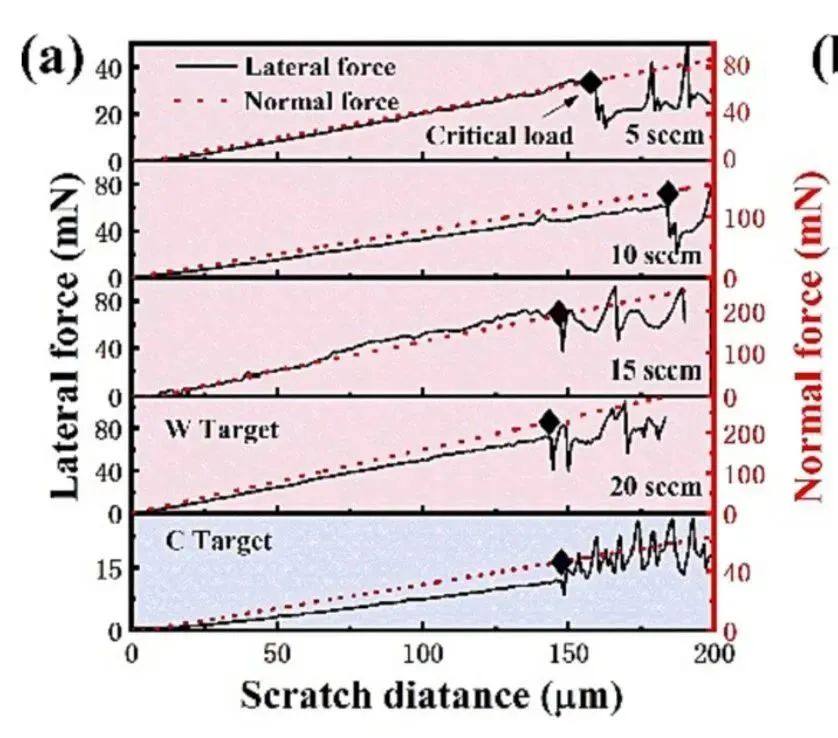
Nano-scratch test results of a-C film
Due to the special microstructure of a-C, not only sp2 and sp3 bonds can coexist in the carbon film system, but also allow other element atoms to be doped. In particular, doping different types and concentrations of metal atoms will significantly help control the content of different hybrid bonds in the carbon film. The doped metals can exist in the form of carbides, metal clusters, and metal oxides. Different forms of existence It also gives the carbon film different performances. For example, Li et al. used DC balanced magnetron sputtering technology to prepare a-C films with different Ti-doped amounts on 316L stainless steel substrates. Ti doping significantly improves the structure of the a-C film, avoids the growth of large-scale columnar crystals, and increases the density of the film layer. The introduction of Ti atoms promotes the sp2 hybridization of the a-C film, and increasing the Ti doping amount will promote the formation of carbides, which will significantly improve the conductive properties of the film.
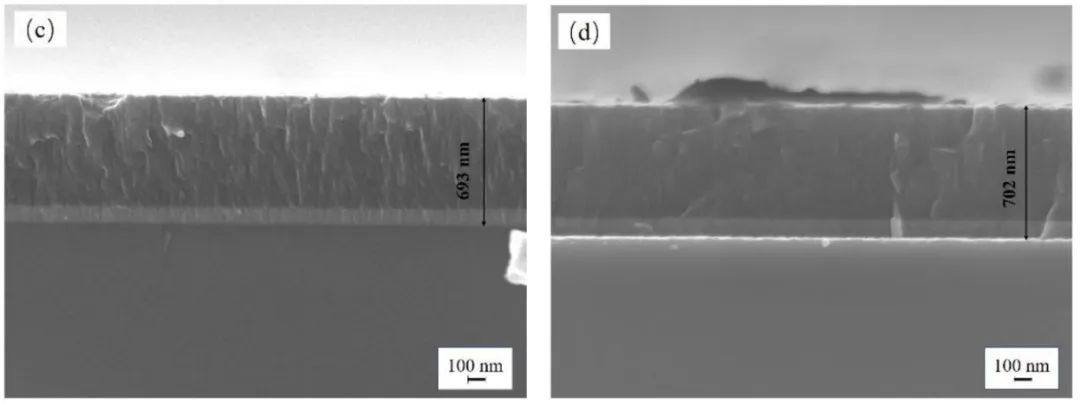
Cross section of a-C film after Ti doping
Generally, the presence of doped metals in a-C films is different, mainly due to the influence of the amount of metal doping. Zhang used closed-field non-equilibrium magnetron sputtering technology to prepare a-C films with different Ag and Cr doping amounts on the 316L surface. Since the presence of soft metal phase Ag increases the degree of diffusion of deposited atoms, as the Ag incorporation concentration increases, the surface morphology distribution of the carbon film gradually becomes uniform, and Ag gradually grows in the form of cluster aggregation. When Cr is doped and reaches a certain concentration, Cr carbide nanocrystals will precipitate in the film, causing size shrinkage in the nearby area to achieve the effect of promoting the density of the film. Not only that, co-doping of Ag and Cr can significantly improve the ID/IG of Raman, which not only increases the sp2 ratio in the film, but also makes the sp2 bond configuration more compact.
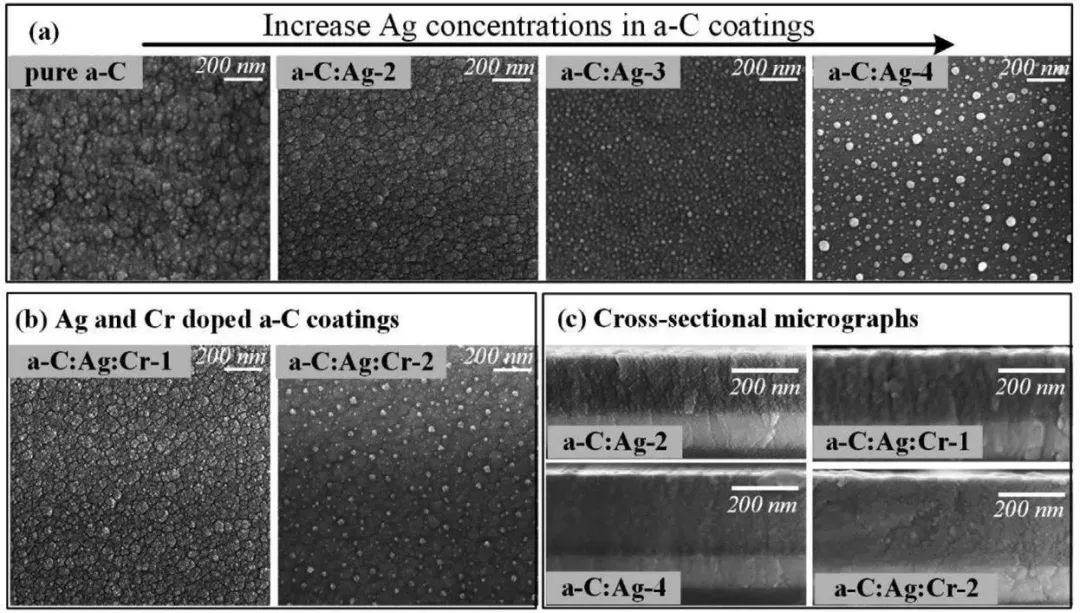
Morphology of a-C film under different Ag and Cr doping concentrations
However, it does not mean that the higher the concentration of doping elements, the better the overall performance of the film. Although high-concentration Ag doping will increase the electron transmission path in the film layer, the large-sized Ag clusters embedded will become a preferential corrosion zone, providing a path for the electrolyte to spread into the film layer. And due to the dissolution of Ag nanoclusters and the generation of Cr oxide, the ICR will grow after potentiostatic polarization.
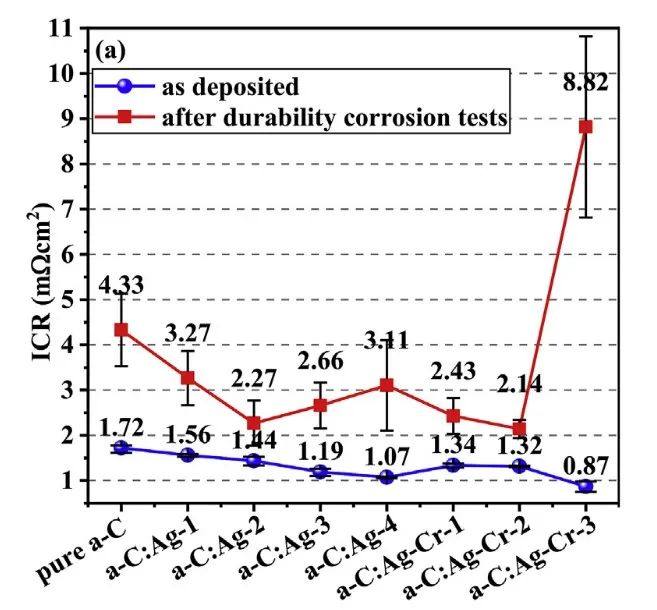
ICR changes after corrosion resistance test
Summarize
There are many processes for improving the performance of metal bipolar plates by adjusting the structure of amorphous carbon coatings, and everyone is working hard to develop and try them in multiple directions. However, how to improve the life of bipolar plates while reducing costs has always been the core issue for large-scale commercial applications. Ehisen has also conducted a lot of research and verification in the above aspects, and has a complete bipolar plate evaluation system. Through in-depth communication and cooperation with suppliers, Ehisen develops high-performance metal bipolar plate components. Currently, the latest carbon-coated metal bipolar plates applied by Ehisen have passed comprehensive performance testing and strict online durability testing, and are sufficient to support a stack operating life of more than 20,000 hours. The application of a new generation of carbon-coated metal bipolar plates not only improves the performance of the stack on the original basis, but also greatly reduces the cost of the stack.
related products in ehisen


Click on the products name to learn more about the products!