

Introduction
In recent years, tungsten cubes have gained surprising attention across a wide range of industries and user groups-from engineers and educators to collectors and procurement managers. At first glance, a tungsten cube may appear to be just a simple metal block. However, once you hold one in your hand, the experience is completely different from expectations.
The unusual weight, compact size, and precision machining make tungsten cubes both a scientific tool and a conversation piece. More importantly, behind this seemingly simple product lies a combination of advanced material science, machining expertise, and real industrial value.
This article explains why people are getting tungsten cubes, what drives demand, and how to select the right product for your specific application.
What Is a Tungsten Cube?

A tungsten cube is a solid metal block manufactured from tungsten or tungsten-based alloys, typically machined into a precise cubic shape. These cubes are known for their:
• Extremely high density
• Excellent dimensional stability
• Strong resistance to wear and deformation
• High melting point and thermal stability
Depending on the application, tungsten cubes can be produced with varying levels of purity, tolerances, and surface finishes. They are often used in both technical and non-technical fields, making them a versatile product in modern material applications.
Why Tungsten Feels So Heavy

The most striking feature of tungsten is its density. When compared to commonly used metals such as aluminum or steel, tungsten is significantly heavier for the same volume.
This means that a small tungsten cube can feel unexpectedly heavy in your hand. This contrast between size and weight creates a strong sensory impact, which is one of the main reasons people are drawn to tungsten cubes.
From a technical perspective, this high density allows tungsten to deliver:
Maximum mass in minimal space
Compact design solutions
Enhanced stability in mechanical systems
This property is critical in industries where space efficiency and weight concentration are required.
Top Reasons People Buy Tungsten Cubes
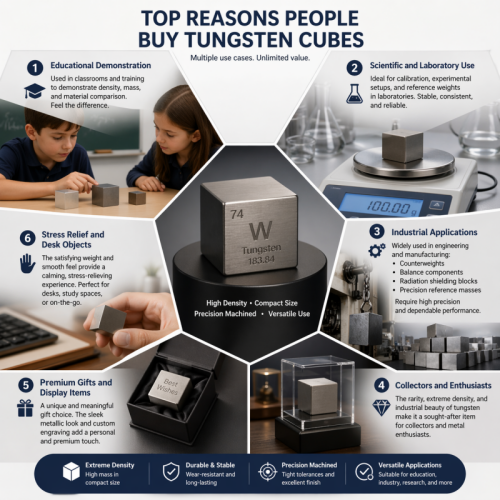
The demand for tungsten cubes comes from multiple use cases, each with its own motivations. Understanding these helps explain the growing popularity of the product.
1. Educational Demonstration
Tungsten cubes are widely used in classrooms and training environments to demonstrate physical concepts such as density, mass, and material comparison. Instead of abstract explanations, students can directly feel the difference between materials.
2. Scientific and Laboratory Use
In laboratories, tungsten cubes can be used for calibration, experimental setups, or as reference weights. Their stability and consistency make them suitable for controlled environments.
3. Industrial Applications
In engineering and manufacturing, tungsten cubes are often used as:
● Counterweights
● Balance components
● Radiation shielding blocks
● Precision reference masses
These applications require reliable material properties and tight machining tolerances.
4. Collectors and Enthusiasts
Some buyers are attracted purely by the uniqueness of tungsten. The combination of rarity, density, and industrial aesthetics makes tungsten cubes desirable for collectors.
5. Premium Gifts and Display Items
Due to their unusual weight and clean metallic appearance, tungsten cubes are also used as high-end gifts or display items. Custom engraving can further increase their value.
6. Stress Relief and Desk Objects
The tactile experience of holding a dense object has led to tungsten cubes being used as desk accessories or stress-relief tools.
Educational and Scientific Value
Tungsten cubes provide a simple yet powerful way to explain complex physical concepts.
Instead of relying on formulas, users can directly compare:
● Weight differences between materials of the same size
● Volume versus mass relationships
● Material density in real-world terms
For educators, this creates a more engaging and memorable learning experience. For researchers, it offers a consistent and reliable reference material.
Industrial and Engineering Applications
Beyond education and novelty, tungsten cubes have serious industrial relevance.

Counterweight Systems
In applications where space is limited but weight is required, tungsten cubes provide a compact solution. This is particularly useful in precision equipment or compact mechanical systems.
Radiation Shielding
Tungsten is commonly used in environments where radiation shielding is necessary. Its density allows it to absorb and block radiation effectively within a smaller footprint.
Precision Calibration
Due to its stability and resistance to deformation, tungsten can be used as a reference mass in certain calibration setups.
High-Temperature Environments
Tungsten maintains structural integrity at temperatures where many other metals would fail, making it suitable for specialized environments.
Why Choose Tungsten Instead of Other Metals?
When selecting materials for weight-based or high-performance applications, tungsten stands out due to its unique combination of density, stability, and safety.
Material Comparison Table
| Property / Material | Tungsten | Aluminum | Steel | Lead |
|---|---|---|---|---|
| Density (Weight per Volume) | Extremely high | Very low | Medium | High |
| Size Efficiency | Maximum weight in compact size | Requires large volume for weight | Moderate | Larger than tungsten for same weight |
| Machinability | More difficult | Easy | Moderate | Easy |
| Mechanical Strength | Excellent | Low | High | Low |
| High-Temperature Performance | Outstanding | Poor | Moderate | Poor |
| Environmental & Safety | Non-toxic, stable | Safe | Safe | Toxic, restricted in many applications |
| Durability | Very high | Moderate | High | Low (soft material) |
| Typical Use Cases | Counterweights, shielding, precision components | Lightweight structures | General engineering | Radiation shielding (limited use due to toxicity) |
Key Takeaways
● Higher Density: Tungsten provides significantly more weight in a smaller volume compared to aluminum and steel.
● Compact Design Advantage: Ideal for applications where space is limited but mass is required.
● Safer Alternative to Lead: Unlike lead, tungsten is non-toxic and environmentally compliant.
● Superior Performance: Maintains structural integrity under extreme conditions, including high temperatures.
💡 Buyer Insight:
If your application requires maximum weight, compact size, and long-term reliability, tungsten is often the most efficient and future-proof material choice.
Available Sizes and Specifications
Tungsten cubes can be manufactured in a wide range of sizes and specifications to meet different application needs, from education and display to industrial and scientific use.


1. Standard Size Range
| Size Category | Edge Length (mm) | Typical Use Cases |
|---|---|---|
| Small Cubes | 10 – 30 mm | Education, demonstrations, desk items, gifts |
| Medium Cubes | 30 – 60 mm | Laboratory use, display, collectors |
| Large Cubes | 60 – 100 mm+ | Industrial applications, counterweights, special projects |
2. Customization Options
| Specification Item | Available Options | Description |
|---|---|---|
| Dimensional Tolerance | Standard / Tight Tolerance | Suitable for general use or precision applications |
| Surface Finish | Machined / Polished / Mirror Finish | From industrial finish to high-end display quality |
| Engraving Options | Logo / Serial Number / Custom Text | Ideal for branding, traceability, or gifts |
| Material Type | Pure Tungsten / Tungsten Alloy | Selected based on performance or cost requirements |
| Edge & Corner Treatment | Sharp Edge / Chamfered / Rounded | Adjusted based on safety or aesthetic needs |
| Packaging | Standard / Protective / Gift Box | Optional packaging depending on application |
3. Industrial Specification Flexibility
| Requirement Type | Customization Capability |
|---|---|
| Application Environment | Can be adjusted for lab, industrial, or display use |
| Weight Requirement | Precise weight control available |
| Quantity | From single sample to bulk production |
| Surface Quality | Controlled based on functional or visual needs |
What Affects Tungsten Cube Pricing?
Understanding what drives the price of a tungsten cube is important for both first-time buyers and professional purchasers. Although a tungsten cube may look like a simple machined block, its final cost is influenced by much more than just its dimensions. Material value, processing difficulty, tolerance requirements, finishing standards, and customization details can all significantly affect the quotation.
For buyers, knowing these factors helps in two ways: first, it makes supplier quotations easier to understand and compare; second, it helps identify where cost can be optimized without sacrificing the performance actually needed for the application.
Below are the main factors that affect tungsten cube pricing.
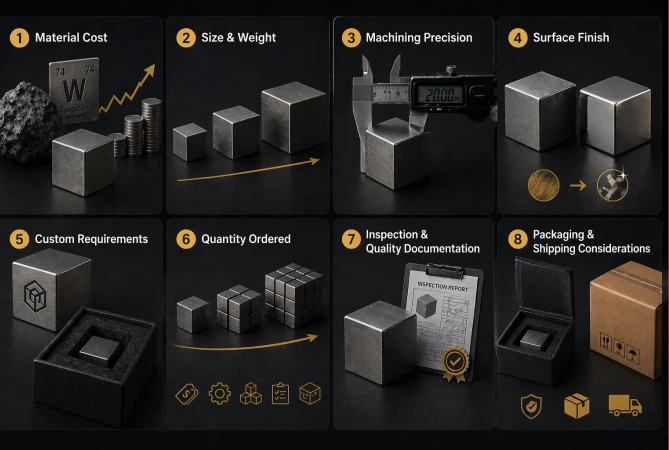
1. Material Cost
The most important part of tungsten cube pricing is usually the material itself.
Tungsten is a high-value metal with a very high density, which means even a relatively small cube contains a meaningful amount of raw material by weight. This is one reason why tungsten cubes often seem more expensive than buyers initially expect. A small change in cube size can create a noticeable increase in material consumption because the product is dense and heavy.
Material cost can also vary depending on several underlying factors, including:
● the grade of tungsten used
● purity requirements
● whether the product is made from pure tungsten or a tungsten alloy
● raw material market conditions
● supply availability for specific sizes or forms of stock
For standard display or educational cubes, buyers may focus mainly on appearance, weight feel, and basic dimensional accuracy. But for industrial or technical use, the material specification often matters much more. If higher purity, more stable internal structure, or stricter material consistency is required, the price will typically increase.
In simple terms, tungsten cube pricing starts with the value of the metal itself, and because tungsten is dense and costly compared with many common engineering metals, material cost is usually the foundation of the quotation.
2. Size and Weight
Size has a direct and major impact on price.
A larger tungsten cube requires more raw material, but that is only part of the story. As cube size increases, the total weight rises quickly, and that affects not only material cost but also machining effort, handling, inspection, and shipping. Because a cube is a three-dimensional product, small increases in edge length can lead to a much larger increase in total volume and mass.
For example, when the cube becomes larger:
● more tungsten is consumed
● machining time increases
● cutting and finishing become more demanding
● inspection may take longer
● packaging requirements become more robust
● shipping cost may rise because of the higher weight
This is especially relevant for buyers comparing several size options. In many cases, selecting a slightly smaller cube can reduce cost noticeably while still meeting the practical purpose of the product.
For educational use, gift use, or display use, buyers often choose cube sizes based on visual impact and hand feel. For industrial use, the size may be linked to a required weight or installation space. In either case, larger size usually means higher total cost, not only because of material consumption, but because the entire production and delivery process becomes heavier and more demanding.
3. Machining Precision
Machining precision is another major factor that affects tungsten cube pricing.
At first glance, a cube may seem simple to manufacture, but a high-quality tungsten cube is not just a cut block. If a buyer expects sharp edges, flat surfaces, accurate dimensions, consistent squareness, and a refined appearance, the manufacturing process must be controlled carefully.
Price will rise when the buyer requests tighter requirements for:
● dimensional tolerance
● edge straightness
● corner sharpness or corner consistency
● flatness of each face
● parallelism and perpendicularity
● weight consistency between multiple pieces
The tighter the tolerance, the more demanding the machining process becomes. This usually means:
● more precise equipment
● slower cutting and grinding
● additional process control
● more frequent dimensional checks
● higher rejection risk during production
This is particularly important in industrial and laboratory applications. A decorative tungsten cube and a reference cube for technical use may look similar in photos, but the production standards behind them can be very different. Higher precision means more time, more skill, and more quality control, which naturally leads to a higher price.
For procurement, this also means it is helpful to define actual needs clearly. If standard tolerance is enough, there is no need to pay for ultra-precision machining. But if the cube must fit a fixture, serve as a precision mass, or match other components, tighter tolerances may be necessary and worth the additional cost.
4. Surface Finish
Surface finish can significantly influence the final price, especially for cubes intended for display, gifts, premium presentation, or branding purposes.
A basic tungsten cube may be supplied with a standard machined finish, which is functional and clean but may still show normal machining marks. If the customer wants a more refined appearance, extra finishing operations are required.
Common finish levels may include:
● standard machined finish
● fine ground finish
● brushed finish
● polished finish
● mirror-like decorative finish
Each higher finish level usually means more processing time and more manual or semi-manual work. It may also require more careful handling to avoid scratches, marks, or edge damage before shipment.
Surface finish affects price because it often involves:
● extra grinding or polishing steps
● tighter visual inspection
● more labor input
● stricter packaging protection
● higher rejection standards for cosmetic defects
This is especially true for tungsten cubes sold as premium products, executive gifts, collector items, or showroom samples. In these cases, the buyer is not only purchasing the metal itself, but also the visual impact and tactile quality of the finished product.
For industrial buyers, however, a premium cosmetic finish may not always be necessary. If the cube is used internally in equipment or for weight balancing, a standard industrial finish may provide a better cost-performance balance.
5. Custom Requirements
Customization is one of the most common reasons that tungsten cube prices vary between projects.
A standard tungsten cube is usually more economical because the supplier can manufacture it with established tooling, routine inspection methods, and conventional packaging. Once custom requirements are added, the production process often becomes more complex and less standardized.
Typical custom requirements that can increase cost include:
● custom dimensions
● special tolerance requirements
● engraved logos or text
● serial numbers or traceability marks
● special edge design
● unique surface finish requirements
● custom packaging boxes or presentation cases
● quantity-matched labeling
● non-standard inspection reports
● one-piece prototype production
Customization affects price because it may require engineering review, special programming, additional setup time, separate inspection processes, and more communication between buyer and supplier.
For example, engraving may seem simple, but it still adds process steps and may require careful alignment to maintain appearance. Special gift packaging can improve product value, but it also adds packaging material cost and assembly time. Non-standard dimensions may reduce production efficiency, especially in small quantities.
That said, customization is often worthwhile when the cube is intended for gifting, branding, product display, education kits, or system integration. The key is to distinguish between features that are truly necessary and those that are optional, so the final product matches both the application and the budget.
6. Quantity Ordered
Although the tungsten cube itself is a relatively compact product, order quantity still plays an important role in pricing.
Single-piece or low-volume orders generally carry a higher unit cost because setup, machining preparation, inspection, and packaging are spread across fewer pieces. In contrast, larger orders can often reduce the average unit price because production becomes more efficient.
● Quantity influences price through:
● material purchasing efficiency
● machine setup distribution
● batch processing efficiency
● inspection consistency
● packaging standardization
For buyers who need tungsten cubes for resale, education kits, promotional use, or repeated industrial applications, batch ordering may provide better cost control than repeated small purchases.
If the project is still in the evaluation stage, one common approach is to start with a sample or pilot batch, then move to a larger order once the size, finish, and quality expectations are confirmed.
7. Inspection and Quality Documentation
For some buyers, especially industrial purchasers, the product itself is only part of the requirement. Documentation can also affect cost.
If the buyer requests additional quality support, such as:
● dimensional inspection records
● material certificates
● weight records
● appearance inspection reports
● custom labeling for traceability
then the price may increase accordingly. These requirements add time to inspection and document preparation, even if they do not change the physical cube itself.
For a simple desk cube or retail display item, this level of documentation is usually unnecessary. But for industrial buyers or distributors, having proper records can be valuable and may justify the additional cost.
8. Packaging and Shipping Considerations
Because tungsten is extremely dense, shipping is often more important than buyers expect.
Even a small tungsten cube can be heavy enough to require stronger packaging for protection and transport safety. If the customer requests premium packaging, gift boxes, foam inserts, anti-scratch wrapping, or export-grade protection, total cost will increase.
Shipping-related cost considerations may include:
● total gross weight
● protective packaging level
● single-piece vs. bulk packing
● domestic or international shipping
● risk of surface damage during transit
For high-finish cubes, packaging quality becomes even more important because polished surfaces are easier to mark or scratch. This means packaging is not only a logistics matter, but also part of quality protection.
Why Buyers Should Understand These Cost Drivers
For procurement teams, understanding tungsten cube pricing helps avoid two common problems: overpaying for unnecessary features, or choosing a low-cost offer that does not actually meet the required standard.
A good quotation should reflect the real needs of the application. For example:
● If the cube is for education or display, appearance and reasonable size may matter more than ultra-tight tolerance.
● If the cube is for industrial balancing or calibration, accuracy and consistency may be more important than decorative finish.
● If the cube is for gifts or branded presentation, engraving and packaging may be worth the added cost.
When buyers clearly define what matters most, suppliers can provide more accurate recommendations and more practical quotations.
How to Optimize Cost Without Reducing Product Value
If budget is important, there are several practical ways to control tungsten cube pricing:
● choose a standard size instead of a fully custom dimension
● use standard industrial tolerance unless tighter accuracy is necessary
● select a clean machined finish instead of a mirror finish for technical use
● combine multiple pieces into one order to improve unit cost
● confirm whether engraving or special packaging is truly needed
● define the application clearly so the supplier can recommend the most suitable specification
Cost optimization is not just about reducing price. It is about matching the product specification to the real purpose of the purchase.
Tungsten cube pricing is influenced by a combination of material value, size, machining difficulty, finishing level, and custom requirements. What appears to be a simple cube can involve very different cost structures depending on whether it is intended for education, industrial use, scientific reference, premium gifting, or branded display.
For serious buyers, the best approach is to evaluate price together with specification, finish, and intended use. A professional supplier should be able to explain these cost drivers clearly and help you choose a solution that balances performance, appearance, and budget.
How to Choose the Right Tungsten Cube

Selecting the right tungsten cube depends on your specific use case.
Key Factors to Consider
● Required size and weight
● Application environment
● Tolerance requirements
● Surface finish expectations
● Budget constraints
For industrial applications, it is important to confirm all specifications before placing an order to ensure compatibility with your system.
Customization and OEM Capabilities
Professional manufacturers can provide tailored solutions to meet unique requirements.
Typical Custom Services
● Custom dimensions and tolerances
● Surface treatment options
● Logo or serial number engraving
● Bulk production for industrial use
Customization allows buyers to integrate tungsten cubes directly into their products or systems.
Common Questions Buyers Ask
01.Is the cube made from pure tungsten?
02.How accurate is the size?
03.Will the surface oxidize?
04.Can I request custom sizes?
Why Work with a Professional Supplier

Choosing the right supplier is critical to ensuring product quality and consistency.
A professional tungsten supplier can provide:
● Verified material quality
● Stable production processes
● Precision machining capabilities
● Consistent delivery timelines
● Technical support for application matching
This reduces risks and ensures that the product performs as expected in real-world use.
Conclusion
Tungsten cubes are more than just dense metal blocks-they represent a combination of material science, engineering precision, and practical functionality.
From education and research to industrial applications and premium gifts, their unique properties make them valuable across multiple fields.
As demand continues to grow, understanding the reasons behind this interest helps buyers make informed decisions and select the right product for their needs.

Get in Touch
If you are looking for high-quality tungsten cubes or custom tungsten solutions, feel free to contact us with your specifications.
Our team can assist you with:
• Product recommendations
• Custom design support
• Accurate quotations
• Sample evaluation
We are ready to support your project with reliable materials and professional service.
Email: info@ehisen-anode.com
Phone: +86 15291791403 Eve


