

Introduction
Reverse polarity is widely used in many sodium hypochlorite generators to reduce electrode scaling and improve long-term operating stability.
However, many users still have questions:
● Why does scale form inside the electrolytic cell?
● Does scale mainly form on the anode or cathode?
● How does reverse polarity remove deposits?
● How often should polarity be reversed?
● Can any MMO titanium anode work in a reversible system?
The answer depends on electrode design, water quality, operating conditions, and maintenance requirements.
This guide explains the relationship between titanium anodes, electrode scaling, reverse polarity, and electrode selection.
1. How a Sodium Hypochlorite Generator Works
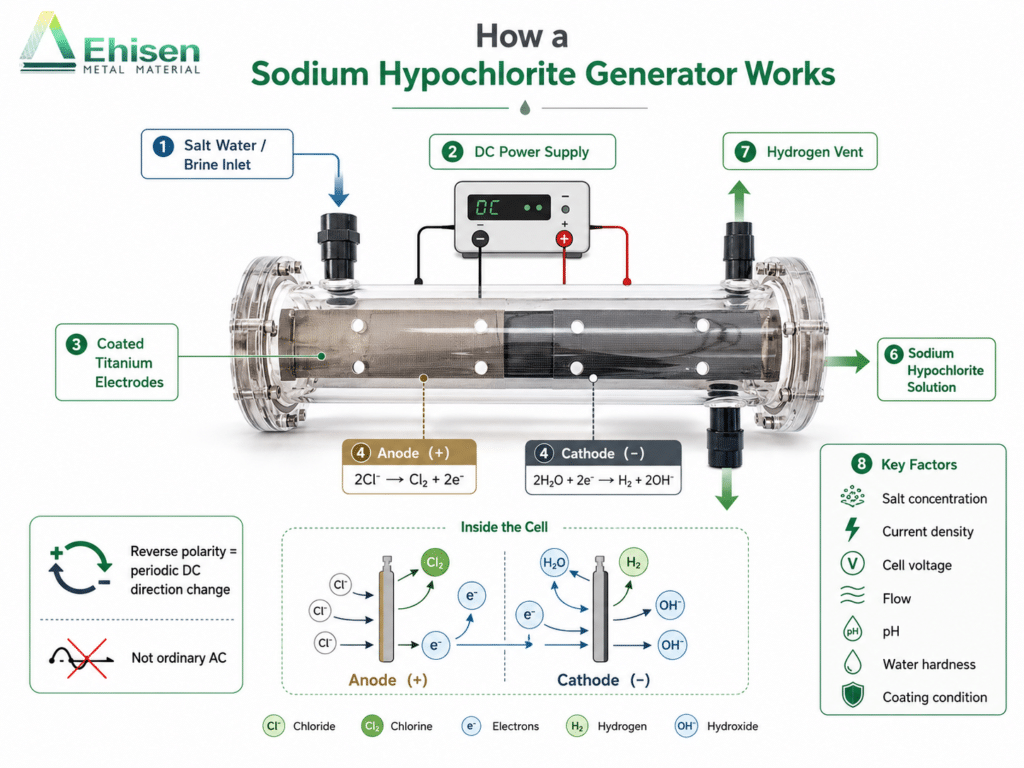
A sodium hypochlorite generator produces disinfectant through the electrolysis of sodium chloride solution.
Inside the electrolytic cell:
At the anode:
2Cl⁻ → Cl₂ + 2e⁻
Chlorine is generated and reacts with water to form hypochlorous acid and hypochlorite.
At the cathode:
2H₂O + 2e⁻ → H₂ + 2OH⁻
Hydrogen and hydroxide ions are produced.
The actual performance of the generator depends on:
● Salt concentration
● Current density
● Cell voltage
● Electrode spacing
● Water temperature
● Flow conditions
● Water hardness
● Titanium electrode coating condition
Why coated titanium electrodes are used
Bare titanium can conduct electricity, but it is not an efficient long-term chlorine-evolution anode.
Titanium naturally forms a passive oxide layer, which increases electrical resistance during anodic operation.
A noble-metal oxide coating, such as Ru-Ir MMO coating, provides:
● Higher catalytic activity
● Lower operating voltage
● More stable chlorine generation
● Longer electrode service life
For sodium hypochlorite generators, electrode coating design should match:
● Chloride concentration
● Current density
● Temperature
● Expected lifetime
● Reverse polarity requirements
2. Why Does White Scale Form Inside the Electrolytic Cell?
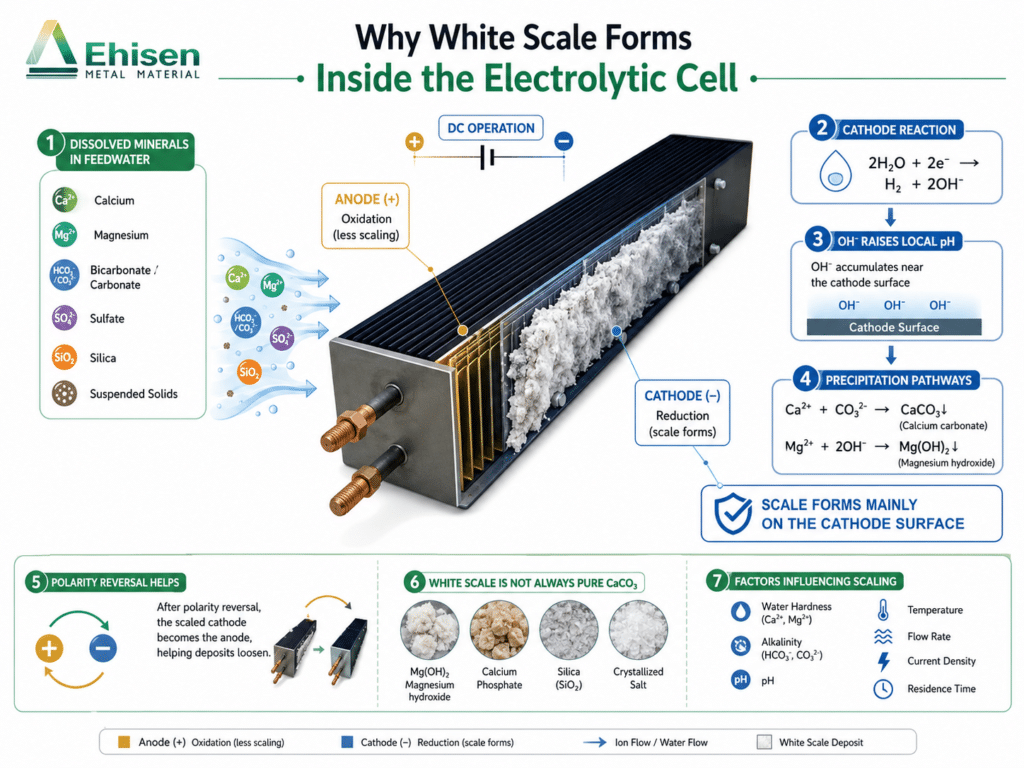
One of the most common problems in sodium hypochlorite generators is mineral scale.
Feedwater may contain:
● Calcium ions
● Magnesium ions
● Carbonate
● Bicarbonate
● Silica
● Other minerals
During electrolysis, hydroxide ions are generated near the cathode:
2H₂O + 2e⁻ → H₂ + 2OH⁻
The local pH near the cathode increases, causing calcium and magnesium compounds to precipitate.
Common deposits include:
● Calcium carbonate (CaCO₃)
Magnesium hydroxide (Mg(OH)₂)
Therefore, under normal DC operation, scale generally forms on or near the cathode.
This is important because reverse polarity works by changing this electrode environment.
3. How Scale Affects Electrode Performance
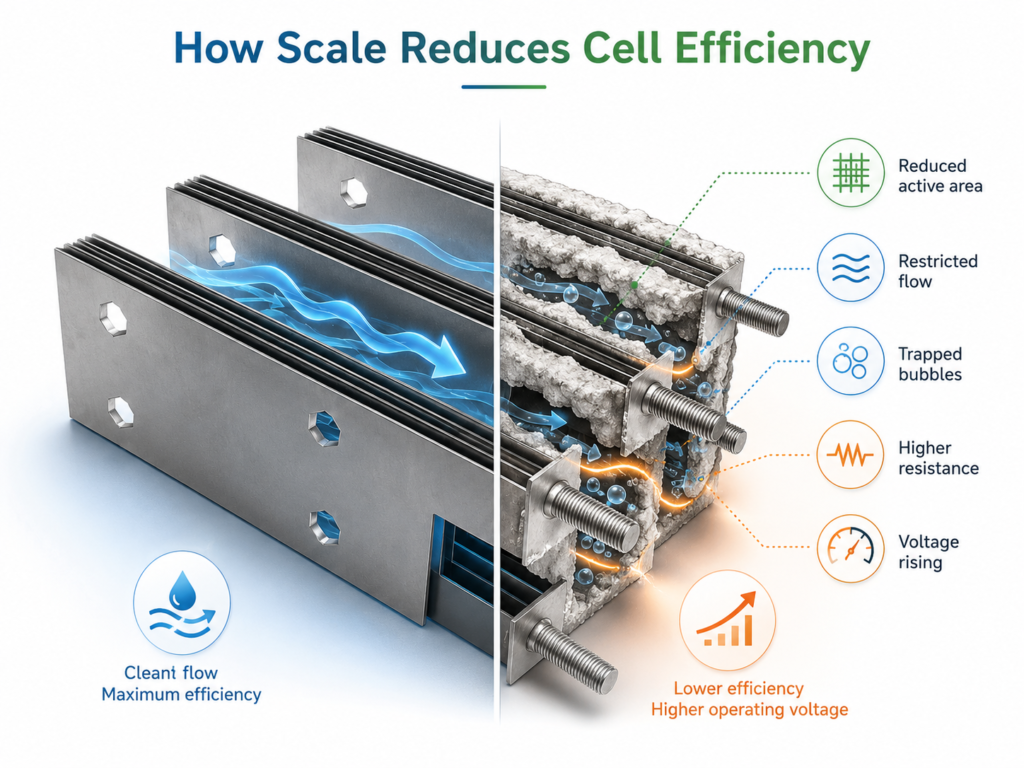
Scale is not only a visual problem.
As deposits accumulate, they can:
Reduce effective reaction area
A mineral layer blocks contact between electrolyte and electrode surface.
This reduces:
● Reaction efficiency
● Ion transport
● Gas release
● Current distribution uniformity
Increase cell voltage
Mineral deposits increase resistance inside the cell.
To maintain the same current, the power supply must increase voltage.
A gradual voltage increase is often one of the first signs of electrode fouling.
However, high voltage can also result from:
● Low salt concentration
● Poor conductivity
● Gas accumulation
● Loose electrical connections
● Reduced flow
● Coating deterioration
● Voltage should always be evaluated together with operating conditions.
Restrict flow and gas release
Thick deposits may:
● Narrow electrode gaps
● Trap gas bubbles
● Reduce water circulation
● Create uneven current distribution
This can lead to unstable chlorine production and increased energy consumption.
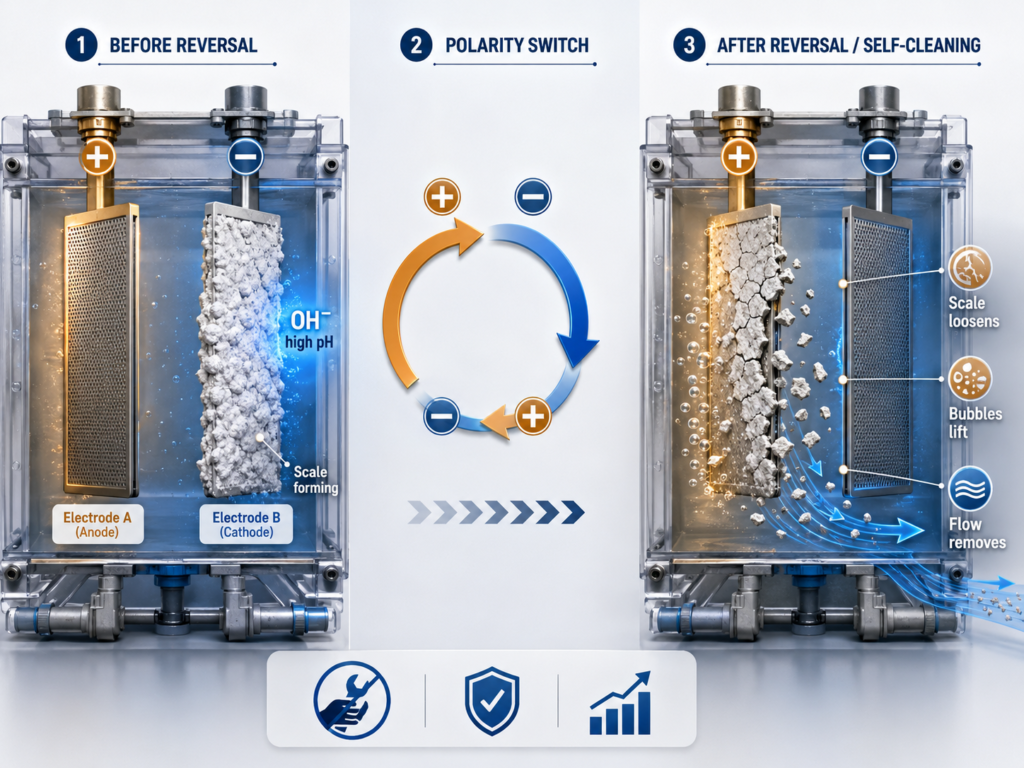
4. How Does Reverse Polarity Remove Scale?
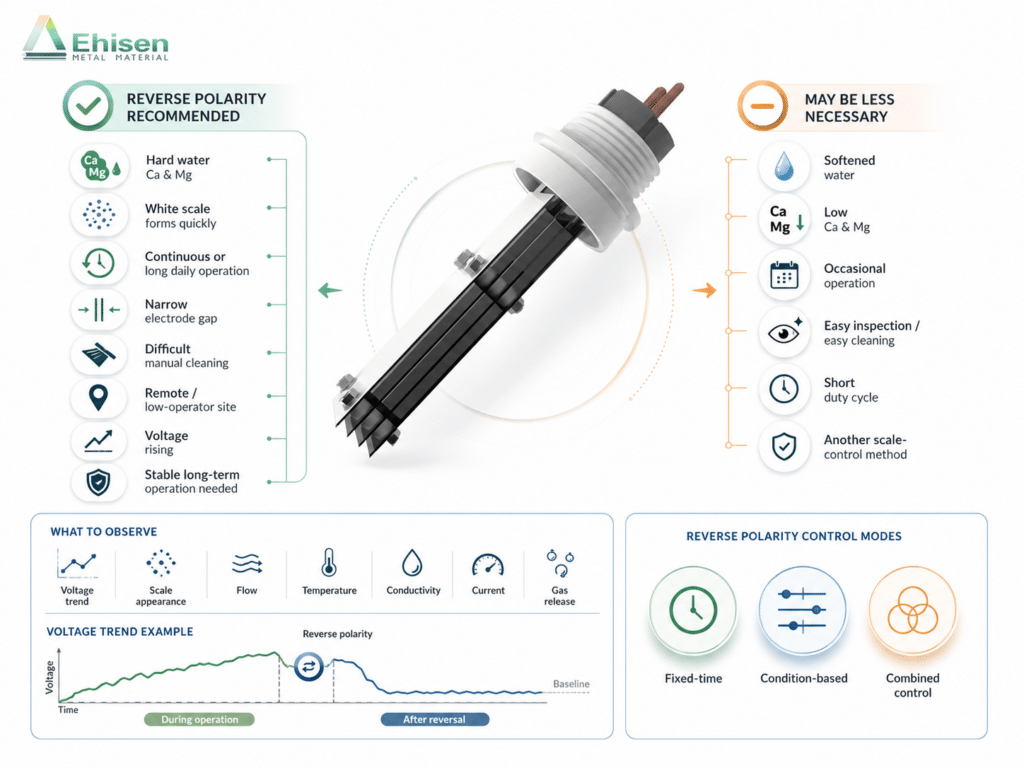
Reverse polarity periodically changes the electrode direction.
Before reversal:
● Electrode A = Anode
● Electrode B = Cathode
● Scale mainly forms on the cathode
After reversal:
● Electrode A = Cathode
● Electrode B = Anode
The previously scaled cathode enters a different electrochemical environment.
The self-cleaning effect comes from several mechanisms:
1. The high-pH scaling environment disappears
The former cathode no longer generates hydroxide ions, reducing the conditions that promote mineral precipitation.
2. Surface chemistry changes
The electrode potential, local pH, and interfacial reactions change.
Deposits may:
● Crack
● Lose adhesion
● Dissolve partially
● Detach from the surface
3. Gas bubbles assist removal
Gas generation during polarity reversal can create mechanical disturbance, helping loosen weak deposits.
4. Water flow removes particles
A properly designed cell allows detached deposits to leave the electrode gap.
Reverse polarity does not guarantee a completely scale-free electrode.
It is a scale-control method, not a replacement for proper water treatment or maintenance.
5. How Often Should Polarity Be Reversed?
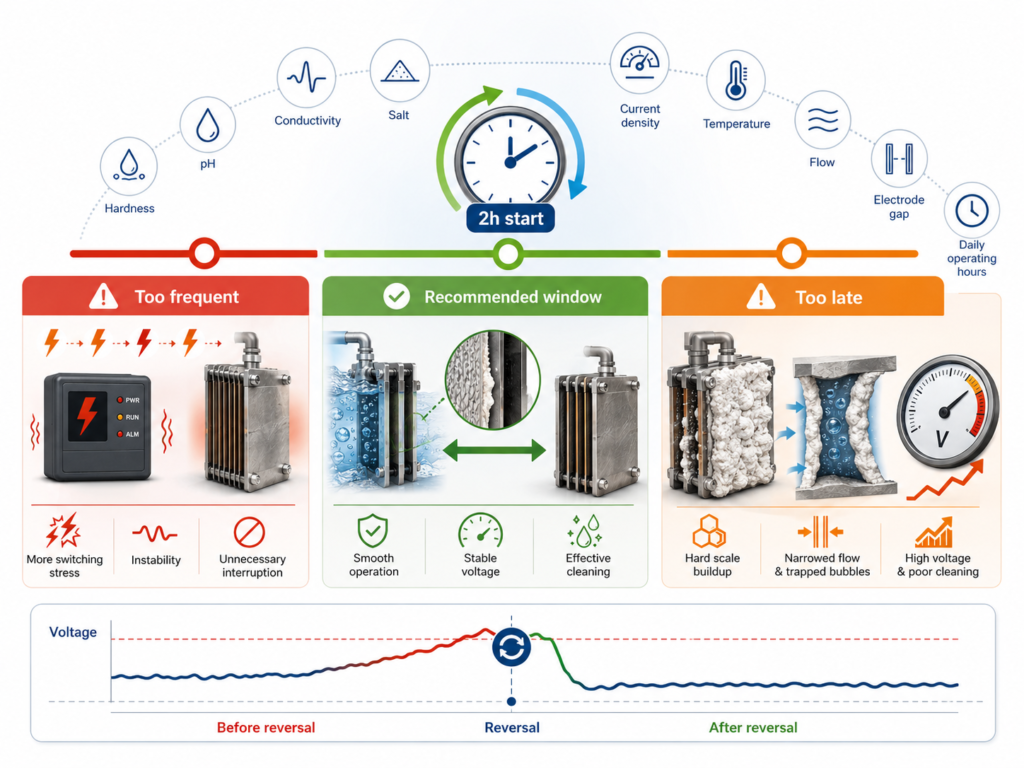
There is no universal reversal interval.
The correct cycle depends on:
● Water hardness
● Calcium and magnesium concentration
● Salt concentration
● Current density
● Electrode spacing
● Temperature
● Flow rate
● Operating hours
● Deposit formation speed
A two-hour reversal interval may be used as an initial setting for some systems.
However, it should be optimized according to actual operation.
If reversal is too late:
● Scale becomes harder
● Deposits become thicker
● Flow channels may block
● Chemical cleaning may be required
If reversal is too frequent:
● Switching components experience more stress
● Operation may become unstable
● Electrode loading changes more often
The best cycle is not the shortest cycle.
The best cycle is the one that maintains stable voltage and minimizes maintenance.
6. Can Every MMO Titanium Anode Be Used for Reverse Polarity?
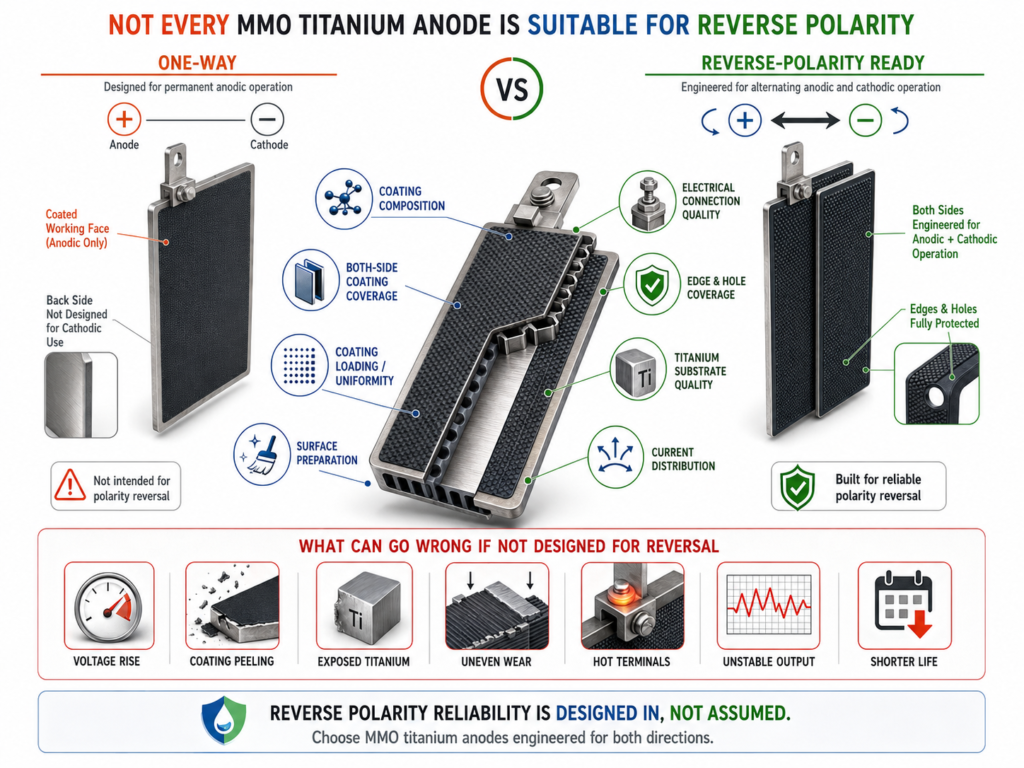
No.
A titanium electrode designed for normal one-direction anodic operation is not automatically suitable for polarity reversal.
A reversible sodium hypochlorite generator requires:
Suitable coating design
The coating must tolerate repeated changes between:
● Anodic operation
● Cathodic operation
Proper coating coverage
If both sides become active during operation, both surfaces may require suitable coating.
Important factors include:
● Coating area
● Edge coverage
● Hole coverage
● Connection area
Correct titanium substrate
The substrate should have:
● Suitable thickness
● Good mechanical strength
● Proper flatness
● Reliable welding quality
Good electrical connection
Poor connections can cause:
● Voltage loss
● Terminal heating
● Uneven current distribution
A successful reverse-polarity electrode requires the combination of:
● Titanium substrate
● MMO coating
● Electrode structure
● Electrical design
● Operating conditions
7. Reverse Polarity and Maintenance
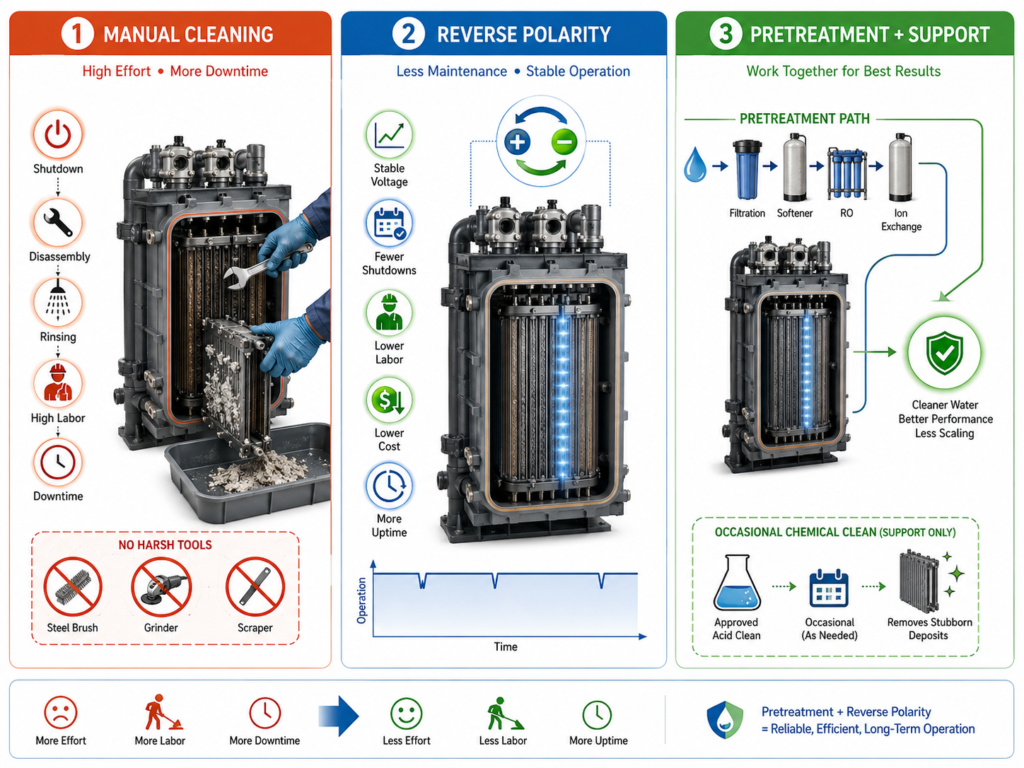
The main benefit of reverse polarity is reducing manual maintenance.
Without reverse polarity, operators may need to:
● Stop operation
● Open the cell
● Remove electrodes
● Clean deposits
● Reassemble equipment
● Restart the system
This increases:
● Labor cost
● Downtime
● Risk of installation errors
Reverse polarity helps achieve:
✔ Less frequent cleaning
✔ More stable operation
✔ Lower maintenance cost
✔ Longer continuous running time
However, reverse polarity does not completely replace:
● Water pretreatment
● Periodic inspection
● Chemical cleaning when necessary
For very hard water, combining:
Water pretreatment + Reverse polarity
usually provides better long-term performance.
8. Common Misunderstandings
Myth 1:Scale mainly forms on the anode.
Scale normally forms near the cathode because of the high local pH environment.
Myth 2:Any MMO titanium electrode can be reversed.
Only electrodes designed for polarity reversal should be used.
Myth 3:.Two hours is the standard reversal time.
Two hours is only a possible starting point.
Myth 4:Reverse polarity increases chlorine production directly.
It mainly maintains cleaner electrode surfaces and stable operation.
Myth 5:High voltage always means coating failure.
Voltage can increase because of scale, water conditions, flow problems, or electrical issues.
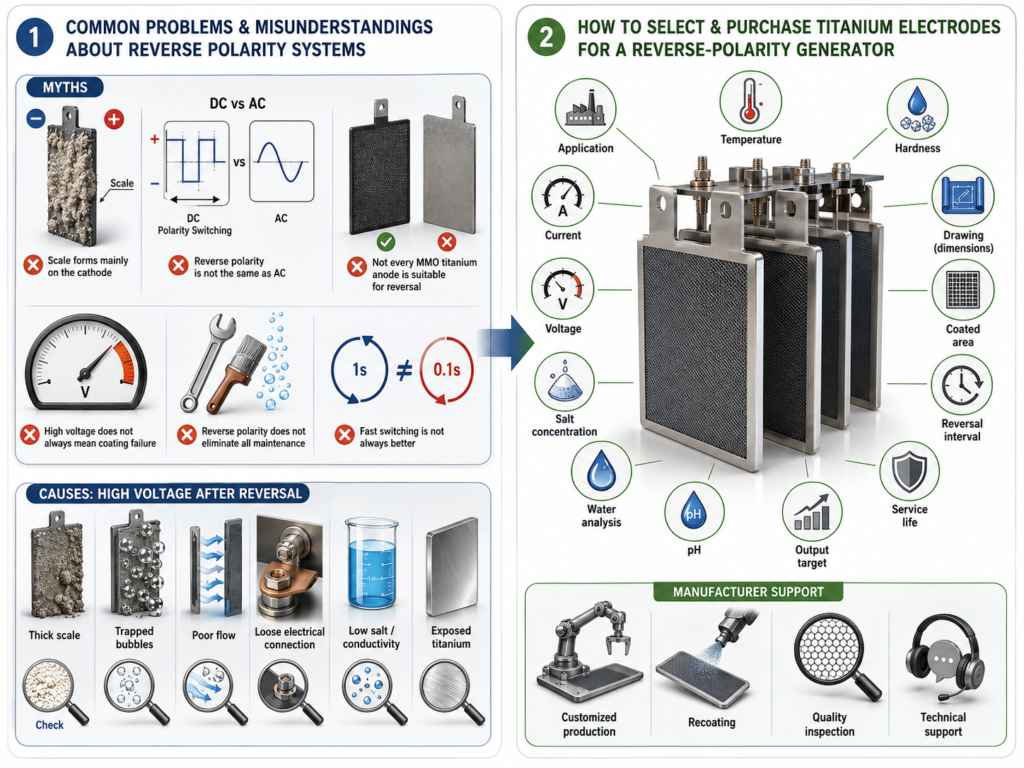
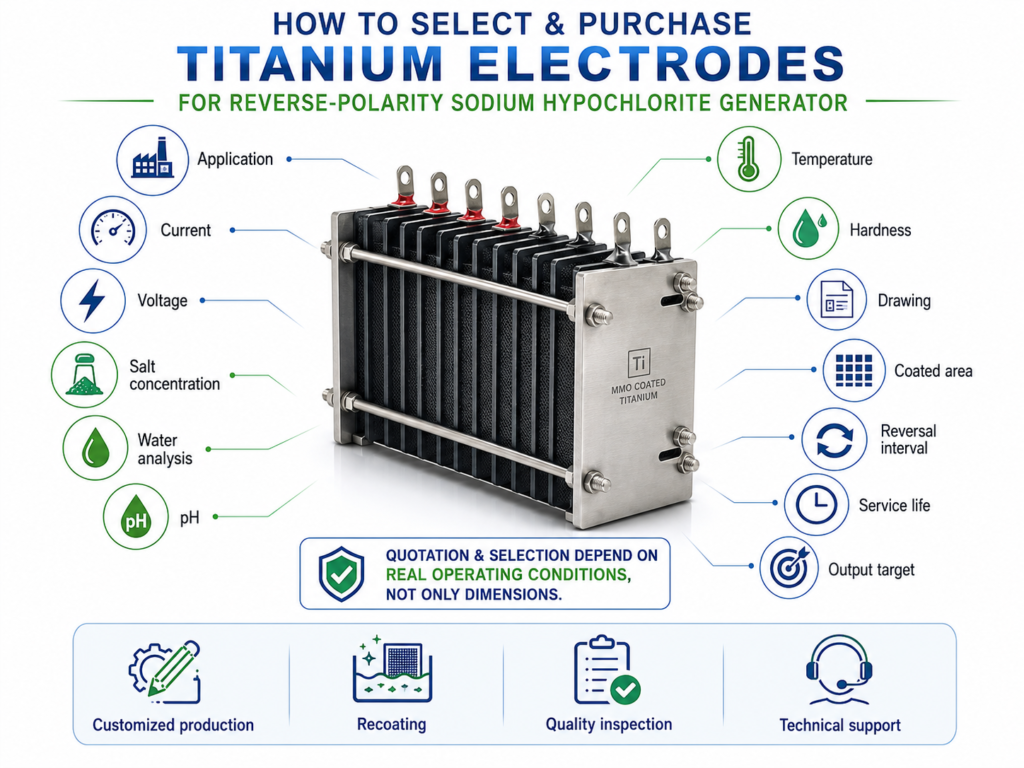
9. How to Select Titanium Electrodes for Reverse-Polarity Generators
A professional electrode supplier needs more than electrode dimensions.
Important information includes:
Application
● Sodium hypochlorite generation
● Electrochlorination
● Swimming pool disinfection
● Wastewater treatment
● Industrial water treatment
Electrical parameters
● Operating current
● Maximum current
● Voltage
● Current density
● Power supply type
● Reversal cycle
Water conditions
● Salt concentration
● Conductivity
● pH
● Temperature
● Calcium
● Magnesium
● Total hardness
Electrode information
●Drawing
● Size
● Quantity
● Electrode structure
● Coated area
● Single-side or double-side coating
● Expected lifetime
Operating requirements
● Chlorine output
● Daily running hours
● Maintenance cycle
● Existing problems
The correct electrode design depends on actual operating conditions, not only product dimensions.
10. How Ehisen Supports Sodium Hypochlorite Generator Projects
Ehisen specializes in customized noble-metal-coated titanium electrodes for:
● Sodium hypochlorite generators
● Electrochlorination systems
● Water treatment applications
● Industrial electrochemical processes
Products include:
● Ru-Ir coated titanium plates
● Titanium mesh electrodes
● Titanium tube electrodes
● Multi-plate electrode assemblies
● Reverse-polarity titanium electrodes
Our technical evaluation considers:
● Salt concentration
● Current density
● Water hardness
● Temperature
● Electrode structure
● Reversal cycle
● Expected lifetime
Manufacturing processes include:
● Titanium substrate inspection
● Surface preparation
● Controlled coating application
● Thermal treatment
● Dimensional inspection
● Coating quality inspection
For a quotation, please provide:
● Electrode drawing
● Quantity
● Operating current
● Voltage
● Salt concentration
● Water analysis
● Operating temperature
● Reversal interval
● Expected service life
● Current problems
A correctly designed titanium electrode is the foundation of stable sodium hypochlorite generation.