

Gravure cylinder electroplating is an important part of the cylinder manufacturing process. Copper plating creates the metallic surface required for engraving, while chromium plating protects the engraved cylinder against wear during printing.
In these electroplating processes, the anode does more than complete the electrical circuit. Its material, active coating, geometry, effective area, and position relative to the cylinder can all influence the electrochemical reaction and current distribution.
For gravure cylinder plating systems using insoluble electrodes, coated titanium anodes, including Ir-Ta MMO titanium anodes and platinized titanium (Pt/Ti) anodes, can provide dimensionally stable and customizable electrode solutions.
This guide explains how anodes work in gravure cylinder copper and chrome plating, the difference between soluble and insoluble anodes, how coated titanium anodes function, why anode geometry matters, and what information should be considered when selecting a titanium anode for a plating line.

1. How Does Gravure Printing Work and Why Does the Cylinder Need Electroplating?
Gravure printing is based on an engraved printing cylinder.
Unlike printing processes in which the image is carried on a raised surface, gravure printing uses thousands of microscopic recessed cells engraved into the surface of the cylinder.
During printing, these cells hold ink. Excess ink is removed from the non-image surface, while the ink remaining inside the engraved cells is transferred to the printing material.
This means the surface quality of the cylinder is extremely important.
Before engraving, the cylinder needs a surface that can be accurately machined and engraved. After engraving, that surface must also withstand repeated mechanical contact during printing.
This is why electroplating plays two important roles in gravure cylinder manufacturing.
A copper layer is normally applied before engraving.
Copper provides a suitable metallic surface for producing the fine cells required for the printing image.
The quality and uniformity of this copper layer therefore affect the subsequent engraving and finishing processes.
After engraving, the cylinder surface requires additional protection.
A hard chromium layer is commonly applied over the engraved copper surface to improve wear resistance during printing.
The simplified manufacturing sequence can therefore be expressed as:
Cylinder Preparation → Copper Plating → Surface Finishing → Engraving → Chromium Plating → Final Finishing → Printing
Copper plating and chromium plating have different purposes and different electrochemical requirements.
This distinction is important when discussing anode selection.
An anode suitable for one plating process should not automatically be assumed to be suitable for another.

2. How Does Electroplating Work in Gravure Cylinder Manufacturing?
Electroplating is an electrochemical process in which electrical current drives a reaction that deposits a metallic layer onto a conductive surface.
In a gravure cylinder plating tank, the basic system includes:
DC Power Supply + Anode + Electrolyte + Gravure Cylinder Cathode
The gravure cylinder is connected as the cathode, while the anode is connected to the positive side of the DC power supply.
When current passes through the system, electrochemical reactions occur at both electrode surfaces.
At the cathode, metal-containing species in the electrolyte are reduced and metal is deposited onto the cylinder surface.
The exact anodic reaction depends on the plating chemistry and the type of anode being used.
This is one reason anode selection cannot be separated from bath chemistry.
The Anode Influences More Than the Electrical Circuit
From a practical engineering perspective, several anode-related factors can influence the plating process:
● anode material;
● active coating;
● effective anode area;
● anode current density;
● anode geometry;
● anode-cathode distance;
● position relative to the cylinder;
● electrical connection;
● electrolyte circulation around the electrode.
For a cylindrical cathode, geometry becomes especially important.
If the electrode gap varies significantly around the cylinder, the electrical field and current distribution can also vary.
For this reason, gravure cylinder electroplating should be considered as an electrochemical system, rather than simply a tank containing an anode and a cathode.

3. What Is the Role of the Anode in Copper and Chrome Plating?
The role of the anode depends strongly on whether the plating system uses a soluble anode or an insoluble anode.
This difference is particularly important when comparing copper plating and chromium plating.
Conventional acid copper plating commonly uses soluble copper anodes, including phosphorized copper anodes.
The simplified anodic reaction is:
Cu → Cu²⁺ + 2e⁻
At the cylinder surface, the cathodic reaction can be simplified as:
Cu²⁺ + 2e⁻ → Cu
The copper anode therefore performs two functions.
First, it participates in the electrochemical circuit.
Second, it dissolves and helps replenish the copper consumed from the electrolyte during cathodic deposition.
This is fundamentally different from an insoluble titanium anode.
A coated titanium anode does not normally act as the copper source.
Instead, the active coating supports the required anodic reaction while copper ions are deposited at the cathode.
Therefore:
Copper Deposition ≠ Copper Dissolution from the Titanium Anode
If an insoluble anode is introduced into a copper plating process, copper-ion concentration must be managed through an appropriate replenishment system.
This is an important engineering distinction.
An MMO titanium anode should therefore not be presented as a simple one-for-one replacement for a soluble copper anode without considering the entire plating process.
Chromium plating also requires an anodic reaction, but the chemistry is different from conventional copper plating.
Historically, lead-alloy insoluble anodes have been widely associated with chromium plating systems.
In suitable systems, coated titanium anodes may also be considered.
However, compatibility depends on factors such as:
Electrolyte Chemistry + Anodic Reaction + Current Density + Temperature + Voltage + Required Service Life
Therefore, saying that a titanium anode is suitable for "chrome plating" is not enough.
The actual chromium plating chemistry and operating conditions should be evaluated before selecting the coating system.
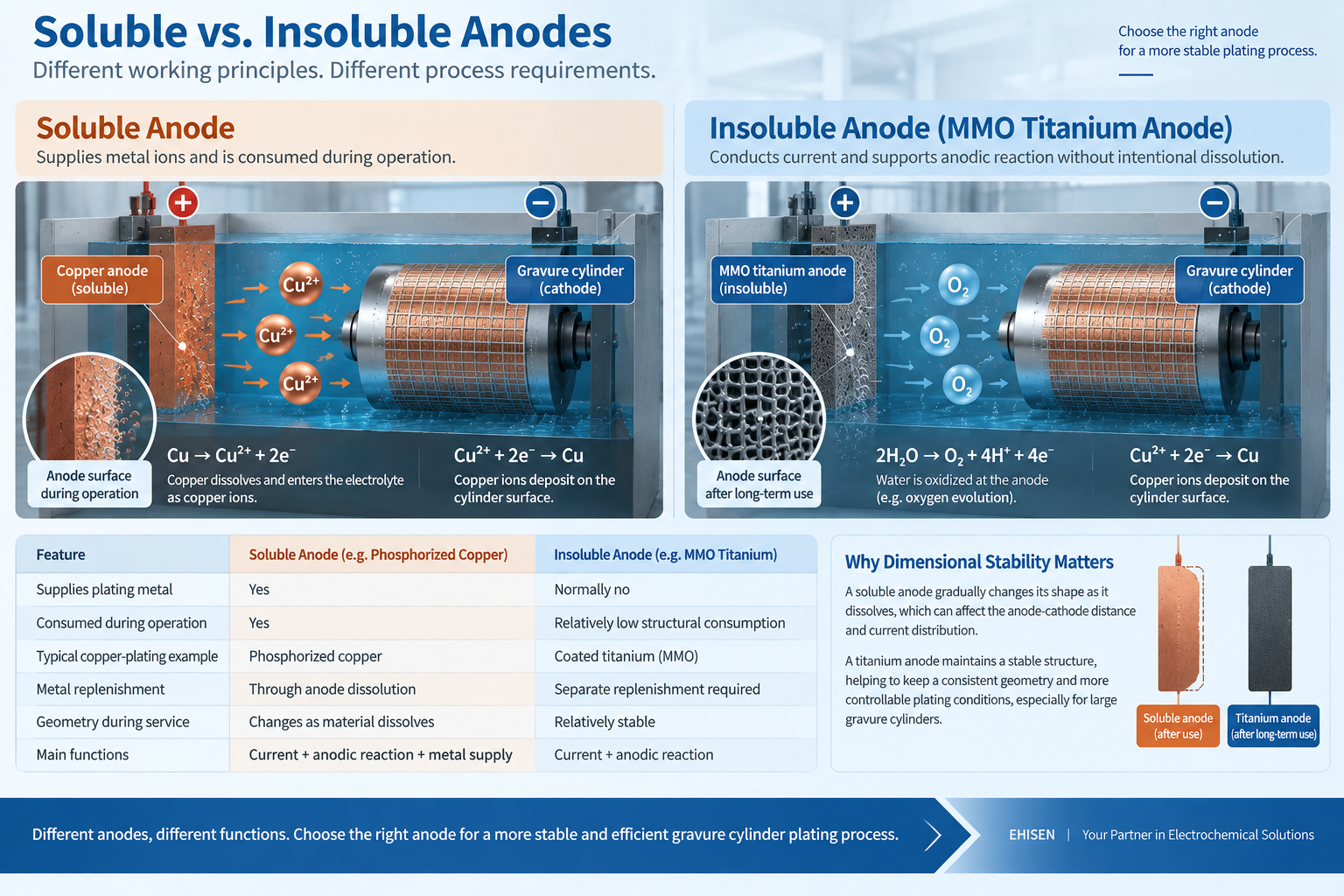
4. Soluble vs. Insoluble Anodes: What Is the Difference?
The distinction between soluble and insoluble anodes is one of the most important concepts when evaluating titanium anodes for electroplating.
A soluble anode intentionally participates in the electrochemical reaction by dissolving into the electrolyte.
In copper plating, the copper anode is gradually consumed while supplying copper ions to the solution.
Its geometry therefore changes over time.
The electrode is both:
An Electrochemical Component + A Source of Plating Metal
An insoluble anode works differently.
Instead of intentionally supplying the plating metal, it provides an active surface for the required anodic reaction.
A coated titanium anode typically consists of:
Titanium Structure + Electrocatalytically Active Coating
The titanium provides mechanical support and current conduction, while the coating provides the active electrochemical interface.
Because the electrode is not designed to dissolve in the same way as a soluble metal anode, its geometry can remain more stable during operation.
This is why coated titanium anodes are often described as dimensionally stable electrodes.
In many electroplating systems, electrode position affects current distribution.
If a consumable anode gradually changes shape, the relationship between the anode and cathode also changes.
A dimensionally stable titanium structure makes it possible to design a more consistent electrode geometry.
For gravure cylinder plating, this is particularly useful because the cathode has a large cylindrical surface.
A curved or segmented titanium anode can be designed to follow the cylinder profile and maintain a more controlled electrode gap.
However, dimensional stability does not mean that an insoluble anode can operate indefinitely.
The active coating still has a finite service life, and its performance depends on coating specification and operating conditions.

5. Why Does Anode Geometry Affect Gravure Cylinder Plating Uniformity?
Anode material is important, but anode geometry can be equally important in a gravure cylinder plating system.
Consider a large cylindrical cathode positioned next to a flat anode.
The distance between the two electrode surfaces may vary across the plating area.
This can affect local electrical resistance and current distribution.
The distance between the anode and cathode is one of the important design variables in an electroplating cell.
For a cylindrical workpiece, maintaining a controlled gap can be more difficult than with two parallel flat electrodes.
A curved anode can be designed to follow the cylinder contour more closely.
The basic relationship is:
Cylinder Diameter → Anode Curvature
A properly designed curved structure can provide more controlled spacing around the effective plating area.
Cylinder length also matters.
The effective anode area should correspond appropriately to the area of the cylinder being plated.
This can be simplified as:
Cylinder Length → Effective Anode Length
Edge areas may require additional attention because current distribution near the ends of the cylinder can differ from the central area.
Depending on the equipment design, shielding, segmented anodes, or auxiliary electrodes may be used to help manage these regions.
The relationship between current and active electrode area is another important parameter:
Current Density = Operating Current ÷ Effective Active Area
Simply increasing the physical size of a titanium structure does not automatically improve electrochemical performance.
The effective coated area and operating current must be considered together.
This is why anode drawings should ideally be reviewed together with electrical and process parameters.

6. Ir-Ta MMO vs. Pt/Ti Anodes in Electroplating: How Do They Work?
For electroplating systems using coated titanium anodes, two important technologies are:
Iridium-Tantalum MMO (Ir-Ta) Titanium Anodes
and
Platinized Titanium (Pt/Ti) Anodes
Both use titanium as a dimensionally stable structural substrate, but their active surfaces are different.
This difference affects their electrochemical behavior, coating specification, applicable operating conditions, and cost structure.
The correct question is therefore not simply:
"Should I choose MMO or platinum?"
A more useful question is:
"Which active coating is compatible with my electrolyte and required anodic reaction?"
6.1 How Ir-Ta MMO Titanium Anodes Work
An Ir-Ta MMO titanium anode uses an iridium-tantalum mixed metal oxide coating as its active surface.
In electroplating systems where oxygen evolution is an important anodic reaction, Ir-Ta MMO can provide an electrocatalytically active interface.
The process can be simplified as:
Ir-Ta MMO Surface → Anodic Oxidation / Oxygen Evolution
↓
Electrical Current Through the Cell
↓
Cathodic Reaction → Metal Deposition
The titanium underneath provides the mechanical structure and current pathway.
The Ir-Ta MMO coating provides the electrochemical interface with the electrolyte.
This separation between mechanical and electrochemical functions provides considerable design flexibility.
Advantages of Ir-Ta MMO in Electroplating
For suitable electroplating conditions, potential engineering advantages include:
Stable Electrode Geometry
The titanium structure is not intentionally consumed like a soluble copper anode. This allows the electrode geometry to remain more stable during operation.
Customized Electrode Shape
Titanium can be fabricated into mesh, plate, tube, curved sections, segmented structures, and welded assemblies.
This is useful for gravure cylinder plating systems requiring an electrode profile that follows the cylinder.
Controlled Active Area
The active coating can be applied according to the required electrochemical area rather than simply relying on the overall physical size of the electrode.
Suitability for Oxygen-Evolution Conditions
Ir-Ta MMO systems are particularly associated with electrochemical environments where oxygen evolution is important.
Recoating Potential
When the titanium substrate remains mechanically suitable, it may be possible to remove the exhausted coating, recondition the substrate, and apply a new active coating.
This should always be evaluated case by case.
6.2 How Pt/Ti Anodes Work
A platinized titanium anode, or Pt/Ti anode, uses metallic platinum as the active electrochemical surface.
Its structure can be simplified as:
Titanium Substrate + Platinum Active Layer
Platinum is not an MMO coating.
This distinction is important for both technical specifications and purchasing.
During operation, current is conducted through the titanium substrate to the platinum surface, where the required anodic electrochemical reaction occurs.
Like Ir-Ta MMO electrodes, Pt/Ti electrodes can be manufactured in many geometries:
● plate;
● mesh;
● tube;
● rod;
● wire;
● curved electrode;
● segmented structure;
● customized welded assembly.
This allows Pt/Ti anodes to be integrated into electroplating equipment with specific mechanical requirements.
Advantages of Pt/Ti in Electroplating
In suitable electrochemical environments, Pt/Ti offers several useful characteristics.
Platinum provides a noble-metal active surface with high electrochemical stability in many compatible conditions.
At the same time, using titanium as the substrate avoids manufacturing the complete electrode from bulk platinum.
The electrode can also maintain a stable geometry and be designed around the plating equipment.
For gravure cylinder systems, a Pt/Ti anode can therefore combine:
Platinum Electrochemical Surface + Customized Titanium Structure
Platinum Thickness Is an Important Specification
One of the most important differences when purchasing Pt/Ti electrodes is the platinum specification.
Two Pt/Ti anodes may:
have the same titanium dimensions;
use the same mesh;
have the same curved structure;
look almost identical;
but contain very different amounts of platinum.
A meaningful Pt/Ti specification should therefore include:
Titanium Substrate + Effective Coated Area + Pt Thickness/Loading + Coating Location
This is particularly important when comparing quotations.
A lower-priced Pt/Ti anode should not automatically be assumed to be equivalent unless the platinum specification is also comparable.
6.3 Ir-Ta MMO or Pt/Ti: Which Is Better?
Neither coating is universally "better."
They are different electrochemical technologies.
A simplified comparison is:
| Factor | Ir-Ta MMO | Pt/Ti |
|---|---|---|
| Active surface | Iridium-tantalum mixed metal oxide | Metallic platinum |
| Titanium substrate | Yes | Yes |
| Dimensionally stable structure | Yes | Yes |
| Custom geometry | Yes | Yes |
| Curved/segmented structures | Yes | Yes |
| Oxygen-evolution applications | Commonly considered | Depends on operating conditions |
| Main coating specification | Chemistry and precious-metal loading | Pt thickness/loading |
| Supplies plating metal | Normally no | Normally no |
| Recoating | Potentially possible | Potentially possible |
The selection process should therefore begin with:
Electrolyte Composition
↓
Dominant Anodic Reaction
↓
Operating Current & Current Density
↓
Temperature & Voltage
↓
Electrode Geometry & Gap
↓
Required Service Life
↓
Coating Selection
Do not select Ir-Ta simply because it is an MMO coating.
Do not select Pt simply because platinum is a noble metal.
The active coating should match the electrochemical process.

7. Titanium Anodes vs. Copper, Lead Alloy and Graphite Anodes
Different electroplating processes have historically used different anode materials.
There is no single anode material that is automatically best for every plating bath.
The correct comparison depends on what function the electrode is expected to perform.
In conventional copper plating, soluble copper anodes have an important advantage:
they replenish copper ions while current passes through the cell.
This function cannot simply be ignored when considering an insoluble titanium anode.
A titanium anode may provide dimensional stability, but a copper replenishment strategy is still required.
Therefore, the comparison is not simply:
Copper vs. Titanium
It is:
Soluble-Anode Process vs. Insoluble-Anode Process
That is a much more meaningful engineering comparison.
Lead-alloy insoluble anodes have historically been used in some electroplating applications, including chromium plating.
A coated titanium anode offers a different electrode concept: a fabricated titanium structure combined with an engineered active coating.
One potential advantage is the ability to create precise mesh, curved, segmented, or customized electrode structures.
However, replacement should only be considered after evaluating compatibility with the actual bath chemistry.
Graphite is another traditional electrode material used in selected electrochemical processes.
Compared with graphite, a coated titanium structure provides different mechanical characteristics and can be fabricated into thinner, curved, mesh, or welded assemblies.
Again, this does not mean titanium is universally superior.
The appropriate choice depends on:
Process Chemistry + Required Reaction + Mechanical Design + Current Density + Maintenance Requirements
For procurement, this process-based comparison is more useful than comparing electrode materials only by purchase price.

8. Where Can Titanium Anodes Be Used in Gravure Cylinder Electroplating?
Coated titanium anodes can be considered in several areas of gravure cylinder plating, depending on the process design.
In copper plating systems designed around insoluble anodes, coated titanium electrodes can provide a stable anodic structure.
Because the titanium anode does not supply the deposited copper, the system must separately maintain copper-ion concentration.
This type of application therefore requires consideration of both:
Anode Electrochemistry + Bath Replenishment
Coated titanium anodes may also be evaluated for chromium plating where the active coating is compatible with the specific electrolyte and anodic reaction.
The coating should not be selected simply because the application is called "chrome plating."
Actual bath composition, current density, temperature, voltage, and expected service conditions should be reviewed.
Titanium-based electrodes can also be manufactured as auxiliary anodes for areas where current distribution requires additional control.
Because titanium is highly fabricable, these electrodes can be designed into relatively specific shapes and positioned according to the equipment geometry.
New gravure cylinder plating equipment provides an opportunity to consider electrode geometry at the design stage rather than trying to fit a new electrode into an existing arrangement.
The equipment designer can evaluate:
Cylinder Diameter → Anode Curvature
Cylinder Length → Active Electrode Length
Operating Current → Required Active Area
Bath Chemistry → Active Coating
Equipment Layout → Electrical Connection and Mounting
This integrated approach can be particularly useful for customized plating lines.

9. How to Select a Titanium Anode for Gravure Cylinder Plating
A mechanical drawing is important when manufacturing a customized anode, but it does not provide enough information to select the correct coating.
For a meaningful technical evaluation, the supplier should understand both the mechanical requirements and electrochemical operating conditions.
1. Plating Application
First define the actual process.
Is the electrode intended for:
copper plating;
chromium plating;
an auxiliary electrode;
another electroplating process?
The application provides the first indication of the required electrochemical reaction.
2. Electrolyte Composition
Provide as much information as possible about the bath, including:
main metal-containing species;
concentration;
acid concentration;
pH where relevant;
chloride or other important ions;
additives where relevant.
The electrolyte directly affects coating compatibility.
3. Operating Current and Current Density
Both normal operating current and maximum current are useful.
If the effective electrode area is known, current density can be evaluated.
This is important because coating requirements should be considered relative to the electrical load placed on the active surface.
4. Operating Temperature
Provide both typical and maximum bath temperature where possible.
Temperature can affect electrochemical reaction rates and electrode operating conditions.
5. Cylinder Dimensions
For a gravure cylinder system, important dimensions include:
Cylinder Diameter + Total Length + Effective Plating Length
These dimensions help determine anode curvature, effective length, and overall structure.
6. Anode-Cathode Distance
The required electrode gap is an important design parameter.
If an existing system already has a defined gap, this should be included in the technical information.
7. Existing Anode Information
For an existing plating line, information about the current electrode is extremely useful.
This may include:
● anode material;
● dimensions;
● drawings;
● photographs;
● typical operating voltage;
● service life;
● failure mode;
● used electrode sample where available.
A used anode can sometimes provide valuable information about actual operating conditions and failure patterns.
8. Electrical Connection
The electrode must also integrate correctly with the existing power supply and busbar system.
Connection position, current-carrying requirements, mounting arrangement, and contact design should therefore be considered during fabrication.
9. Operating Schedule
Is the plating line operated:
continuously;
intermittently;
in multiple shifts;
with frequent start-stop cycles?
Also clarify whether the anode remains immersed when the power is switched off.
These operating details can be relevant when evaluating electrode service conditions.
10. Existing Process Problems
If the purpose of changing the electrode is to solve an existing problem, describe the problem directly.
Examples may include:
● short electrode life;
● uneven plating;
● changing anode geometry;
● unstable operating voltage;
● difficult electrode-gap control;
● frequent maintenance;
● contamination concerns;
● need for a customized shape.
This helps ensure the new electrode is designed around the actual objective rather than simply reproducing the old dimensions.
11. Expected Service Life
If the project has a service-life target, it should be discussed together with current density and coating specification.
Service life cannot be evaluated meaningfully from dimensions alone.
Final Thoughts: Select the Anode for the Process, Not Just the Drawing
For gravure cylinder electroplating, the anode should not be treated simply as a fabricated titanium component.
Its performance depends on the interaction between:
Electrolyte + Anodic Reaction + Active Coating + Active Area + Current Density + Geometry + Electrode Gap + Operating Conditions
For copper plating, it is also essential to distinguish between soluble-anode and insoluble-anode process concepts.
For coated titanium anodes, Ir-Ta MMO and Pt/Ti provide different active surfaces and should be selected according to the actual electrochemical environment.
At the same time, gravure cylinder geometry makes mechanical design particularly important.
A well-designed electrode therefore combines:
Correct Titanium Structure + Correct Active Area + Correct Coating System + Correct Current Density
The objective is not simply to manufacture a titanium anode that fits inside the plating tank.
It is to develop an electrode that fits the electrochemical process.
Need a Titanium Anode for Your Gravure Cylinder Plating Line?
Ehisen develops customized Ir-Ta MMO titanium anodes and platinized titanium (Pt/Ti) anodes for industrial electrochemical and electroplating applications.
For an initial technical evaluation, you can provide:
Plating Application + Electrolyte + Operating Current + Temperature + Cylinder Dimensions + Electrode Gap + Existing Anode Information + Drawing or Photos
Based on these operating conditions, the electrode structure, effective active area, coating system, and coating specification can be evaluated together.
Operating Conditions → Electrochemical Analysis → Coating Selection → Anode Design → Prototype → Testing → Production