

Overview
Cathodic protection is an electrochemical corrosion-control method used to protect buried pipelines, storage tanks, marine structures, reinforced concrete, industrial water equipment, and other metal assets exposed to conductive environments.
The basic principle is to make the protected metal structure behave as the cathode of an electrochemical system. In an impressed current cathodic protection system, an external DC power supply sends current from an auxiliary anode through soil, water, concrete, or another electrolyte to the protected steel structure. This reduces oxidation on the steel surface and helps control corrosion.
MMO coated titanium anodes are widely used in impressed current systems because they combine a dimensionally stable titanium substrate with an electrochemically active mixed metal oxide coating. However, selecting the correct cathodic protection anode requires more than choosing a shape. The operating environment, coating chemistry, required current output, installation method, protected structure, and electrical connection design must all be considered.
This guide explains the principle of cathodic protection, the roles of anodes and cathodes, the differences between Ir-Ta and Ru-Ir coatings, and the typical applications of MMO tube anodes, flexible anodes, MMO tape, probe anodes, and titanium anode wires.
1. What Is Cathodic Protection?
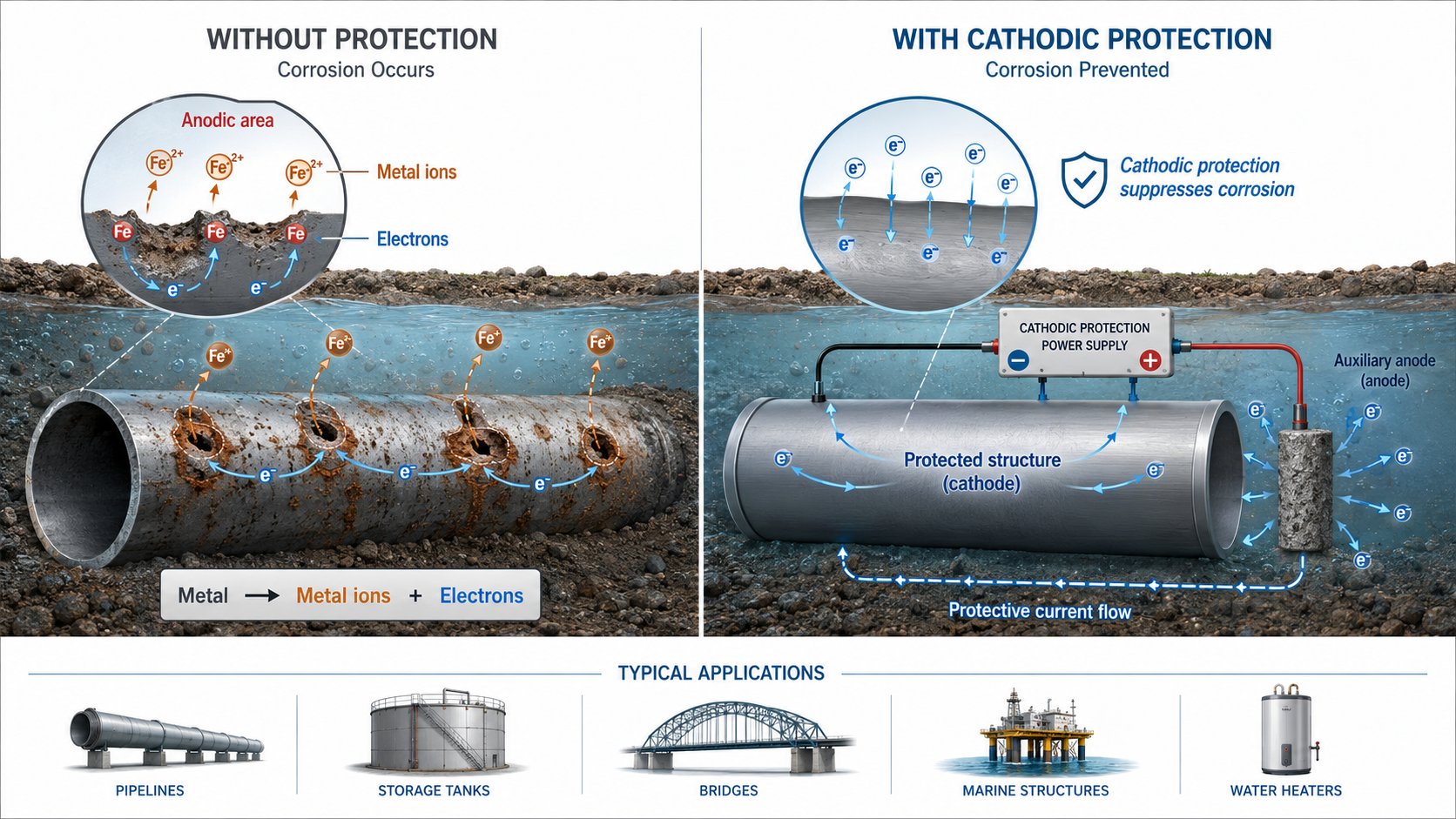
Metal corrosion is fundamentally an electrochemical process.
When a steel pipeline, storage tank, bridge, marine structure, or water heater contacts an electrolyte such as soil, freshwater, seawater, or moist concrete, small electrochemical cells can form on the metal surface.
Some areas become anodic areas, where metal atoms lose electrons and enter the surrounding environment as metal ions. Other areas become cathodic areas, where reduction reactions occur.
The corrosion reaction can be simplified as:
Metal → Metal ions + Electrons
At the anodic area, metal is gradually lost. Electrons move through the metal structure, while ions move through the surrounding electrolyte. If the process continues, the structure may develop:
● Surface rust
● Pitting corrosion
● Wall-thickness reduction
● Coating damage
● Localized perforation
● Mechanical weakening
Cathodic protection changes this electrochemical balance.
Instead of allowing parts of the protected structure to remain anodic, the system supplies electrons or protective current to the structure, forcing it to behave as a cathode.
The objective is not to make the steel physically harder or chemically stronger. The purpose is to change its electrochemical condition so that oxidation is reduced.
Cathodic protection is commonly used where complete isolation from moisture, salts, or chemicals is difficult. It is often combined with protective coatings because coating and cathodic protection perform different functions.
A coating creates a physical barrier between the metal and the environment. Cathodic protection provides electrochemical control at coating defects, exposed areas, joints, scratches, and other locations where the steel may still contact the electrolyte.
2. Why Is It Called Cathodic Protection?
The terms anode and cathode describe electrochemical roles.
In a corrosion cell:
● The anode is where oxidation occurs.
● The cathode is where reduction occurs.
● Corrosion-related metal loss mainly occurs at anodic areas.
Cathodic protection is named according to the role of the protected structure. The steel pipeline, tank, reinforced bar, or marine component is deliberately made the cathode.
The anode in the protection system supplies the required current or electrons. It is not the structure being protected.
There are two main cathodic protection methods.
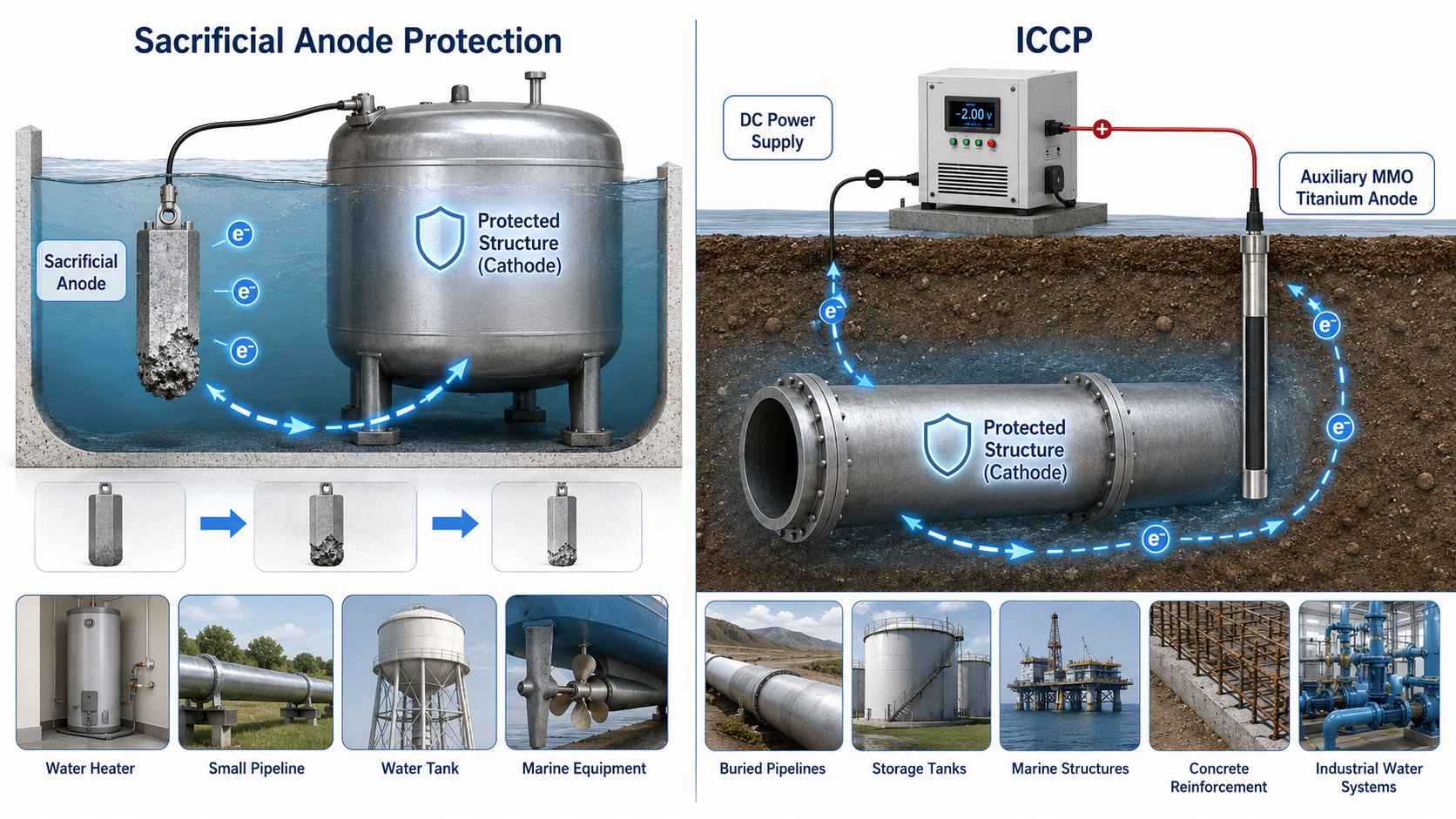
2.1 Sacrificial Anode Protection
Sacrificial anode systems use a metal that is more electrochemically active than the protected steel.
Common materials include:
● Magnesium alloys
● Zinc alloys
● Aluminum alloys
The sacrificial anode is electrically connected to the protected structure. Because it has a stronger tendency to oxidize, it releases electrons and is gradually consumed instead of the steel.
This method has several advantages:
● No external DC power supply is required.
● The system structure is relatively simple.
● Installation can be convenient for small assets.
● Maintenance and monitoring requirements may be lower for basic applications.
Typical applications include:
● Small pipelines
● Water tanks
● Marine components
● Underground containers
● Household water heaters
The main limitation is that the sacrificial anode is consumed during operation. Its mass decreases over time, so inspection and eventual replacement are necessary.
Sacrificial systems also provide a limited driving voltage. For large structures, long pipelines, high-resistance soil, or projects requiring adjustable current output, an impressed current system may be more suitable.
2.2 Impressed Current Cathodic Protection
Impressed current cathodic protection, commonly abbreviated as ICCP, uses an external DC power supply.
A typical system includes:
● DC rectifier or controlled power supply
● Auxiliary anode
● Protected metal structure
● Cables and electrical connections
● Reference electrodes
● Monitoring and control equipment
The general current path is:
DC Power Supply → Auxiliary Anode → Electrolyte → Protected Structure → Power Supply
The auxiliary anode is connected to the positive output of the power supply, while the protected structure is connected to the negative side.
Current leaves the anode, passes through soil, water, concrete, or another electrolyte, and reaches the protected structure. The structure therefore operates as the cathode.
ICCP is commonly selected for:
● Long buried pipelines
● Large storage tanks
● Port structures
● Offshore facilities
● Reinforced concrete
● Industrial water systems
● Structures requiring controllable protection current
Unlike a sacrificial anode, an MMO coated titanium anode is designed to operate as a relatively stable auxiliary electrode. It does not protect the steel by rapidly consuming its full metal body. Instead, its coating provides the active electrochemical surface needed to transfer current into the environment.
3. The Role of MMO Titanium Anodes in Cathodic Protection
A common question is:
If the product is called an anode, why does it protect the cathode?
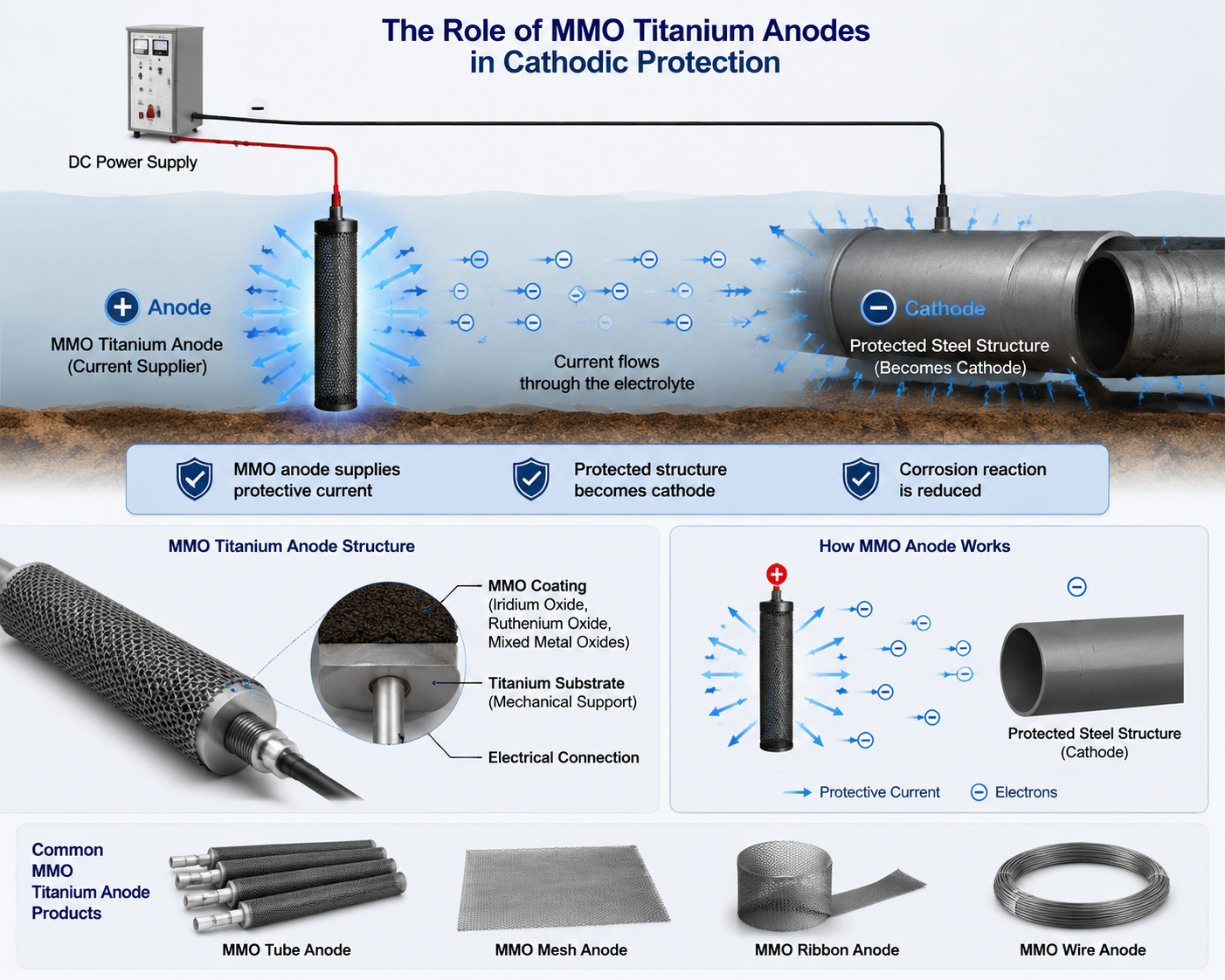
The MMO titanium anode is the anode in the electrical and electrochemical circuit. Its function is to deliver current into the electrolyte.
The steel structure receives that current and becomes the cathode. As a result, oxidation and metal loss on the protected steel are reduced.
The functional relationship can be summarized as:
● MMO titanium anode: supplies electrochemical current
● Electrolyte: carries ionic current
● Protected structure: becomes the cathode
● Corrosion reaction: is controlled or reduced
An MMO titanium anode usually contains two important parts.
Titanium Substrate
The titanium substrate provides:
● Mechanical strength
● Dimensional stability
● Fabrication flexibility
● Corrosion-resistant support
● A suitable base for the active coating
Titanium can be manufactured into tubes, mesh, ribbon, strip, wire, plates, and customized structures.
However, bare titanium alone is not normally the active working surface required for an ICCP anode. The electrochemical function is provided by the coating.
MMO Coating
MMO means mixed metal oxide.
The coating may contain oxides based on:
● Iridium
● Ruthenium
● Tantalum
● Other selected metal-oxide components
The coating is applied to a prepared titanium surface and then thermally treated to form an active oxide layer.
Its main functions include:
● Providing electrochemical activity
● Supporting current transfer
● Improving stability under operating conditions
● Controlling the dominant anode reaction
● Allowing the titanium substrate to work as a dimensionally stable anode
The substrate and coating must work together. A high-quality coating applied to a poorly prepared titanium surface may have weak adhesion. A well-machined substrate with an unsuitable coating may also fail to meet the project requirements.
For this reason, coating selection, surface preparation, thermal treatment, and quality inspection are all important.
4. Why Different Environments Require Different MMO Coatings
Cathodic protection systems operate in very different environments.
Soil may vary in moisture, resistivity, pH, salt content, and contamination. Freshwater normally contains less chloride than seawater. Marine environments contain high levels of chloride and may also involve strong water movement, oxygen variation, and biological activity. Concrete presents another electrochemical environment with its own moisture and ion-transport characteristics.
Therefore, one coating formula should not automatically be used for every project.
The coating system should be selected by evaluating:
● Electrolyte composition
● Chloride concentration
● pH
● Conductivity or resistivity
● Expected anode reaction
● Required current density
● Operating voltage
● Installation configuration
● Project service requirements
Two common coating categories for titanium anodes are Ir-Ta and Ru-Ir.
5. Ir-Ta Coated Titanium Anodes for Soil, Freshwater and Concrete
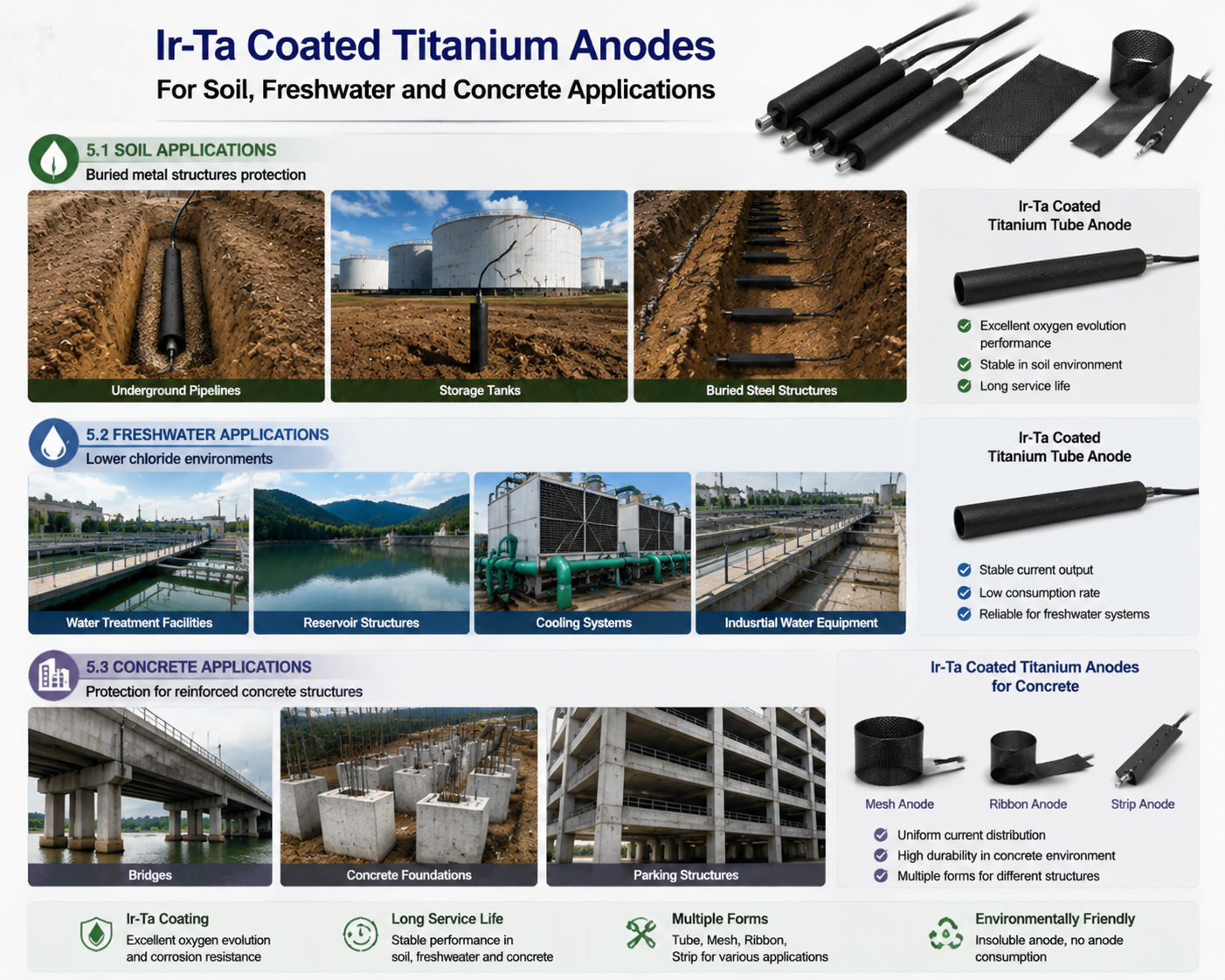
Iridium-tantalum coated titanium anodes are commonly considered for applications where oxygen evolution behavior and stability are important.
Typical application environments include:
● Soil
● Freshwater
● Fine sand
● Reinforced concrete
● Certain industrial water conditions
The final coating design should still be based on actual operating data rather than the environmental name alone.
5.1 Soil Cathodic Protection
Buried pipelines, tanks, and steel foundations are exposed to complex soil conditions.
Soil may contain:
● Moisture
● Dissolved salts
● Organic material
● Industrial pollutants
● Different resistivity zones
● Local pH variations
● Uneven oxygen availability
Even along one pipeline route, soil conditions may change significantly.
Common protected structures include:
● Natural gas pipelines
● Oil pipelines
● Water transmission lines
● Buried storage tanks
● Underground steel structures
● Industrial piping networks
MMO tube anodes are often installed in prepared groundbeds with conductive backfill. Flexible anodes may also be installed parallel to pipelines or around large buried structures to improve current distribution.
For soil projects, the supplier should understand:
● Soil resistivity
● Groundbed design
● Anode depth
● Cable length
● Required current output
● Number of anodes
● Expected current distribution
● Backfill and installation method
Ir-Ta coatings are frequently considered for oxygen-evolution conditions and soil-based impressed current applications. However, acidic soil, chloride-rich contamination, or unusual chemical exposure may require a different coating design.
5.2 Freshwater Applications
Freshwater generally has a lower chloride concentration than seawater, but its actual chemistry can vary.
Freshwater applications may include:
● Reservoir structures
● Water-treatment facilities
●Cooling-water systems
● Industrial water tanks
● Intake structures
● Process-water equipment
Because freshwater may have lower conductivity, the anode arrangement and operating voltage require careful evaluation.
A supplier should review:
● Water conductivity
● Chloride content
● Temperature
● Flow conditions
● Required current
● Anode-to-structure distance
● Available installation space
Ir-Ta coated titanium anodes may be suitable where oxygen evolution is the main anode reaction and long-term stability is required.
Possible product forms include:
● Tube anodes
● Mesh anodes
● Plate anodes
● Ribbon anodes
● Custom assemblies
5.3 Reinforced Concrete Protection
Steel reinforcement in sound concrete is normally protected by the alkaline concrete environment.
However, corrosion can begin when aggressive substances penetrate the concrete. Common causes include:
● Chloride ingress
● Carbonation
● Water penetration
● Cracks
● Deicing salts
● Marine exposure
● Construction defects
Corrosion products occupy more volume than the original steel and may create internal pressure. This can contribute to cracking, delamination, and spalling of the concrete cover.
Cathodic protection may be used to reduce corrosion activity in reinforced concrete structures such as:
● Bridges
● Bridge columns
● Concrete foundations
● Parking structures
● Tunnels
● Industrial buildings
● Marine concrete facilities
MMO anodes for concrete may be manufactured as:
● Mesh
● Ribbon
● Tape
● Strip
● Flexible anode
● Customized embedded elements
The objective is to distribute current across the reinforcing steel while integrating the anode with the repair mortar, overlay, or concrete structure.
For concrete projects, anode placement and electrical continuity are as important as the coating itself.
For concrete projects, anode placement and electrical continuity are as important as the coating itself.
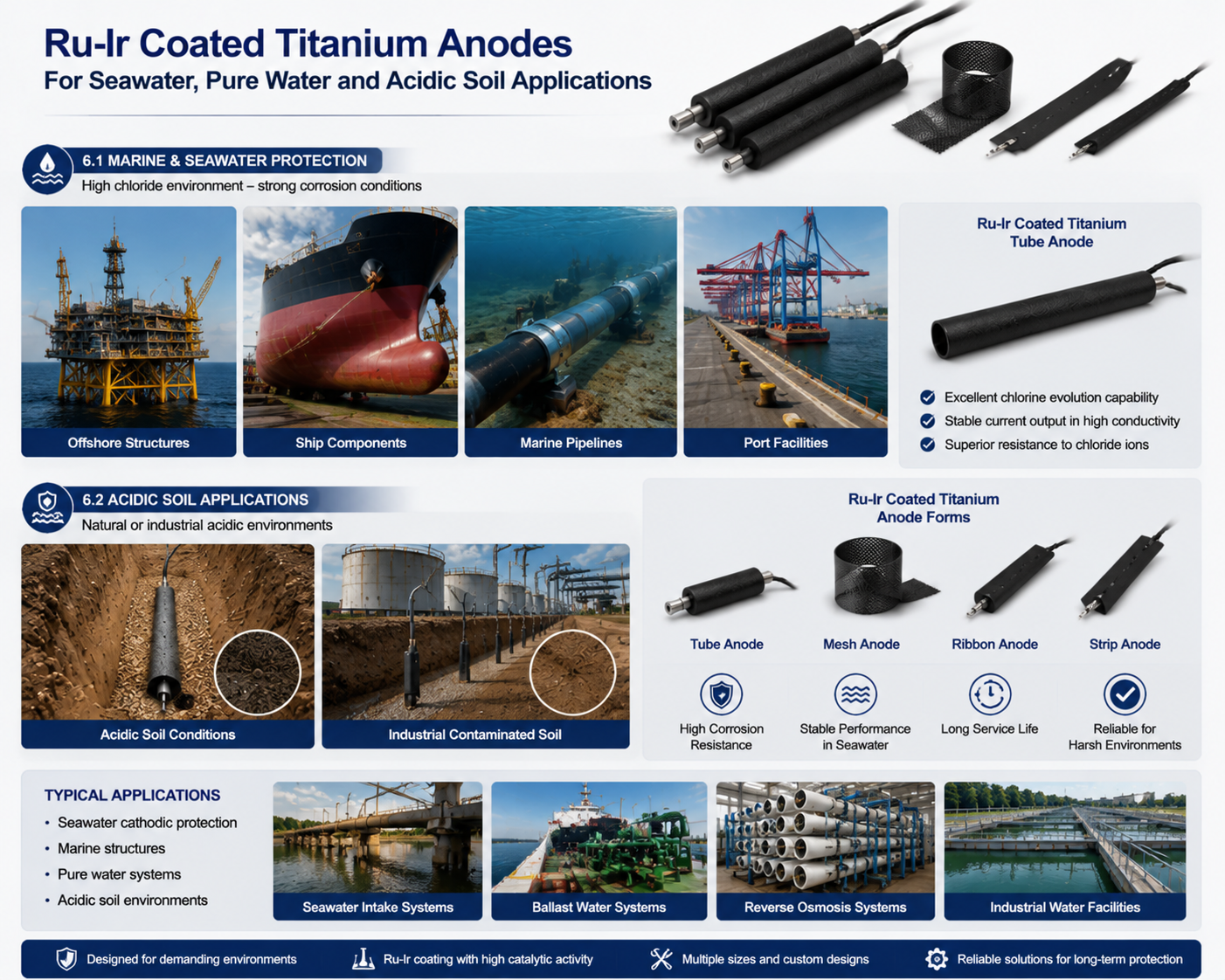
6. Ru-Ir Coated Titanium Anodes for Seawater, Chloride-Rich and Acidic Environments
Ruthenium-iridium coated titanium anodes are commonly used where chloride-containing electrolytes, high conductivity, and chlorine-evolution activity are important.
Typical environments include:
● Seawater
● Marine systems
● Chloride-rich water
● Certain industrial water systems
● Acidic soil
● Chemically demanding environments
The exact coating ratio and loading should be selected according to the operating conditions.
6.1 Marine and Seawater Applications
Seawater creates a highly corrosive environment for carbon steel because it contains chloride ions and provides good ionic conductivity.
Protected structures may include:
● Offshore platforms
● Port facilities
● Ship components
● Marine pipelines
● Seawater intake systems
● Cooling-water equipment
● Jetties and piles
● Submerged steel structures
In these applications, the anode must provide stable current output while resisting chloride-related electrochemical conditions.
Ru-Ir coated titanium anodes may be manufactured as:
● Tubes
● Rods
● Mesh
● Plates
● Ribbons
● Customized assemblies
The product structure depends on the protected asset.
For example, a marine pipeline may use distributed tube anodes or remotely installed anode assemblies. A seawater intake system may require compact anodes installed near water channels or equipment. A port structure may need multiple anodes positioned to achieve more uniform protection.
Important project information includes:
● Seawater temperature
● Chloride level
● Flow rate
● Installation depth
● Required current
● Mechanical exposure
● Cable-sealing requirements
● Maintenance accessibility
6.2 Acidic Soil and Industrial Contamination
Some soils are naturally acidic, while others are affected by:
● Chemical leakage
● Industrial waste
● Fertilizers
● Mining activity
● Process-water discharge
● Local microbiological conditions
These environments may create more demanding operating conditions for anodes and electrical connections.
Ru-Ir coatings can be considered for certain acidic or chloride-containing soil applications, but the decision should not be made using pH alone.
The supplier should also evaluate:
● Soil conductivity
● Chloride concentration
● Sulfate content
● Moisture level
● Groundbed backfill
● Current density
● Expected anode reaction
Customized coating design may be necessary when the environment combines low pH, high chloride, industrial contamination, and high current demand.
6.3 Pure-Water and Industrial-Water Systems
The term "pure water" covers a wide range of water qualities. Some systems have very low conductivity, while others contain process chemicals or controlled ionic content.
Therefore, coating selection should be based on actual water analysis.
Ru-Ir coated titanium anodes may be considered for certain water systems where chloride-related reactions or specific electrochemical performance is required. In low-conductivity water, the electrical design, electrode spacing, and operating voltage become especially important.
Before selection, provide:
● Conductivity
● Chloride content
● pH
● Temperature
● Flow rate
● Required current
● System purpose
● Maximum operating voltage
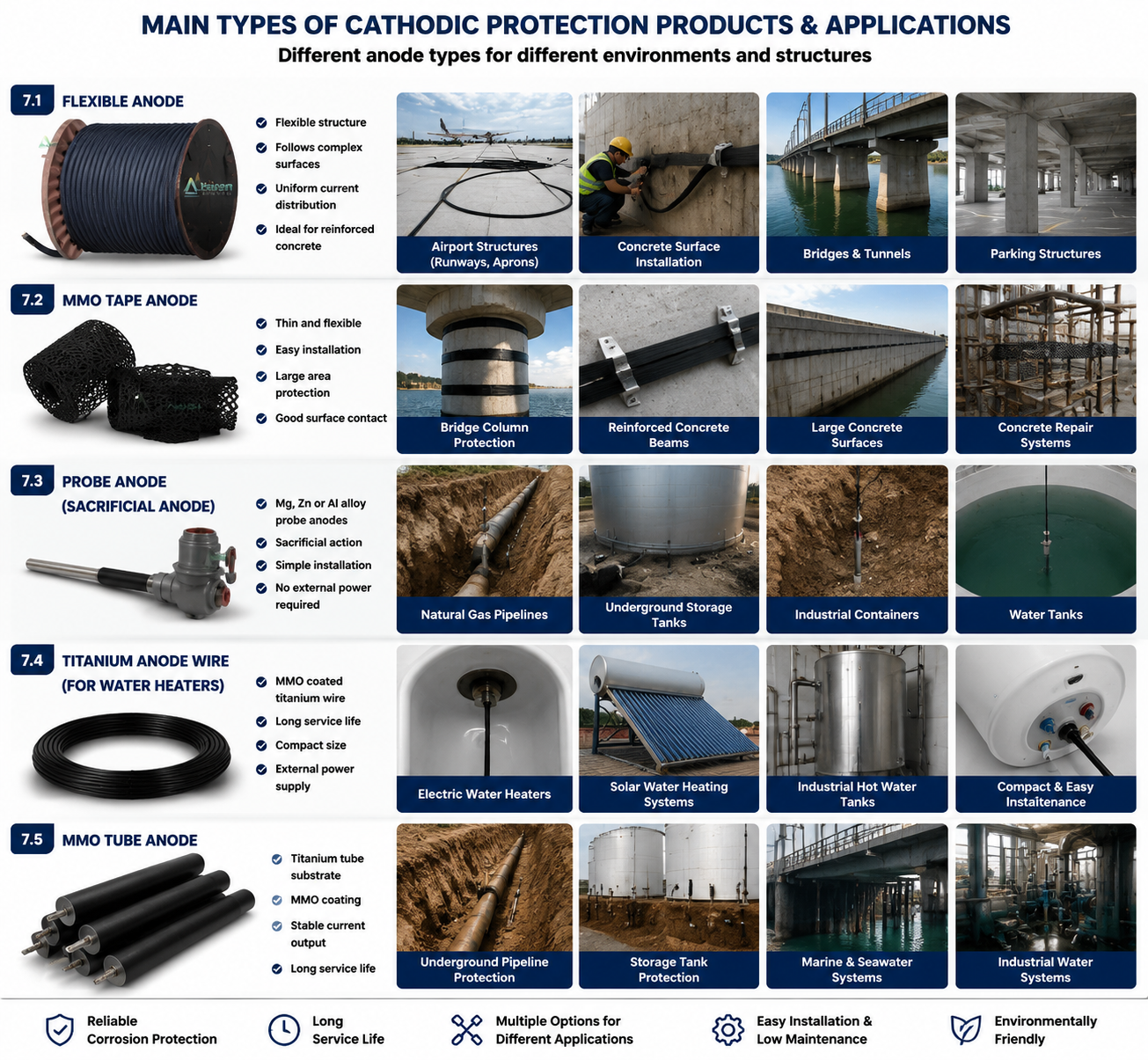
7. Main Types of Cathodic Protection Products and Their Applications
Cathodic protection anodes are available in different shapes because installation conditions and current-distribution requirements vary.
The main product types include:
● MMO tube anodes
● Flexible anodes
● MMO tape anodes
● Probe anodes
● Titanium anode wires
The product shape should match the protected structure rather than being selected only from a catalog.
7.1 MMO Tube Anodes
MMO tube anodes are widely used in impressed current cathodic protection systems.
A typical product includes:
● Titanium tube substrate
● MMO coating
● Cable connection
● Sealed electrical joint
● Optional backfill or protective assembly
The titanium tube provides a stable structure, while the MMO coating forms the electrochemically active surface.
Typical applications include:
● Underground pipeline groundbeds
● Storage tanks
● Buried steel structures
● Marine facilities
● Seawater systems
● Industrial water equipment
Tube anodes can be installed vertically or horizontally, individually or in groups.
For underground applications, they may be placed in conductive backfill to improve current distribution and reduce contact resistance.
For storage tanks, tube anodes may be installed around the tank perimeter, beneath the tank bottom, or in another engineered arrangement.
For marine and water systems, cable sealing and mechanical design must resist moisture, pressure, movement, and long-term immersion.
7.2 Flexible Anodes
Flexible anodes are designed for long, distributed installations and irregular surfaces.
A typical flexible anode may include:
● MMO coated titanium conductor
● Conductive carbon-based material
● Protective braided outer layer
● Insulated connection cable
● Flexible structural components
The main advantage is its ability to follow long or complex installation routes.
Typical applications include:
● Airport runways and aprons
● Reinforced concrete areas
● Buried pipelines
● Tank-bottom protection
● Bridges
● Tunnels
● Parking structures
● Industrial concrete facilities
Flexible anodes can improve current distribution where a small number of rigid anodes may create localized current concentration.
For large concrete areas, they may be installed in slots, repair mortar, overlays, or prepared channels. For pipelines, they can be placed parallel to the protected line.
Selection should consider:
● Cable length
● Current output per unit length
● Bending requirements
● Installation spacing
● Connection design
● Mechanical protection
7.3 MMO Tape Anodes
MMO tape, also called MMO ribbon or expanded-mesh tape, is suitable for linear and surface-distributed protection.
It is generally thin and flexible, making it easier to install around:
● Bridge columns
● Concrete beams
● Large wall surfaces
● Reinforcement zones
● Repair areas
● Marine concrete structures
MMO tape can be fixed along the concrete surface or embedded into a repair layer.
Its advantages include:
● Flexible installation
● Large contact area
● Uniform current distribution
● Easy integration with concrete repair systems
● Suitability for curved or linear structures
The tape width, thickness, mesh opening, coating type, and connection method should be selected according to the project.
7.4 Probe Anodes
Probe-type anodes may be used in tanks, pipelines, containers, and water systems.
Depending on the system design, a probe anode may be:
● A sacrificial magnesium, zinc, or aluminum alloy anode
● An impressed current electrode assembly
● A monitoring or reference-related component
● A customized insertion-type anode
Therefore, the exact function should be confirmed before quotation.
Sacrificial probe anodes are commonly used where:
● No external power source is available
● The protected structure is relatively small
● The required current is moderate
● Simple installation is preferred
Applications may include:
● Water tanks
● Small underground tanks
● Industrial containers
● Local pipeline protection
● Compact equipment
Because sacrificial probe anodes are consumed, their size and material determine the available protection capacity and replacement interval.
7.5 Titanium Anode Wires
MMO coated titanium anode wires are compact electrodes suitable for systems with limited installation space.
One important application is electronic cathodic protection for water heaters.
Traditional water heaters often use magnesium rods. The magnesium gradually dissolves while protecting the steel tank.
An MMO titanium anode wire works differently. It operates with an external power source and provides protective current without functioning as a conventional consumable magnesium rod.
Typical applications include:
● Electric water heaters
● Solar water-heating systems
● Industrial hot-water tanks
● Compact water-storage systems
Potential advantages include:
● Compact size
● Reduced replacement frequency
● Stable electronic control
● Suitability for modern equipment designs
The anode wire must be matched with the power supply, tank size, water chemistry, and electrical connection design.
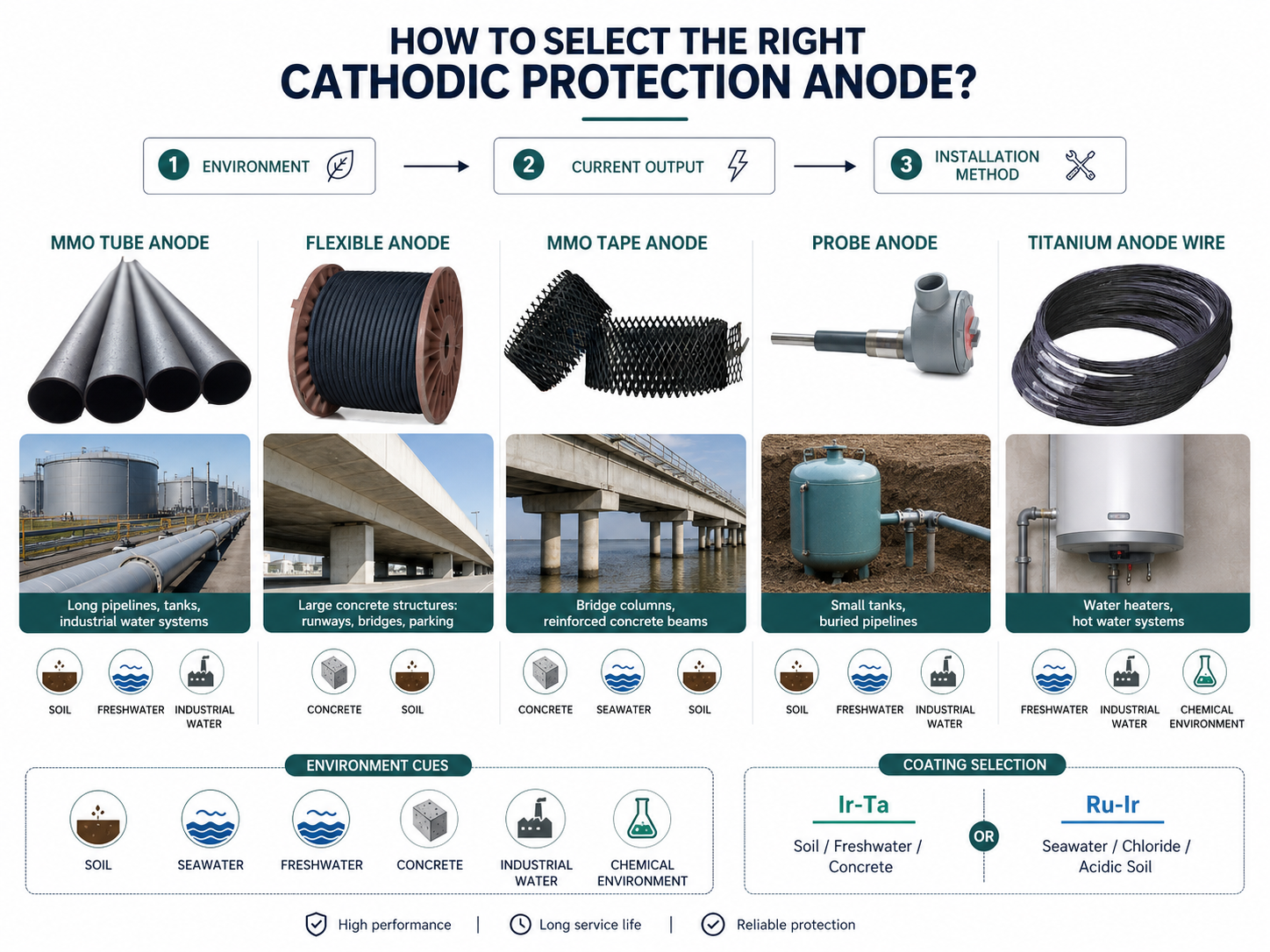
8. How to Select the Right Cathodic Protection Anode
Selecting the correct anode requires three main decisions:
1.Which coating is suitable?
2.Which product form fits the structure?
3.What current output and installation design are required?
8.1 Confirm the Application Environment
First identify the electrolyte:
● Soil
● Seawater
● Freshwater
● Concrete
● Industrial water
● Acidic soil
● Chemical environment
A preliminary coating guide is:
| Environment | Common coating consideration |
|---|---|
| Soil | Ir-Ta |
| Freshwater | Ir-Ta |
| Reinforced concrete | Ir-Ta |
| Seawater | Ru-Ir |
| Chloride-rich water | Ru-Ir |
| Acidic soil | Ru-Ir or customized design |
This table is only an initial reference. Actual chemistry and electrical conditions must be reviewed.
8.2 Confirm the Protected Structure
Provide information about:
Material
Dimensions
Surface area
Coating condition
Installation depth
Geometry
Number of structures
Electrical continuity
A long pipeline, large tank bottom, bridge column, and water heater require very different anode arrangements.
8.3 Define the Electrical Requirements
Important information includes:
Required protection current
Normal operating current
Maximum current
Operating voltage
Maximum voltage
Power-supply mode
Anode quantity
Anode spacing
Cable length
Expected current distribution
The total current alone is not sufficient. The supplier also needs to know how that current should be distributed.
An incorrect design may cause:
Insufficient protection in remote areas
Excessive local current
Uneven potential distribution
Higher operating voltage
Premature coating stress
Unstable system performance
8.4 Confirm the Installation Method
Typical product selection may follow this logic:
Long buried pipelines → MMO tube or flexible anodes
Large concrete structures → flexible anodes
Bridge columns and beams → MMO tape
Small tanks → probe anodes
Water heaters → titanium anode wire
Marine structures → MMO tube, rod, mesh, or customized assemblies
Installation conditions may also require:
Special cable lengths
Waterproof sealing
Pressure-resistant connections
Mounting brackets
Protective housings
Conductive backfill
Customized terminals
8.5 Provide Water or Soil Information
For water applications, provide:
pH
Conductivity
Chloride concentration
Temperature
Flow conditions
Other major ions
For soil applications, provide:
Soil resistivity
Moisture
pH
Chloride or sulfate content
Groundbed design
Backfill material
This information allows the manufacturer to recommend a more suitable coating and product structure.
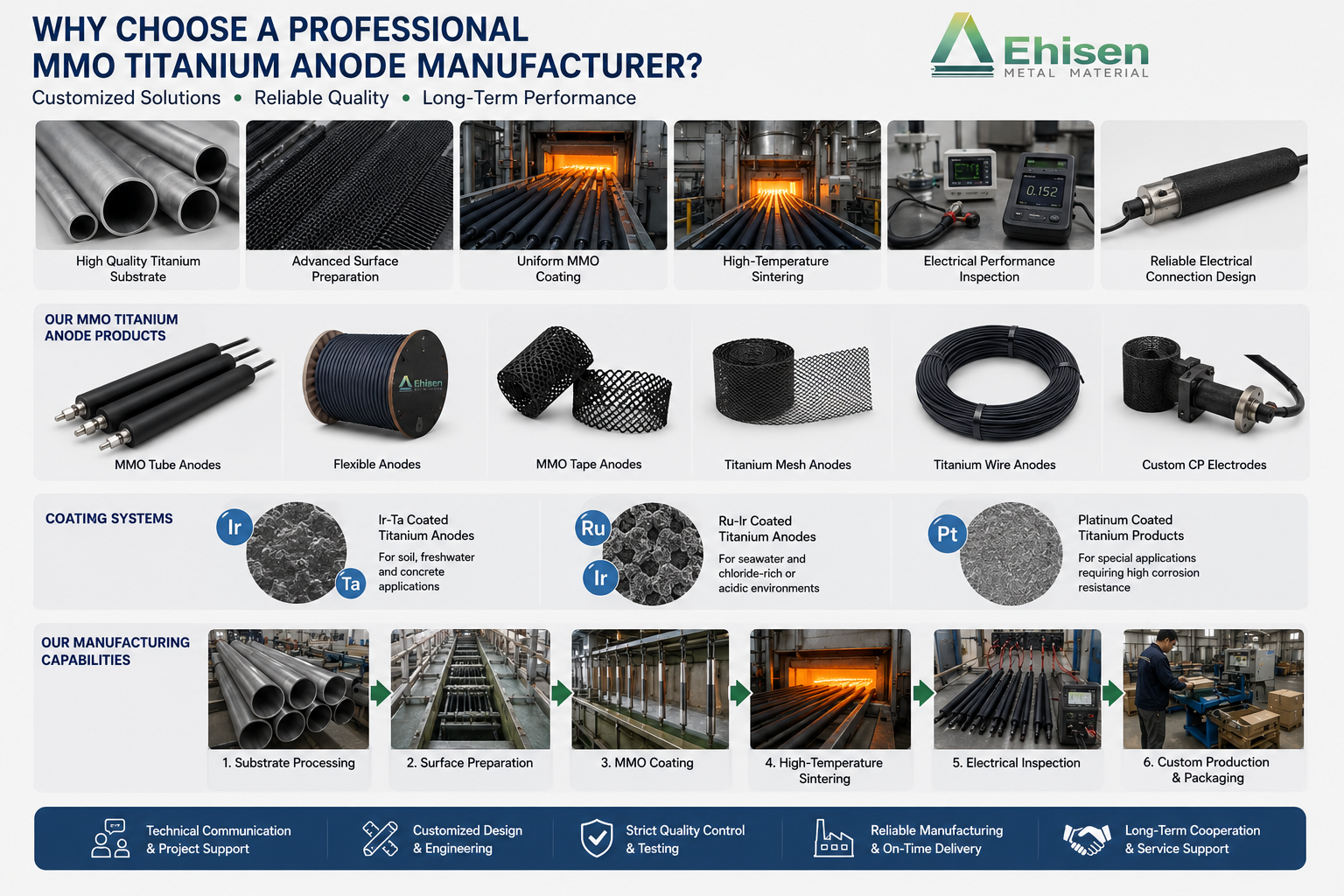
9. Why Choose a Professional MMO Titanium Anode Manufacturer?
The performance of a cathodic protection anode depends on the complete manufacturing process.
Important factors include:
● Titanium substrate quality
● Machining accuracy
● Surface preparation
● Coating composition
● Coating uniformity
● Thermal treatment
● Electrical connection
● Cable sealing
● Inspection and testing
A professional manufacturer should be able to produce customized solutions instead of supplying only fixed standard sizes.
Titanium Substrate Processing
The substrate must meet the required dimensions, shape, and surface condition.
Tube straightness, mesh size, ribbon width, connection area, and welding quality can all affect installation and performance.
Surface Preparation
Before coating, the titanium surface must be properly cleaned and prepared.
The objective is to:
● Remove contamination
● Create a suitable surface condition
● Improve coating adhesion
● Support uniform coating formation
Insufficient preparation may lead to weak bonding or inconsistent electrochemical performance.
Coating Application
The coating must be selected according to the environment and operating reaction.
Control is required over:
● Coating formulation
● Application uniformity
● Number of coating cycles
● Target loading
● Drying conditions
● Sintering conditions
High-Temperature Treatment
Thermal treatment helps form the mixed metal oxide coating.
Temperature, heating time, and cycle control can influence:
● Coating structure
● Adhesion
● Uniformity
● Electrochemical activity
● Stability
Electrical Connection Design
The connection between the titanium anode and cable is a critical point.
It should provide:
● Low electrical resistance
● Mechanical strength
● Reliable sealing
● Protection from moisture
● Compatibility with the installation environment
A high-quality coating cannot compensate for a poorly sealed cable connection.
Quality Inspection
Inspection may include:
● Dimensional checks
● Surface examination
● Coating loading verification
● Coating adhesion evaluation
● Electrical resistance testing
● Cable connection inspection
● Customized performance tests
The inspection plan should match the product and project requirements.
Ehisen Customized MMO Titanium Anode Solutions
Ehisen specializes in precious metal coated titanium anodes for cathodic protection and industrial electrochemical applications.
Our cathodic protection products include:
● MMO tube anodes
● Flexible anodes
● MMO tape anodes
● Titanium mesh anodes
● Titanium wire anodes
● Customized electrode assemblies
Available coating systems include:
● Ir-Ta coated titanium anodes
● Ru-Ir coated titanium anodes
● Platinum coated titanium products
Our manufacturing services cover:
● Titanium substrate processing
● Surface preparation
● Precious metal oxide coating
● High-temperature sintering
● Electrical connection assembly
● Quality inspection
● Customized OEM production
We support both prototype development and industrial production.
To prepare a reliable recommendation or quotation, customers are encouraged to provide:
● Application environment
● Product drawings
● Protected structure information
● Water or soil analysis
● Required current and voltage
● Installation method
● Quantity
● Cable and connection requirements
Based on this information, Ehisen can assist with coating selection, product structure, manufacturing feasibility, and customized production.
Our manufacturing services cover:
● Titanium substrate processing
● Surface preparation
● Precious metal oxide coating
● High-temperature sintering
● Electrical connection assembly
● Quality inspection
● Customized OEM production
We support both prototype development and industrial production.
To prepare a reliable recommendation or quotation, customers are encouraged to provide:
● Application environment
● Product drawings
● Protected structure information
● Water or soil analysis
● Required current and voltage
● Installation method
● Quantity
● Cable and connection requirements
Based on this information, Ehisen can assist with coating selection, product structure, manufacturing feasibility, and customized production.
10. Conclusion
Cathodic protection is a complete electrochemical system rather than a single anode product.
The protected steel structure must become the cathode, while the selected anode supplies current through soil, water, concrete, or another electrolyte.
Different applications require different solutions:
● Ir-Ta coated titanium anodes are commonly considered for soil, freshwater, fine sand, and concrete.
● Ru-Ir coated titanium anodes are commonly considered for seawater, chloride-rich water, and certain acidic environments.
● MMO tube anodes are suitable for pipelines, tanks, marine facilities, and water systems.
● Flexible anodes are suitable for long routes and large or complex surfaces.
● MMO tape is suitable for bridge columns, concrete beams, and distributed concrete protection.
● Probe anodes are used in tanks, pipelines, and compact systems.
● Titanium anode wires provide a compact solution for electronic water-heater protection.
The right selection should be based on the operating environment, coating chemistry, current demand, structure size, and installation method.
For MMO tube anodes, flexible anodes, MMO tape, titanium anode wires, or custom cathodic protection electrodes, contact Ehisen with your application details, drawings, and operating parameters for technical evaluation and quotation.