

Introduction
Electrocatalysis plays a pivotal role in modern energy conversion and storage technologies, such as water electrolysis, fuel cells, and carbon dioxide reduction. The performance of an electrocatalyst is not only judged by its activity and selectivity but also critically by its stability under operational conditions. Stability determines the longevity, efficiency, and economic viability of electrocatalytic devices. Therefore, rigorous testing and understanding of electrocatalyst stability are essential for both fundamental research and industrial applications.
This article provides a comprehensive overview of the core methods for testing electrocatalyst stability, the characterization techniques used to compare catalysts before and after testing, and the common mechanisms that lead to catalyst degradation. By elucidating these aspects, we aim to offer a clear and practical guide for researchers and engineers involved in the development and evaluation of electrocatalytic materials.
Core Methods for Stability Testing
Stability testing involves subjecting the electrocatalyst to prolonged electrochemical operation while monitoring its performance. The goal is to simulate real-world conditions and accelerate degradation to understand the catalyst's lifespan and failure modes. The primary electrochemical techniques used for stability assessment are chronoamperometry, chronopotentiometry, cyclic voltammetry, and multi-step testing.
1. Chronoamperometry (CA)
Chronoamperometry, also known as current-time testing, is a fundamental technique for evaluating electrocatalyst stability. In this method, a constant potential is applied to the working electrode, and the resulting current is measured as a function of time. The potential is chosen based on the reaction of interest, typically at a value where the reaction rate is significant.

Principle and Procedure:
The experiment begins by setting the electrochemical cell to the desired potential. The current response is monitored over time. For a stable catalyst, the current should remain relatively constant, indicating sustained catalytic activity. However, most catalysts exhibit a gradual decay in current due to various degradation processes.
The current decay can be analyzed to extract information about the degradation kinetics. For instance, a rapid initial decay might indicate poisoning or leaching of active sites, while a slow, continuous decline could suggest gradual morphological changes or dissolution.
Applications and Considerations:
Chronoamperometry is widely used for reactions like the oxygen evolution reaction (OER) and hydrogen evolution reaction (HER), where catalysts are often operated at constant potential. It is particularly useful for assessing short-term stability and identifying obvious failure modes.
However, CA has limitations. The constant potential condition may not represent dynamic operational environments, such as those in renewable energy systems where input power fluctuates. Additionally, changes in current can also arise from factors unrelated to catalyst degradation, such as bubble formation (e.g., O2 or H2 bubbles) blocking active sites or altering mass transport. Therefore, complementary techniques and post-test characterization are necessary to confirm degradation.
Data Interpretation:
The current-time curve provides qualitative and quantitative insights. The percentage of current retention after a specific duration (e.g., 10 hours) is a common metric. For example, a catalyst retaining 90% of its initial current after 10 hours is considered more stable than one retaining only 70%. The decay rate can be modeled using exponential or linear decay functions to compare different materials.
2. Chronopotentiometry (CP)
Chronopotentiometry, or potential-time testing, is the complementary technique to chronoamperometry. Here, a constant current is applied, and the potential required to maintain that current is measured over time.

Principle and Procedure:
In chronopotentiometry, the current density is set to a value typical for the intended application. The potential is then recorded as a function of time. For a stable catalyst, the potential should remain constant. An increase in potential indicates that more energy is required to sustain the same reaction rate, signifying catalyst degradation.
This method is especially relevant for devices like electrolyzers and fuel cells, which often operate at constant current. It directly reflects the energy efficiency loss over time.
Applications and Considerations:
CP is extensively used in evaluating catalysts for reactions such as OER and HER, as well as for full cell tests. It is sensitive to changes in catalyst activity, conductivity, and interface properties.
One challenge with CP is that potential shifts can also be caused by factors other than catalyst degradation, such as changes in electrolyte concentration, reference electrode stability, or ohmic losses. To mitigate these issues, iR compensation is often applied to account for solution resistance. Additionally, like CA, CP results should be corroborated with other tests.
Data Interpretation:
The potential-time curve is analyzed for stability. The overpotential increase at a fixed current density is a key metric. For instance, a catalyst showing a 50 mV increase after 20 hours is less stable than one with only a 20 mV increase. The time taken for the potential to reach a certain threshold (e.g., a 100 mV increase) can also be used to compare stability.
3. Cyclic Voltammetry (CV) for Stability Assessment
Cyclic voltammetry is primarily used to study the electrochemical behavior of catalysts over a range of potentials. While it is not a prolonged stability test like CA or CP, it can be employed to assess stability through repeated cycling.

Principle and Procedure:
In CV, the potential is scanned linearly between set limits and then reversed, creating cycles. For stability testing, multiple cycles (often hundreds or thousands) are performed, and changes in the voltammograms are monitored. Key features include the shift in peak potentials, changes in peak currents, and alterations in the electrochemical surface area (ECSA).
ECSA is often estimated from the charge associated with surface redox peaks (e.g., underpotential deposition of hydrogen for Pt-based catalysts) or double-layer capacitance. A decrease in ECSA indicates loss of active surface area due to dissolution, agglomeration, or detachment.
Applications and Considerations:
CV cycling is particularly useful for catalysts in applications with potential variations, such as regenerative fuel cells or electrochemical sensors. It helps identify degradation mechanisms like oxidation/reduction-induced changes, dissolution, and particle growth.
However, CV-based stability tests may not directly translate to constant operation conditions. The degradation accelerated by cycling might differ from that under steady-state conditions. Therefore, CV is often used alongside CA or CP.
Data Interpretation:
The stability is evaluated by comparing the voltammograms before and after cycling. The retention of ECSA, maintenance of peak currents, and minimal shift in onset potential are indicators of good stability. For example, after 1000 cycles, a catalyst with 95% ECSA retention is more stable than one with 80% retention.
4. Multi-Step Tests
Multi-step tests combine elements of CA and CP to simulate more complex operational profiles. For instance, a series of constant current steps with increasing magnitude or alternating between different currents can be applied to mimic real-world dynamics.
Principle and Procedure:
In a typical multi-step test, the current density is held constant at one value for a period, then stepped to a higher value, and so on. The potential response is recorded at each step. This approach helps evaluate stability across different load conditions.
Alternatively, potential steps can be used. This is useful for assessing performance under varying driving forces.
Applications and Considerations:
Multi-step tests are valuable for understanding how catalysts behave under non-steady-state conditions, such as in renewable energy integration where input power varies. They can reveal degradation mechanisms that are not apparent in single-mode tests.
The complexity of data interpretation increases with multi-step tests, as degradation may be accelerated at higher currents or potentials. Careful design of step sequences is necessary to avoid artifacts.
Data Interpretation:
The potential at each current step is compared over time. Degradation may manifest as a progressive increase in potential for the same current step. The test can also identify critical current or potential thresholds beyond which degradation accelerates rapidly.
Characterization Techniques Before and After Stability Testing
Electrochemical tests provide performance data but do not directly reveal the physical and chemical changes causing degradation. Therefore, pre- and post-test characterization is crucial to correlate performance loss with structural, compositional, and morphological changes.
1. X-ray Photoelectron Spectroscopy (XPS)
XPS is a surface-sensitive technique that provides information about the elemental composition, chemical states, and oxidation states of elements within the top few nanometers of a sample.

Pre-test Analysis:
Before stability testing, XPS establishes the baseline surface composition and oxidation states. For example, for a metal oxide catalyst, the ratio of different metal oxidation states (e.g., Mn2+ vs. Mn4+) can be determined.
Post-test Analysis:
After testing, XPS can detect changes such as:
Surface Oxidation: For metal catalysts, increased oxide formation can passivate the surface.
Dissolution: Loss of certain elements, indicated by reduced spectral peaks.
Contamination: Adsorption of species from the electrolyte, such as carbonates or phosphates.
Reduction: For oxide catalysts, reduction to lower oxidation states might occur.
For instance, if post-test XPS shows a significant decrease in Pt0 and an increase in Pt2+ species for a Pt catalyst, it suggests surface oxidation contributing to degradation.
Limitations:
XPS is ultra-high vacuum based, so ex situ analysis might not capture metastable states present during operation. In situ or operando XPS is emerging but remains challenging.
2. X-ray Diffraction (XRD)
XRD is used to identify crystalline phases, measure crystal size, and detect structural changes.

Pre-test Analysis:
Initial XRD identifies the crystal structure, phase purity, and crystallite size (via Scherrer equation).
Post-test Analysis:
After stability tests, XRD can reveal:
Phase Changes: Transformation to different phases, e.g., from amorphous to crystalline, or between polymorphs.
Particle Growth: Increase in crystallite size, indicating sintering or agglomeration.
Dissolution: Loss of crystallinity or peak intensity.
For example, after OER testing, a catalyst might show new peaks corresponding to higher oxides or hydroxides.
Limitations:
XRD is bulk-sensitive and might not detect surface changes or amorphous phases. Complementary techniques are needed for surface analysis.
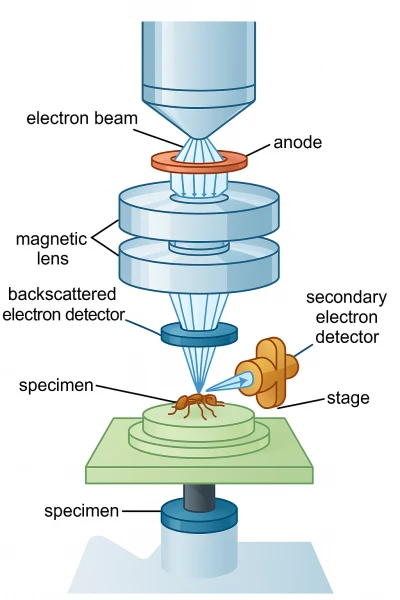
3. Scanning Electron Microscopy (SEM)
SEM provides high-resolution images of the catalyst morphology, including particle size, shape, and distribution.
Pre-test Analysis:
Initial SEM images show the pristine morphology, such as nanoparticle dispersion on a support.
Post-test Analysis:
Post-test SEM can identify:
Particle Agglomeration: Larger particles due to sintering.
Detachment: Catalyst material detached from the substrate.
Morphological Changes: Etching, corrosion, or deposition of new species.
For instance, SEM might reveal that nanoparticles have coalesced into larger clusters, reducing the active surface area.
Limitations:
SEM primarily offers morphological information; elemental analysis requires energy-dispersive X-ray spectroscopy (EDS).
4. Transmission Electron Microscopy (TEM)
TEM offers higher resolution than SEM, allowing imaging at the atomic scale. It can provide details on particle size, distribution, and even crystal lattice fringes.

Pre-test Analysis:
Initial TEM characterizes nanoparticle size, shape, and dispersion.
Post-test Analysis:
Post-test TEM can detect:
Particle Growth:Precise measurement of changes in particle size distribution.
Structural Changes: Lattice distortions, amorphization, or phase segregation.
Support Degradation: Changes in the support material, such as carbon corrosion.
For example, TEM might show that initially well-dispersed particles have agglomerated, or that the support has corroded, leading to particle detachment.
Limitations:
Sample preparation is complex, and analysis is limited to small sample areas.
5. Other Characterization Techniques
Inductively Coupled Plasma Mass Spectrometry (ICP-MS): Measures dissolved metal ions in the electrolyte after testing, quantifying catalyst dissolution.
Raman Spectroscopy: Identifies molecular vibrations, useful for detecting carbonaceous species, oxides, or surface adsorbates.
BET Surface Area Analysis: Measures changes in specific surface area after testing, indicating sintering or pore blockage.
Electrochemical Impedance Spectroscopy (EIS): Probes interfacial processes; changes in charge transfer resistance or double-layer capacitance after testing can indicate degradation.
By combining these techniques, a comprehensive picture of degradation mechanisms emerges.
Common Electrocatalyst Degradation Mechanisms
Understanding how and why catalysts degrade is essential for designing more stable materials. Degradation mechanisms can be categorized into intrinsic catalyst deactivation, loss of catalyst-support interaction, and electrode structure degradation.
1. Intrinsic Catalyst Deactivation
This refers to changes within the catalyst material itself, often due to the harsh electrochemical environment.
a. Dissolution:
Many catalysts, especially metals and metal oxides, dissolve under operational potentials. For example, in acidic OER, Ir-based catalysts may dissolve as Ir³⁺ or Ir⁴⁺ ions. Dissolution is often potential-dependent and exacerbated at high anodic potentials.
b. Oxidation/Reduction:
Redox processes can alter the catalyst's surface composition. For instance, Pt surfaces can form thick oxide layers that reduce activity for HER. Conversely, reduction of oxide catalysts might form less active metallic phases.
c. Poisoning:
Adsorption of impurities from the electrolyte (e.g., anions like chloride or organic species) can block active sites. Poisoning is often reversible by cleaning, but strong adsorption may cause permanent deactivation.
d. Phase Transformation:
Some catalysts undergo phase changes under operation. For example, amorphous catalysts might crystallize, or metastable phases might transform to more stable but less active ones.
2. Catalyst-Support Interaction Failure
Many catalysts are nanostructured materials supported on conductive substrates (e.g., carbon black, metal oxides). Degradation often involves the support or its interface with the catalyst.
a. Support Corrosion:
Carbon supports are prone to oxidation at high potentials, especially in OER or positive electrodes. Carbon corrosion leads to loss of electrical contact and catalyst detachment. Alternative supports like metal oxides (e.g., TiO2, SnO2) are more stable but may have lower conductivity.
b. Catalyst Detachment:
Weak adhesion between catalyst and support can cause particles to detach during operation, particularly under gas evolution (bubble forces) or mechanical stress.
c. Sintering or Ostwald Ripening:
Small catalyst particles may migrate and coalesce (sintering) or dissolve and redeposit on larger particles (Ostwald ripening), reducing the active surface area. This is accelerated at high temperatures or potentials.
3. Electrode Structure Degradation
At the electrode level, macro-scale changes can degrade performance.
a. Binder Degradation:
Polymeric binders (e.g., Nafion) may degrade chemically or electrochemically, leading to loss of mechanical integrity and catalyst detachment.
b. Mass Transport Limitations:
Over time, pore blockage by gas bubbles, precipitated salts, or degraded products can hinder reactant access to active sites.
c. Current Collector Corrosion:
For non-noble current collectors (e.g., nickel foam), corrosion can lead to increased resistance and mechanical failure.
Conclusion
Evaluating electrocatalyst stability is a multi-faceted process that requires a combination of electrochemical testing and sophisticated characterization. Techniques like chronoamperometry, chronopotentiometry, cyclic voltammetry, and multi-step tests provide insights into performance decay under various conditions. Pre- and post-test characterization with XPS, XRD, SEM, and other tools helps identify the physical and chemical changes underlying degradation. Understanding common degradation mechanisms-intrinsic deactivation, catalyst-support interaction failure, and electrode structure degradation-is crucial for developing more durable electrocatalysts.
As the field advances, in situ and operando techniques will become increasingly important for real-time monitoring of degradation processes. Ultimately, a holistic approach to stability assessment will accelerate the development of efficient and long-lasting electrocatalytic systems for sustainable energy technologies.
This guide provides a foundation for researchers to design comprehensive stability tests and interpret their results, contributing to the advancement of electrocatalysis.