

In industries where metal structures are exposed to harsh environments, corrosion is a constant threat. Corrosion can lead to costly repairs, loss of structural integrity, and shortened equipment lifespan. To mitigate this, two key techniques are used: sacrificial anode protection (SACP) and cathodic protection. Although both methods aim to prevent corrosion, they operate on different principles. In this article, we'll explore how these methods work, their advantages and disadvantages, and how to choose the right one for your needs.

What is Sacrificial Anode Protection?
A sacrificial anode is a more reactive metal used to protect a less reactive metal structure. Common materials used for sacrificial anodes include zinc, aluminum, and magnesium. These metals are selected because they have a higher electrochemical potential than the metal they are meant to protect, such as steel. When placed in an electrolyte (like water or soil), the sacrificial anode corrodes or "sacrifices" itself, sparing the protected metal from corrosion.
Key Features of Sacrificial Anode Protection:
Self-regulating: Requires no external power source.
Simple installation: Attach the anode to the metal structure.
Low cost: Initially less expensive than some other forms of corrosion protection.
Short lifespan: Anodes need to be replaced periodically as they corrode over time.

How Does It Work?
In a sacrificial anode system, the anode becomes the anode of an electrochemical cell, and the structure to be protected acts as the cathode. Because the anode is more "active" (it has a higher potential to corrode), it corrodes first. As long as the anode is present and functioning, the metal structure remains protected.
This method is widely used for protecting underground pipelines, ships, tanks, and other structures in marine and underground environments.
Applications of Sacrificial Anodes:
Marine environments: Ships, boats, and offshore platforms use sacrificial anodes to protect their hulls and structures from saltwater corrosion.
Pipelines: Underground and undersea pipelines benefit from sacrificial anodes to prevent rusting and degradation.
Water heaters: Home water heaters often employ sacrificial anodes to extend their lifespan by protecting the internal metal parts from corrosion.

What is Cathodic Protection?
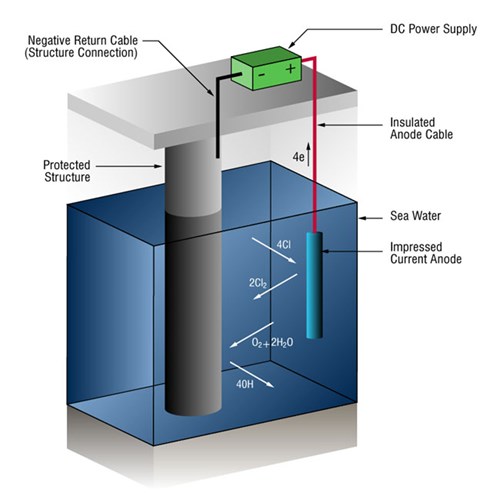
Cathodic protection is a corrosion control method that involves turning the entire metal surface to be protected into a cathode. This method can be applied using sacrificial anodes or by using an external current, known as Impressed Current Cathodic Protection (ICCP).
Cathodic protection works by supplying electrons to the metal structure, thereby preventing it from losing electrons (which is what happens during corrosion). The supplied electrons prevent the metal from undergoing oxidation and corroding.
Types of Cathodic Protection:
Sacrificial Anode Cathodic Protection (SACP):
Uses sacrificial anodes as described above.
Best for smaller, less complex structures.
No external power source required.
Impressed Current Cathodic Protection (ICCP):
Uses an external power source (typically a rectifier) and inert anodes (like titanium anodes coated with mixed metal oxides).
Provides a controlled, steady supply of electrons to the protected structure.
Suitable for large or complex structures like bridges, ships, and long pipelines.
Advantages of Cathodic Protection:
Comprehensive protection: Covers large areas or complex structures.
Long-term solution: Impressed current systems can be fine-tuned and monitored for optimal performance.
Customizable: Current flow can be adjusted based on environmental conditions.
Disadvantages of Cathodic Protection:
Costly setup: Impressed current systems are more expensive initially due to the need for power supplies and specialized anodes.
Ongoing maintenance: ICCP systems require monitoring and regular maintenance to ensure continued effectiveness.
Sacrificial Anode vs. Impressed Current Cathodic Protection (ICCP)
The main difference between these two methods lies in how the protective current is provided. In a sacrificial anode system, the current is naturally generated by the difference in electrochemical potential between the anode and the protected metal. In an ICCP system, an external power source drives the current.
Key Differences:
| Feature | Sacrificial Anode Cathodic Protection (SACP) | Impressed Current Cathodic Protection (ICCP) |
|---|
| Power Source | None, self-regulating | External power source required |
| Protection Range | Best for small to medium structures | Ideal for large, complex structures |
| Maintenance | Anodes need to be replaced periodically | Requires regular monitoring and adjustment |
| Initial Cost | Low | Higher initial setup cost |
| Lifespan | Short (anodes corrode) | Long (adjustable for optimal performance) |
Advantages and Disadvantages of Sacrificial Anodes
Advantages:
Simple and cost-effective: Sacrificial anodes are inexpensive and easy to install.
Self-regulating: The system requires no external power or monitoring, making it ideal for remote or inaccessible locations.
Disadvantages:
Limited lifespan: Anodes need to be replaced once they corrode, adding maintenance costs over time.
Limited protection: Best suited for smaller structures; for large-scale projects, an ICCP system may be more cost-effective in the long run.
Advantages and Disadvantages of Impressed Current Cathodic Protection (ICCP)
Advantages:
Comprehensive protection: ICCP can protect large structures over a wide area, even in harsh environments like the sea or underground.
Adjustable: The current flow can be controlled based on the level of corrosion threat, ensuring optimal performance.
Disadvantages:
High initial cost: The installation of an ICCP system is more expensive, requiring a power source, rectifiers, and inert anodes.
Requires monitoring: ICCP systems must be carefully monitored to ensure they are functioning correctly, which can increase operational
costs.
Titanium Anodes in Cathodic Protection
In Impressed Current Cathodic Protection (ICCP) systems, titanium anodes are often used due to their excellent corrosion resistance, durability, and ability to withstand harsh environments. Titanium anodes, coated with mixed metal oxides (MMO), provide a stable and long-lasting solution for corrosion prevention.
Why Titanium Anodes?
Durability: Titanium anodes have a longer lifespan than traditional anodes.
Efficiency: Titanium anodes deliver a consistent current, ensuring uniform protection across the structure.
Low Maintenance: These anodes require little maintenance, making them ideal for large-scale industrial projects where downtime is costly.

Summary
When it comes to corrosion prevention, both sacrificial anode protection (SACP) and cathodic protection (ICCP) have their advantages. Sacrificial anodes are a simple, cost-effective solution for smaller structures, while ICCP offers scalable, long-term protection for large industrial installations. Choosing the right system depends on the specific needs of your project, including the size of the structure, the environment, and your budget.
At Ehisen Anode, we specialize in titanium anodes, which provide the highest level of corrosion protection in ICCP systems. Our products are tailored to meet the specific needs of industries like electroplating, water treatment, and hydrogen production. To learn more about our titanium anodes and how they can protect your infrastructure, visit our website at Ehisen Anode or contact our team for expert advice.